

In order to understand the significance of Martin’s exhibition choices, we must first examine how the RA wielded power and influence through its connection to the Crown, using privileges to promote the careers of its members. The Academy was intertwined with the Crown since its inception by a group of artists with the help of King George III in 1768. From the beginning, the King was invested in a symbiotic relationship based on the principle that “the success of individual artists, in turn proves the worth of the Academy, which in turn proves the worth of the state.”[12] He allowed the Academy to base itself in Somerset House, which had previously been a residence for British royalty.[13] Between 1769 and 1780, he attended to the accounts and even balanced their books using money from his personal income. The King also had veto power over certain decisions and could even nominate members.[14] His successor, George IV, did not exercise these privileges, reducing his direct involvement in the RA; however, the royal connection remained, and Academicians reaped the benefits of this association. The title of Academician, and access to the Academy’s resources, provided an artist with royal connections, exhibition space, training, and social currency.[15] All these privileges not only augmented an artist’s fame, status, and financial gain during their lifetime, but continued to benefit these artists after death: the title of Royal Academician helped to solidify an artist’s legacy.
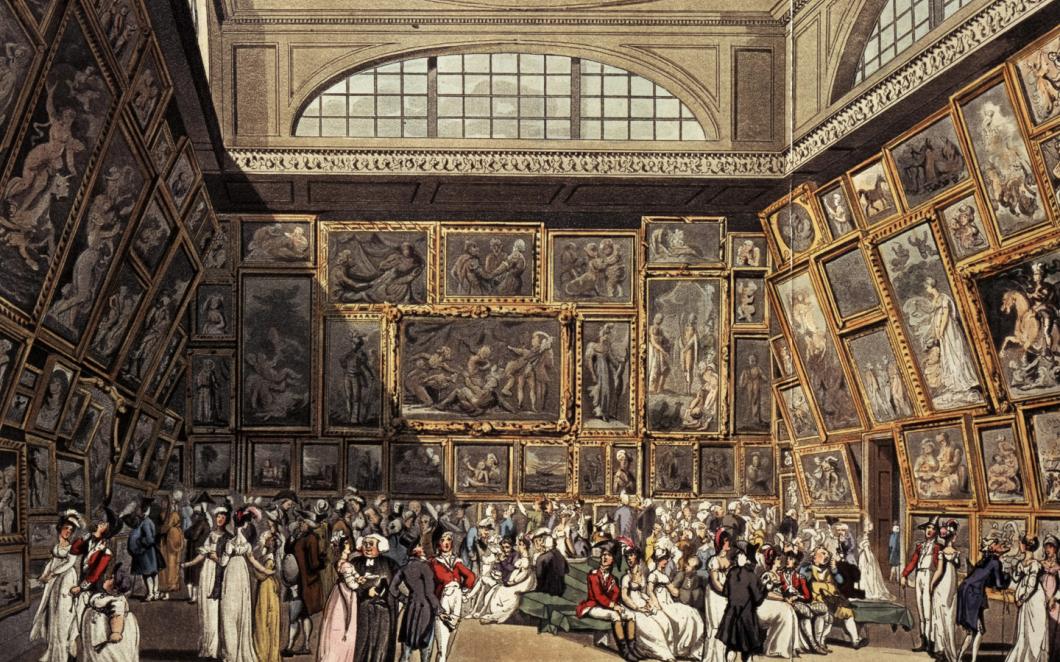
Thomas Rowlandson and Augustus Charles Pugin, Exhibition Room, Somerset House, Aquatint and etching, 19.4 x 25.9 cm, Royal Academy of Arts.
Although the Academy allowed non-academicians to participate in its annual exhibitions, the body extended privileges to members that disadvantaged and alienated non-member exhibitors. In addition to the prestige and connections that came with the title of Royal Academician, they were granted exclusive entitlements during exhibitions. Each Academician was allotted eight slots to fill with their works for every exhibition, while the inclusion of non-members was never guaranteed. Academicians’ hanging took priority as well, giving them access to the most coveted wall space.[16] Academicians gave their members gallery placements that were sure to attract public attention, while non-members typically were left with less-than-ideal locations. The most coveted spot in the exhibition was the Great Room, which was large, with high ceilings to accommodate big pictures, and brightly lit by a sizeable skylight. Being placed in the main exhibition room also signaled to visitors that a work was deemed important, and therefore worthy of attention.[17] According to period accounts, the other exhibition spaces were offshoots from the Great Room that were small, dimly lit, low traffic areas. In his 1849 autobiographical text, Martin described these anterooms as “a dark hole.”[18] As Martin’s comment suggests, the placement of works in these rooms would be a sort of banishment that, at best, made exhibiting a waste of time, and at worst could harm their reputation.
Once all admitted artworks were hung on the walls, Academicians enjoyed a further privilege: they could enter the space before the opening, on so-called “Varnishing Days,” where they could touch up their paintings and lay on a varnish, or protective coating.[19] By contrast, other exhibitors could not ensure that their work was being treated properly during those weeks between hanging and opening. These circumstances intensified the competitive atmosphere amongst all participants. As Leo Costello notes, a work’s placement implicitly invited comparisons to neighboring works:
Because…pictures would often appear different once they were placed among the rest of the works, with the brightness and intensity of colours affected by the tones of neighbouring picture, the time during which they were placed was one of constant pleas and cajoling from painters of a wide range of levels attempting to gain an advantageous spot.[20]
With the ability to participate in Varnishing Days, Academicians could take advantage of their placement, touching up their work in a way that would overshadow or negatively affect their neighbors. This ability to manipulate perceptions of other artists’ works gave Academicians an even greater edge over non-members.
The Academy’s policies thus had the potential to benefit members and wreak immense damage to careers of non-members. Exhibitors recognized their potential for good as well as “how the power of the Academy could ruin them.”[21] The experience of Benjamin Robert Haydon, one of Martin’s peers, exemplifies how much one could suffer at the hands of the Academy. Haydon’s feud with the Academy was said to have begun in 1809, when they placed a work of which he was particularly proud in an anteroom.[22] In his diary, Haydon recorded his strong distaste for the Academy in terms that align its power with that of the Crown and nobility: “I found the Academy too strongly embedded in the Aristocracy of the Country, headed by the King, to remodel. I was ruined in the attempt. I never flinched. As I find it not vanquishable by open attack, I will now try conciliation.”[23] As this passage suggests, Haydon continued to submit to the RA exhibitions, and to socialize with the Academicians to curry favor with them.[24] However, his attempts appear to have been ineffective, since the following year he wrote, “the Academy and the Academy alone had been the sole cause of ruining my plans.”[25] Aiming to escape the Academy’s unjust rules, Haydon put on a solo exhibition in 1846. This failed spectacularly: his exhibit, staged next to a curiosity show featuring “General Tom Thumb,” a little person named Charles Stratton, is said to have drawn 12,000 visitors, compared to Haydon’s 133.[26] After this humiliation, Haydon committed suicide.[27] This extreme case illustrates the dangers an artist could face by operating without the Academy’s protection.
Because it came with these crucial privileges, membership in the RA was highly coveted but very hard to procure. There were a finite number of spots: only about 100 Academicians could be active at a time, meaning that new members could only join if there was a death or if an Academician aged past seventy-five.[28] Even if a spot opened, a nomination for membership could only be placed by an existing Academician. [29] Therefore, an artist had to have not only made themselves known to the Academicians, but (as Haydon’s account suggests) they had to be well liked. Even the support of one member was not enough, since after nomination there was a vote where the other Academicians could decide if they accepted the nominee. This structure created a highly socially dependent admission process that relied on an artist’s good relationships with the institution and other Academicians to be nominated and approved.
This process meant that some artists who may have been deserving of membership were passed over due to social conflicts. Sometimes, the path to membership took decades: for example, painter and engraver John Linnell, one of Martin’s contemporaries, spent 27 years trying to join. According to Linnell’s account, his acceptance hinged upon personal connections rather than artistic skill. His experience was recorded by a mutual friend of both Martin and Linnell, Serjeant Ralph Thomas. Thomas’s diary relayed Linnell’s account: “one [member] told me I should give dinners and make the Academicians my friends in that way. Others told me I should get a more fashionable tailor and assume more style. No one ever said, ‘You must paint better to get into the Academy.'”[30] Linnell suggests that decisions about whom to admit had little to do with ability, casting suspicion on the artistic merits of those who had achieved such status.
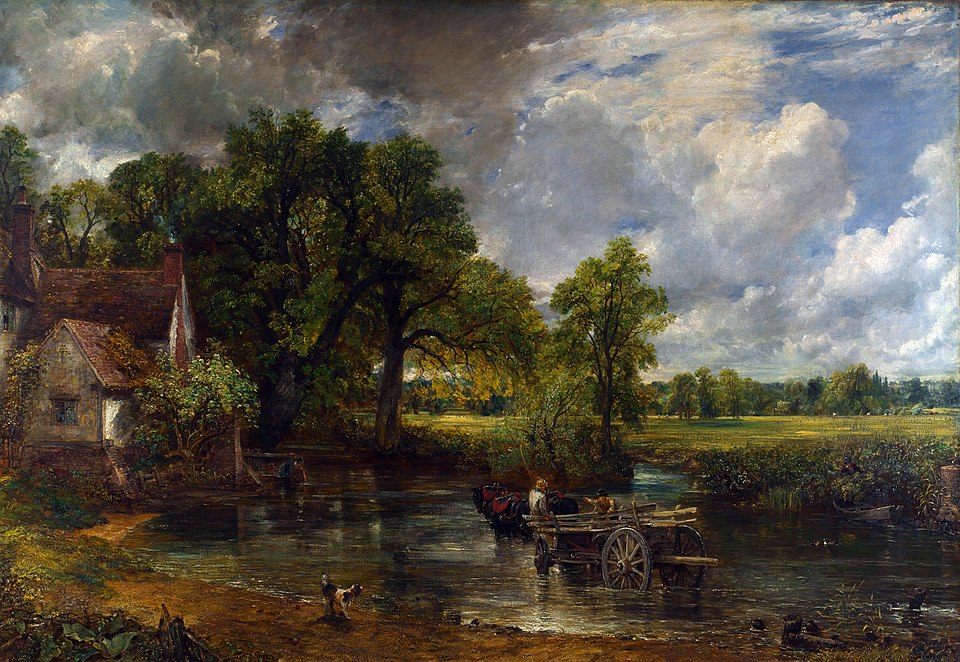
John Constable, The Hay Wain, 1921, oil on canvas, 130.2 cm × 185.4 cm, National Gallery, London.
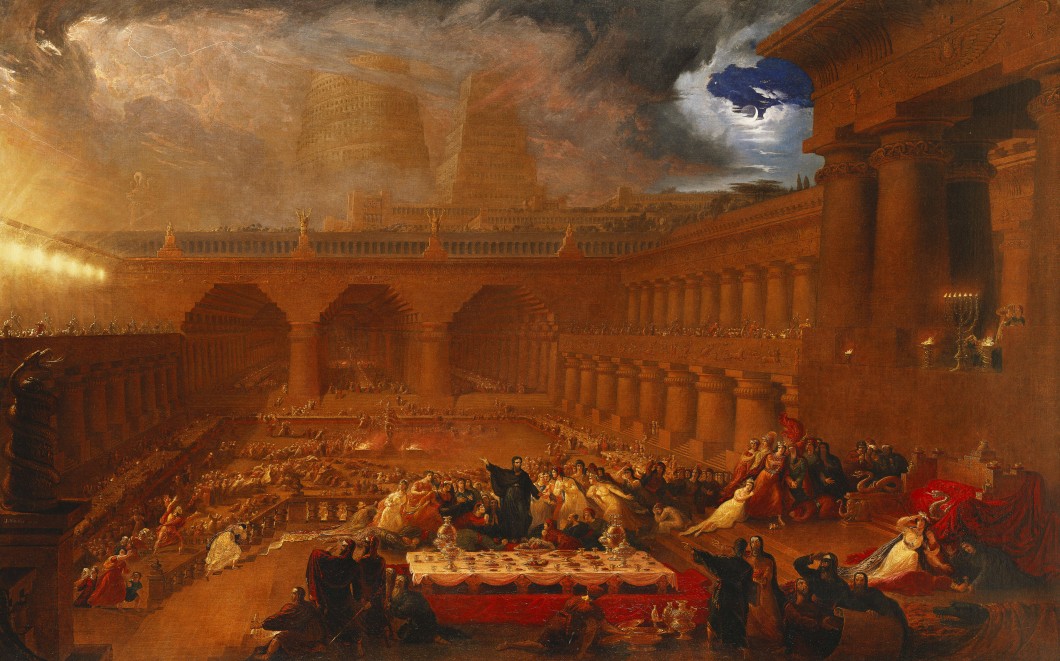
Figure 1. John Martin, Belshazzar’s Feast, 1820, oil on canvas, 160 x 249 cm, Private Collection.
Martin’s negative experience with the Academy cannot be explained by poor social connections: unlike Linnell, Martin was socially adept. He was on friendly terms with several powerful Academicians, including two presidents of the body: Benjamin West (1792-1805, 1806-1820) and Thomas Lawrence (1820-1830).[31] Martin even managed to turn rivalries into respectful friendships, as evidenced in his relationship with Constable. Constable, who had his own difficulties with RA membership in his early career, became an Associate Member in 1819.[32] His one-sided conflict with Martin arose in 1821, when Martin’s success with Belshazzar’s Feast threatened to outshine the debut of Constable’s Hay Wain, the first of his ambitious “six-footer” paintings. According to C.R. Leslie, Constable publicly disparaged Belshazzar’s Feast, referring to it as a mere “pantomime,” casting low-cultural aspersions on its phenomenal popularity.[33] However, Martin and Constable subsequently made up, suggesting that the former was willing to forgive such petty behavior, perhaps in the hope of ingratiating himself with this powerful Academician.[34] Constable also commented directly on Martin’s poor relations with the Academy:
I showed them that if there was any blame anywhere, it was with you, Martin, for not complying with the rules of the society. But that you need not mind being left out of the Academy; they could do you no good. I said that John Martin looked at the Royal Academy from the Plains of Nineveh, from the Destruction of Babylon, etc., I am content to look at the Academy from a gate, and the highest spot I ever aspired to was a windmill![35]
According to Constable, Martin did not find favor with Academicians because he was perceived to place himself far above his peers. He also seems to suggest that Martin did not need membership, perhaps because he was already so popular with the general public. In the same text, Constable conceded that he also objected to some of the Academy’s policies but, unlike Martin, was not courageous enough to oppose them.[36]
For artists who, like Martin, were unable to obtain membership in the Royal Academy, the British Institution offered an alternative: an exhibition space without royal entanglements and more equal hanging procedures.[37] When Martin exhibited Belshazzar’s Feast, the BI was still relatively new. Created in 1805, the BI received financial support from George IV and other members of the nobility, but it was not an instrument of the Crown. It was a “collectively funded philanthropic organization,” which provided artists with a platform to find patrons.[38] It therefore lacked the RA’s high status, but also the inequities that plagued the Academy, making it a more even playing field.[39] Exhibitions were organized by a Committee of Directors elected by patrons who gave more than 100 guineas to the Institution.[40] For these reasons, members of the Academy often participated in BI as well as RA exhibitions. The existence of the BI did not, however, make the Royal Academy obsolete, or diminish its power to shape an artist’s reputation.[41]
[12] Leo Costello, “‘This Cross-Fire of Colours’: JMW Turner (1775-1851) and the Varnishing Days Reconsidered.” The British Art Journal 10, no. 3 (2009): 56.
[13] Linda Colley, “The Apotheosis of George III: Loyalty, Royalty and the British Nation 1760-1820.” Past & Present, no. 102 (1984): 100.
[14] Holger Hoock, The King’s Artists: The Royal Academy of Arts and the Politics of British Culture, 1760-1840 (Oxford: Clarendon Press, 2003), 29.
[15] H.C. Morgan, “The Lost Opportunity of the Royal Academy: An Assessment of Its Position in the Nineteenth Century.” Journal of the Warburg and Courtauld Institutes 32 (1969): 410.
[16] Roach, “The Ecosystem of Exhibitions,” 14.
[17] Roach, “The Ecosystem of Exhibitions,” 32.
[18] John Martin, The Illustrated London News. March 17, 1849, 177.
[19] Costello, “‘This Cross-Fire of Colours,’” 56.
[20] Costello, “‘This Cross-Fire of Colours,’” 58.
[21] Morgan, “The Lost Opportunity,” 411.
[22] E. K. Waterhouse, “Benjamin Robert Haydon’s ‘Dentatus.’” The Burlington Magazine for Connoisseurs 88, no. 520 (1946): 175.
[23] Benjamin Robert Haydon, 1825-1832, vol.3, The Diary of Benjamin Robert Haydon, ed Willard Bissell Pope (Cambridge: Harvard University Press, 1963), 89-90.
[24] Benjamin Robert Haydon, 1825-1832, vol.3, The Diary of Benjamin Robert Haydon, ed Willard Bissell Pope (Cambridge: Harvard University Press, 1963), 105-106; Haydon claimed that he would give the Academy three years to treat him better.
[25] Benjamin Robert Haydon, 1825-1832, vol.3, The Diary of Benjamin Robert Haydon, ed Willard Bissell Pope (Cambridge: Harvard University Press, 1963), 180.
[26] Paul O’Keefe, A Genius for Failure: The Life of Benjamin Robert Haydon (London: The Bodley Head, 2009), 490.
[27] Roach, “The Ecosystem of Exhibitions,” 17.
[28] There is a conflicting record of how many members could be active at a time. On page 30 of Holger Hoock’s book The King’s Artists, he states that the Academy was restricted to forty members. However, on the Royal Academy’s website, they reference that their founding documents had a limit of 100 members. It is possible that the 100 members are divided between forty academicians and sixty associates, but that distinction is not made.
[29] Tom Jeffreys, “How do Academicians get elected?” Royal Academy, Published March 6, 2014, https://www.royalacademy.org.uk/article/how-do-academicians-get-elected.
[30] Pendered, John Martin, 94-95.
[31] Morden, John Martin, 120; Pendered, 175; “John Martin,” Tate, Accessed April 4, 2025, https://www.tate.org.uk/art/artists/john-martin-371.
[32] “John Constable RA (1776 – 1837),” Royal Academy of Arts, April 2, 2025,
https://www.royalacademy.org.uk/art-artists/name/john-constable-ra.
[33] Gregory Dart, “On Great and Little Things: Cockney Art in the 1820s.” Romanticism 14, no. 2 (2008): 154.
[34] As recalled by Martin’s close friend Ralph Thomas, Martin and Constable were friendly and spent time together. According to Thomas’s diary, one evening in about the year 1833, Martin and himself went to Constable’s house after attending an event together. Constable relayed to them a discussion he had with the author Henry Stebbing. Ralph Thomas only refers to him as “Stebbing,” but it is safe to assume he is referring to Henry Stebbing, an author, poet, editor, and active contributor to The Athenæum, a newspaper that often included writings on Martin.
[35] Pendered, John Martin, 179-180.
[36] Pendered, 180.
[37] The British Institution did not reserve spots for members as the Academy did.
[38] Catherine Roach, “Rehanging Reynolds at the British Institution: Methods for Reconstructing Ephemeral Displays”, British Art Studies, Issue 4, p17, https://doi.org/10.17658/issn.2058-5462/issue-04/croach.
[39] Roach, “The Ecosystem of Exhibitions,” 14.
[40] Roach, “Rehanging Reynolds,“ 18.
[41] Roach, “The Ecosystem of Exhibitions,” 12.