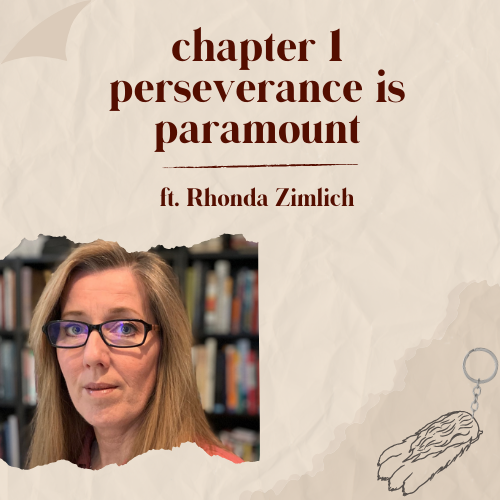
On our first episode (or “chapter”) of The Prose of Publishing, we interview the wonderful Rhonda Zimlich to learn more about her journey to publish her upcoming novel, Raising Panic.
Episode Transcript:
{Music: calm beat starts, plays for :06 seconds before lowering under host’s voice}
HOST: Have you ever found yourself itching to share a story that you’ve been mulling over in your mind, fiction or nonfiction, memoir or vignette, thinking about it often enough that you might consider putting those words to paper? Figuring out how to enter the world of publishing can be daunting. I should know – I’m a creative writing student working towards that goal. Welcome to the Prose of Publishing, I’m Demitra Moutoudis, your host.
{Music: calm beat goes up in volume for :06 seconds before fading out.}
HOST: With first impressions out of the way, let’s be frank. In a competitive world of publishing, you. will. need. help. You may be asking questions like, how do you even entertain the thought of publishing in the first place? Should you publish? Maybe self-publish? And I know that there are many different people out there thinking the same thing: students, parents, teachers, lawyers, policymakers, thinking, where do I start?
Well, that’s why we’re here. For me and fellow beginner writers, I’ve taken it upon myself to interview people who are in the process of, or have even already produced published work.
Which is why I’m really excited to introduce our first guest, Rhonda Zimlich. Rhonda is a professor at American University with an MFA in writing. Currently, she is in the process of publishing her novel Raising Panic, which follows the titular character “Panic” and her sister “PJ.
{Music: melancholic guitar fades in, plays for :04 staying under hosts voice}
HOST: The novel is set in 1978’s rural San Diego, in an era of rabbit’s-foot keychains, ditto bellbottom jeans. The sisters have to deal with their troubled home environment along with Panic witnessing the historic 1978 PSA Jetliner Crash. The sisters find themselves running away from home, realizing that they really can only depend on each other.
Raising Panic is about survival, family bonds, and coming of age when you’re dealt a troubled hand. And even though it isn’t published yet, Rhonda graciously agreed to read a small passage from Raising Panic. The snippet follows PJ who has an upsetting dream about owls and a rabbit.
{Music: melancholic guitar ends :03 seconds.}
{Clip of passage reading begins.}
RHONDA (READING): In the branches near the tree’s center was a hollow where an owl pair had nested for a few seasons. The largest branch extended from the hollow, and the mother owl, perched there against the thrashing, silvered leaves. She was a great horned, and the larger of the pair. In her talons, she held the squirming rabbit to the branch. The rabbit screamed in protest, a sound like a human infant in distress. But it also wailed in concert with the screech of the mother owl calling to her young. Then, PJ saw the juveniles, two clumsy babies still thick with down, emerged from the hollow in the tree and lumbering along the branch, their heads bobbing in an almost comical fashion.
Timidly, they hopped along the scratched bark to where their mother held the prize. The rabbit screamed louder still. They closed in on the trapped creature. And then silenced won out. An absence of sound that was, at once, worse than the screaming, a silence that shot PJ bolt upright in bed.
{Reading ends.}
HOST: Actually, I’ve taken a fiction writing workshop class with Rhonda. She’s brought her manuscript up a few times in class, and that really caught my attention: I was so excited to see a professor actively publishing so I’m definitely not shy to say she’s a great mentor and inspiration!
So, without further ado, let’s get into it: the discussion Rhonda and I had, talking about Panic, publishing, and perseverance.
{Interview begins.}
HOST: Thank you so much for coming on the podcast, we’re really happy to have you here!
RHONDA: Thank you so much for having me.
HOST: I want to start off by asking you: how did you begin your writing career? Did you always envision yourself as a published writer?
RHONDA: Yes, to both of those questions. I started when I was a kid, and I started writing poetry. I sometimes jokingly say “poetry is the gateway drug.” I had a writing mentor who said, “imagine yourself as an adult holding your book. And make sure when you’re an adult, and you have that book in your hands, that you imagine yourself as a child with that wish, and thank yourself for having that wish.”
HOST: Aw, that’s really great advice. I feel like a lot of people can relate to that actually, a dream of an adult you holding a book. But Imagining it the other way around is really endearing. And good advice.
RHONDA: Second question was – have I always written? Yeah, I always have. I think I wrote my first short story in high school and just went from there.
HOST: So obviously, you took that love for writing and you ran with it. But what made you consider publishing your work in the first place?
RHONDA: I wanted to go to graduate school, and I thought I needed publications in order to be considered for graduate school because I was a little bit older as a person going to grad school. It turns out I didn’t need the publications, but I also found out that it was really fun to have my work out in the world. And I got a little rush every time I got an acceptance so I just kept sending things out into the world.
HOST: Yeah, and that actually leads me into my next question, which is: did you ever consider self-publishing, and if you haven’t, what are your thoughts on self-publishing in general?
RHONDA: I had not thought about sending my fiction out into the world self-published. I’d always wanted to work with, you know, dream to get published with one of the Big Five publishers. But I don’t have bad thoughts about people that self-publish or go to boutique publishing or sort of a hybrid. I know that there are people that do hybrid.
But, I did, about 20 years ago now, started a blog and that was a platform for me to put my words into the world without any expectations of having monetary value attached to what I was writing.
HOST: That’s actually interesting! I feel like people don’t immediately think of blogs as a platform to self-publish, you know, professional written work on, until you really think about it. And so would you say that makes it easier? Harder to gain recognition? Maybe it’s even more satisfactory? Or would you still recommend press publishing more?
RHONDA: One of the benefits of being published with the press is working with an editor. Having that outside feedback has been really beneficial. I don’t write in a vacuum, and I’ve had beta readers on my novel manuscript. I also had a sensitivity reader that made sure that, you know, the cultural references in the book are appropriate, and not caricatures out of the way that I render the people in the book. So I think the biggest benefit working with a press is having an editor, or editors to review the work for me.
HOST: If you could elaborate on that, what are your thoughts now that you’ve sent your work in? What was that process like for you? How are you feeling now?
RHONDA: That’s a great question. I am feeling a little nervous because this is a huge project. I have been included in several anthologies, but this will be my first monograph. My first book that’s all mine. And going through the final edits before I sent it to the press. Was a little nerve wracking.
HOST: {agreeing} Mhm.
RHONDA: Wanted everything to be perfect, and now waiting is also a little nerve wracking.
HOST: {agreeing} Mhm!
RHONDA: Because I’m anticipating hearing back from them by the end of the month and hopefully, they’re happy with what they see. And I just have to keep my fingers crossed and wait.
HOST: What was that process like for you?
RHONDA: Some of the book is about abuse, so it’s really hard to look at those abusive sections over and over again. Where I really wanted to make sure I was fine tuning it is that it was a cohesive story from chapter to chapter, and I did find myself tightening things up. And you know, I feel very pleased with where it is now.
HOST: And even though you read it all and you know it all, and you sent it in, you got all those jitters out of the way? How are you feeling now? Normal, excited, relieved?
RHONDA: All of those! I do feel relieved. Most of all, I feel like I can get back to my normal life.
HOST: Mhm.
RHONDA: You know, I’ve put a lot of things on hold while I went through this process and this is sort of the calm before the storm because a book launch is also a big deal. And so I do, I feel relieved more than anything and excited! And it’s a lifelong dream of mine, so, I can’t wait to hold that book in my hands.
HOST: Yeah, I’m really excited for you! When you mentioned it in class, I was like, oh, my gosh, she’s publishing a book right now in the middle, like of the semester! It was just. It’s so exciting. I’m so excited for you.
RHONDA: Thank you.
HOST: Last question, which I feel like is highly anticipated: what advice would you give to people who are looking to get into both writing and publishing? How would one go about starting the process?
RHONDA: Words on the page is first and foremost. You have to write, and I had different people tell me different schools of thought on that: write every single day, which I have done in fits and bursts, but never consistently.
But I’ll say that marketing the book once I had it was probably the most difficult part. Sending it out over and over again, receiving rejections, having it shortlisted for contests; I was just ready to throw in the towel. And I worked with Dolen Perkins-Valdez here in the literature department, and I was talking to her one day about it. And she said, “the people that get published are the people that don’t stop. Just keep sending it out.”
And probably about 3 weeks later I got the news that I was going to be published, so there’s that.
HOST: All right, well, thank you so much for talking with me! It was a great conversation. I’m just so glad I got to sit here and listen to you talk about not only writing and publishing, but also about something you’re genuinely passionate about. I hope people can take something away from that.
RHONDA: And thank you so much Demitra, this was really wonderful.
HOST: Of course! Any time.
{Interview ends.}
{Music: calm beat starts, plays for :02 seconds before lowering under host’s voice}
HOST: To quote our wonderful guest from a previous interview* she had done – “perseverance is paramount; never give up.” I think today we learned that if you decide to publish or not, making sure to persevere with your work, to “just keep sending it out,” is Rhonda’s key to publishing success.
More information about Rhonda’s upcoming novel and its publisher can be found linked in the show notes, as well as resources to look at when considering, the pros of publishing, self or press.
Thank you so much for tuning in to the first episode of The Prose of Publishing! I’m Demitra Moutoudis, it’s a pleasure to have been your host for today.
{Music back to normal volume, plays for :05 seconds before ending.}
==
*note: the aforementioned interview was not released to the public, but the unpublished transcript was sent to the host.
Show Notes
About Rhonda:
Rhonda Zimlich teaches writing at American University in Washington, DC. Her writing focuses on history, grief, and intergenerational trauma, with an occasional ghost story. Her work has been published by Brevity, Past-Ten, American Writer’s Review, Santa Fe Writer’s Project, and more. She was awarded the 2020 Literary Award in Nonfiction from Dogwood, a Journal of Poetry and Prose at Fairfield University, and the 2021 Fiction Award from Please See Me. She received an honorable mention in America’s Best Essays, 2021, and is a 2023 recipient of a Maryland State Arts Council grant for writing.
Works Cited
- Raising Panic, by Rhonda Zimlich, published 2024 Steel Toe Books.
- Intro + Outro: “Okay – Lo-Fi Hip-Hop Beat” by Berool is licensed under CC BY-NC-ND 3.0.
- “acoustic guitar chords simple sad” by Garuda1982 is licensed under CC BY 4.0.