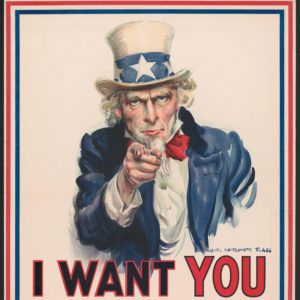
In this episode of “Word of Myth”, we explore whether liberty still rings in the legend of “Uncle Sam”, the long enduring embodiment of the United States government who was once perceived as the personification of American patriotism.
Special guest Lucy Stevenson-Yang shares her perspective on such an American symbol as a US citizen raised in China.
TRANSCRIPTION:
[Music Open (0:12) and under voiceover].
MICHAEL NOTZON: What keeps a story alive? Hello, and welcome to Word of Myth, the podcast where we search for meaning through the characters from myths, folktales, and legends who have lingered in our collective memory rather than simply faded, forgotten into the past. I’m your host, Michael Notzon. I hope you’ll linger with us.
[Singing] Old Uncle Sam come there to change, some pancakes and some onions. For ‘lasses cakes to carry home to give his wife and young ones.
[End music]
MICHAEL NOTZON: In this episode of Word of Myth, we explore whether liberty still rings in the legend of Uncle Sam, the long enduring embodiment of the United States government who was once perceived as the personification of American patriotism. Sam is best known as the elderly white man sporting a stylish goatee, white top hat, and blue tailcoat, who has since 1917 pointed citizens toward the nearest recruitment station where they could sign up to give their lives to and for their country. His true origin story, however, is a mystery that historians debate to this day. For over 200 years, versions of Uncle Sam have appeared in everything from the original lyrics to Yankee doodle, as heard above, Revolutionary era allegorical tales and comic books, to corporate sponsored anti-union attacks, and even appropriated and redesigned for a Soviet government recruitment drive in 1920. While Sam still haunts posters and patriotic paraphernalia to this day, many Americans views on patriotism, nationalism and the government have evolved. Uncle Sam may still want us, but do we still want him?
MICHAEL NOTZON: This episode, we will be joined by guest Lucy Stevenson-Yang, current Program Assistant with the United States Institute for Peace, who, without prior knowledge of what we will be discussing, has kindly and blindly volunteered to her perspective on this episode’s topic, the adventures of Uncle Sam.
MICHAEL NOTZON: Hi Lucy. Thank you for joining us today.
LUCY STEVENSON-YANG Hey, thanks for having me here.
MICHAEL NOTZON: When you hear the name “Uncle Sam,” what is the one word that first comes to mind?
LUCY STEVENSON-YANG: I think I’d probably go with “patriotism,” but I’m not sure that my understanding of patriotism is really the same as some other people here.
MICHAEL NOTZON: Could you tell us a bit about your background?
LUCY STEVENSON-YANG: Sure. I’m an American citizen, born and raised in Beijing, China. Spent my whole life around the international community, and so I think I grew up with a multitude of perspectives, and came here when I was 18 and it was kind of a jarring experience, but moved here for college and have been here ever since. I now work in China security issues.
MICHAEL NOTZON: Do you think your background gave you a different perception of patriotism than someone born in the United States would perhaps have on Uncle Sam?
LUCY STEVENSON-YANG: Yeah, I think I find patriotism and the whole mythos of Uncle Sam both really fascinating and also pretty daunting, and concerning to an extent. Growing up in China, there’s a lot of propaganda launched in every direction, and I think as a result, I’m very wary of the way that plays out in American society. Especially because in China, coming from an authoritarian government, there are many more implications for propaganda and what it means for public life. So coming to the States, the culture around patriotism, flag worship, all of the reverence for the troops and the military — it’s all very new to me. And so I think for that reason, the entire concept of Uncle Sam is very foreign in a lot of ways.
MICHAEL NOTZON: Do you think given those experiences that Uncle Sam seems to you to be more something that promotes a more military culture?
LUCY STEVENSON-YANG: I think so. I haven’t really seen the sort of military culture that you have in States anywhere else. I think a lot of other countries view it as duty, but not necessarily as an honorable thing. And I think the myth of Uncle Sam has really done a good job in glorifying war into something that you’re chosen for, right? The whole slogan of “I want you,” it says a lot about how Americans view military culture.
MICHAEL NOTZON: Do you think other Chinese citizens who are not as westernized as you were would have been familiar with his image, at least on a surface level?
LUCY STEVENSON-YANG: You know, I don’t think so. It’s very strange thinking about when Uncle Sam sort of came into my understanding of the United States. I’m not really sure where it came from. It just seems sort of prevalent in American media, I guess. But I would say that the majority of Chinese citizens don’t really consume American media. And what you hear about the United States, you hear about through the Chinese government and the way that the Chinese government views the United States has changed so vastly over the past two decades. I wouldn’t say that Uncle Sam massively factors into it.
MICHAEL NOTZON: If someone in China came across some sort of iconography of him and asked you to explain it, what do you think you would say?
LUCY STEVENSON-YANG: I think I would say that it’s supposed to be a personification of the United States. You know, the way that Uncle Sam is portrayed as generally strong and, um, kind of a toxic white man, as some might say. I don’t know, I think the way that I would describe it to someone who isn’t familiar is that it’s difficult because it’s not like anything that we have in China. We have propaganda, but it’s more based around the party. Uncle Sam is supposed to be a representation of the country itself. And that’s sort of an interesting dilemma.
MICHAEL NOTZON: From your perspective and what you’ve seen, do you think he was intended more to represent the people or represent the government and do you see those as maybe being, considered separate?
LUCY STEVENSON-YANG: I think that the government would really like for Uncle Sam to represent the, I think the government very much pitches itself as for the people and on the same level as the people, right? But that’s not where we are, obviously. I think those two things are sort of starting to diverge a lot more in the public mind. Maybe prior to a series of economic recessions and I think the horrors of the Vietnam War probably made a really big difference in the American mind. I think the people now more than ever feel very separate from the government and that’s how you end up with more populist heads of state, just as an adverse reaction to that, right? And so, yeah, I think originally maybe it went in that direction, and I don’t know if people think about it in the same way anymore.
MICHAEL NOTZON: And you came over here post-9/11.
LUCY STEVENSON-YANG: Yes.
MICHAEL NOTZON: Okay — just because my experience, you just saw a lot more of, whether you want to call it flag worship or so forth, rising then and really a lot of that sort of glorification of a symbol, regardless of what they may have meant. I was surprised to learn, listening to an old John Prine song, something along the lines of, “your flag decal won’t get you into heaven,” I guess realize that this must be a recurring thing that’s happened…that’s perpetuating.
LUCY STEVENSON-YANG: So do you think that the American understanding of Uncle Sam was very different before 9/11?
MICHAEL NOTZON: In my experience, I think it had kind of passed its glory day. My memory of a lot of military propaganda was, or whenever you want to call it, it’s more kind of videogame-izing things or however you’d want to say. These commercials that, you know, make it look like you’re getting into paintballing or into this sort…gameifying, I guess would be the word. As opposed to having these more kind of bright ideals, more of a sort of, less red, white, and blue and more camouflage. Are you aware of any Chinese characters who kind of occupy a similar sort of role? Or just characters in any sort of culture you’ve been exposed to that have, I guess, what’s almost like a superhero of their culture or of their government or of their flag?
LUCY STEVENSON-YANG: You know, in a weird way, I think the superhero of Chinese history and Chinese propaganda has always been Mao Zedong, who is the father of modern China. It’s very strange, the way that he has been immortalized in the public mind. I think a lot of that is due to a huge propaganda push, and a very successful one. The way that the public sees Mao Zedong, when in its recent history, he did a lot of damage to a lot of Chinese families and brought a lot of pain upon China. I mean, you know, serious famine and suffering, and yet people just idolize him. There’s this cult of personality around him that makes him really untouchable in the public mind and he’s not so much of a historical figure anymore as he is, like Uncle Sam, a myth. I think if I were to choose someone to be the Chinese uncle Sam, then yeah, I think it would be Mao Zedong.
MICHAEL NOTZON: Thanks. If you were trying to think of another fictional character or characters who embody America to you, whether positively or negatively or both, are there ones that come to mind?
LUCY STEVENSON-YANG: I think that my immediate direction that I go with that is superheroes. Um, I kind of think about that as distinctly American and I think that comic book culture is something that seems very American to me and it’s probably just that I don’t know very much else about comic books. I think you might be able to shed some light on this a little bit. Are there like big superheroes that represent the country in other countries in terms of like comic books or that sort of mythos?
MICHAEL NOTZON: Well, Uncle Sam actually became a comic book superhero in the early forties. I don’t think he’s really been pulled out that often, but occasionally. I think he’s actually a real character there, as opposed to just being a sort of billboard. But I mean, Captain America is not the most subtle piece of that. But I also kind of think, not quite comic book, but I think of the Statue of Liberty as being a less government-centric but more ideal-centric, in theory, even though you could argue some things have been lost on that, but this is a larger-than-life icon that conveys something. “Come here,” rather than “sign up here.”
LUCY STEVENSON-YANG: Yeah. I actually want to know a lot more about this Uncle Sam superhero. What was his super power? Just like shunning people?
MICHAEL NOTZON: It was actually patriotism. He could really increase the patriotism of anyone around him. So, I guess, a more organized version of riots.
LUCY STEVENSON-YANG: Hmm. So, mind control. Appropriate.
MICHAEL NOTZON: And he was good friends with Batman. Yeah, I mean maybe more…mind assistance. Well, thanks a lot for coming in and speaking with us. I really appreciate your insight.
LUCY STEVENSON-YANG: Thanks so much for having me.
[Music Open (16:06) under voiceover].
MICHAEL NOTZON: That concludes part one of the Adventures of Uncle Sam. Thank you for tuning in and please join us next week for part two as we delve further into Sam’s origins and impact with our next guest, who shares his own experiences and thoughts on Uncle Sam as a veteran of the second World War. Thank you for listening to the Word of Myth podcast.