
The Complexities and Dangers of Female State Representations
William Underwood
Do you know where the District of Columbia (D.C.) gets its name from? It comes from Columbia, the personification of the United States following the Revolutionary War. The most famous depiction of Columbia comes from John Gast’s 1872 painting American Progress, depicting Columbia, spreading the progress of the new nation, gliding above the settlers, expanding westward with them, laying down telegram wires, and driving the natives.
Manifesting Destiny. It is a simple enough representation, but it begs the question, “Why use a person to represent a nation?” Further, “Why make it a woman?”
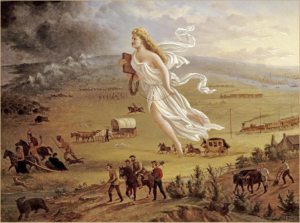
American Progress, John Gast (1872)
Columbia, the Statue of Liberty, and any other vessel for the state exist as icons in our culture. We are familiar with them, and we understand they symbolize the nation and its ideals of enlightenment, liberty and sanctity of law. Icons are special in that they are not just observed, but they have influence. They produce epiphanies, emotional responses, and discourse among us as viewers. Beyond that, Salvatore Alaimo, professor and researcher into the evolution of the Statue of Liberty, argues the status of icons such as the Statue of Liberty are even more influential, defining them as “hypericons” (15). The basis of the distinction is that hypericons are so influential, so ubiquitous in their proliferation that we can observe their material effects on observers over time. In the case of state personifications, how they generate and are subject to political and social values, as well as discourse surrounding them (Alaimo 16).
The mass reproduction and spread of these icons comes largely through political cartoons, artwork, and film (Alaimo 27). While these modes of distribution are relevant to the widespread viewing of these icons, the emotional appeal is what makes them stick. Alaimo opens up this point of discussion, remarking on Lady Liberty, “The potential for emotional interest lies within the past, current, and future viewers’ social constructions of what the statue represents for them, driven by their value orientation and how it aligns with their beliefs and identity” (19). In other words, what the statue symbolizes to each person is informed by that individual’s morals, values, and identity. As such, the values of America can be molded to align with one’s own. I would complicate that this results in us putting a finger on the scale when evaluating the morality of the U.S., as if we associate our own proud values with the state, we are keen to be apologetic when said state does a poor job of reflecting them.
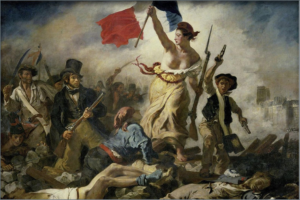
Liberty Leading the People, Eugène Delacroix (1830)
Johannes Heß and Tobias Klee, doctoral researchers on gendered national identity, ask a crucial question: “How come that, at a time when women’s political participation was still very much contested, we find these prominent female figures symbolising the nation?” (Heß and Klee). The answer is that the female form both explicitly and implicitly symbolizes values that men cannot. Charlotte Fischer, an educator of U.S. history, places “symbolic womanhood” into two categories: “Motherhood and the Vulnerable Maiden” (Fischer). Historically, the vulnerability of women is a call to war, a justification for violence, as well as a symbol for a threatened way of life. Johnson places the fine point, “To defend the nation-state is to shelter female bodies from rapacious enemies and to retain the purity and structural integrity of national borders and codes of law” (32). The state illustrates itself as a woman, a damsel in distress, and preys on the patriarchal notions that govern our society in order to rally men who see themselves as her defenders. As for motherhood, women directly represent biological reproduction, as well as a powerful figure that commands respect. As a citizen, you are to respect and revere the nation as one of her own children would.
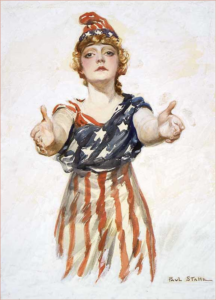
Patriotic WW1 poster depicting Columbia, Paul Stahr (1918)
These female depictions are also often scarcely clothed, with exposed breasts or falling garments. This norm summarizes patriarchal views of the nation, “She must be strong but not in a way that endangers her desirability for men” (Heß and Klee). The female form of the state serves to reinforce the same patriarchal patterns society follows in regards to real women: Women are to be protected in respect to the abstract values men prescribe to them, to the point of violence. And as such, this self-appointed responsibility necessitates governance/control over women, subsuming their own autonomy.
Shifting to the history of state personifications in America, Columbia, lesser-known in modern times to her successor Lady Liberty, was the personified representation of the U.S. in artwork and poetry after the Revolutionary War. Civil War historian Allison M. Johnson tells us that prior to the Revolutionary War, North America was typically represented as “a welcoming indigenous woman, often nude and bedecked with feathers,” branded as an exotic place still accommodating to the European settler (Johnson 34). This sexualized and disingenuous depiction of the native woman would be replaced after the formation of the United States. This transformation produced Columbia, who represented the ideals and interests of the new nation. Columbia had pale, white skin, and wore white or star-spangled robes (Johnson 34). White supremacy was among her primary virtues.
The Statue of Liberty, or Lady Liberty, differs from Columbia firstly in that she has a physical form, and secondly that she served to represent more abstract values than Columbia. The statue, a gift from France, was officially inaugurated in 1886. Writer on American History Christian Blanchett elaborates: “Liberty had become far more than a symbol of friendship between France and the United States. She had become the most powerful modern symbol of the longings of human beings everywhere for freedom, dignity, and well-being” (Qtd. by Alaimo 25). The Statue of Liberty was intentionally built on Bedloe’s Island, now named Liberty Island, to be the first thing immigrants coming from Europe to New York City would see from their boats. It served to “outwardly project to the world, as a beacon and guardian of the American ideal of liberty” (Alaimo 17). This placement proved effective, as mentioned before those who observe the hypericon are likely to align their identities, ideals and highest beliefs with the Statue of Liberty, and thus apply the same to the United States. After all, the purpose of the statue is to represent freedom, dignity and well-being.
Of course, the reality of America did not reflect these tenets for women or poor, black, indigenous and otherwise nonwhite people. Alaimo mentions the discrepancy between these ideals and the reality of the U.S. at the time for marginalized people (19). However, I would argue further, that these new ideals of “liberty and freedom” were not a true departure from the overtly white supremacist values represented by Columbia, but rather a more tacit approach to the same ends, wherein these common human values we all support are associated with a state that still upholds white supremacy. And thus the compromises of the freedom, dignity and well-being of black and marginalized people in America are able to be subsumed into the grander, malleable ideal of “liberty”. Through this construction, white supremacy and liberty become synonymous. And so, through personified manifestations of the state, the governing force of said state can take credit for and vocally promote principles that in reality, it takes action to restrict regularly.
Liberty has also been made to be closely tied to capitalism. The 1792 coinage act stated that all coins minted must have “liberty” imprinted on them; this is still followed today. Whether or not this is something you have thought of before, “liberty” is scribed on our money, producing a subconscious association between the two. Alaimo describes this phenomenon as “stimulus-response-pairing,” where concepts beyond those of the icon itself are tied together.
This relationship was driven zealously during the Reagan administration, which coincided with the 1986 Statue of Liberty Centennial. Reagan-sponsored ad campaigns depicting the Statue of Liberty in peril, in need of funding and faith from the American people were spread in the time surrounding the centennial (Evertz 203). Kathy Evertz, a scholar with a PhD in American Studies, remarks that “Reagan’s belief that the dream can best be defined as the opportunity to get rich, declares that the Centennial-era “lady” in 1986 was a monument to individual financial opportunity” (203). Remembering this in the context of the cold-war era, the Statue of Liberty is in opposition to communism, and reminds us that communism is a fiercely un-American ideology. This served further to curb skepticism of capitalism in the American public, and encourage faith in the free-market neoliberal model the U.S. follows to this day.
The danger of these icons in modern times is that they serve to conflate our morals with those of the state. It is natural for us to pursue and value freedom, liberty, and dignity. These personifications serve to corrupt these social and political values and fool us into thinking the state-constructed definitions of these values align with our own. The Statue of Liberty tells us freedom and dignity is America. And if we, even subconsciously, believe America to be synonymous with freedom and dignity, why would we challenge it? We must be more critical. We cannot believe that the lofty ideals presented by our state’s personifications preclude it from being oppressive and authoritarian. Further, we must see that the racist, patriarchal origins of these characters and the hypocrisies of their unrealized ideals are not glitches in the system but are coded into the state. It is then, with that recognition, that we should rightly ask, “To what degree (if any) should we retain faith in the nation-states these personifications represent?”
Works Cited
Alaimo, Salvatore. “The Evolution of the Statue of Liberty: Determining Factors for Hypericon Status.” The International Journal of the Image, vol. 13, no. 1, 2022, pp. 15–35, https://doi.org/10.18848/2154-8560/CGP/v13i01/15-35.
Delacroix, Eugène. La Liberté guidant le peuple. 1830, The Louvre. https://www.britannica.com/topic/Liberty-Leading-the-People
Evertz, Kathy. “The 1986 Statue of Liberty Centennial: ‘Commercialization’ and Reaganism.” Journal of Popular Culture, vol. 29, no. 3, 1995, pp. 203–24, https://doi.org/10.1111/j.0022-3840.1995.00203.x.
Fischer, Charlotte. “Women as Symbols in Nationalism.” Identity Hunters, 10 Feb. 2021, identityhunters.org/2021/02/10/women-as-symbols-in-nationalism.
Gast, John. American Progress. 1872. https://www.loc.gov/item/97507547/
Heß, Johannes, and Tobias Klee. “Masculine Nations, Female Personifications – the Gendered Imagery of Nationalism.” Contestations of the Liberal Script – (SCRIPTS).
02 December 2021. www.scripts-berlin.eu/publications/Think-Pieces/Masculine-Nations_-Female-Per sonifications/index.html.
Johnson, Allison M. “Columbia and Her Sisters: Personifying the Civil War.” American Studies (Lawrence), vol. 55, no. 1, 2016, pp. 31–57, https://doi.org/10.1353/ams.2016.0053.
Stahr, Paul. Be patriotic. 1918. https://www.loc.gov/item/96515511/