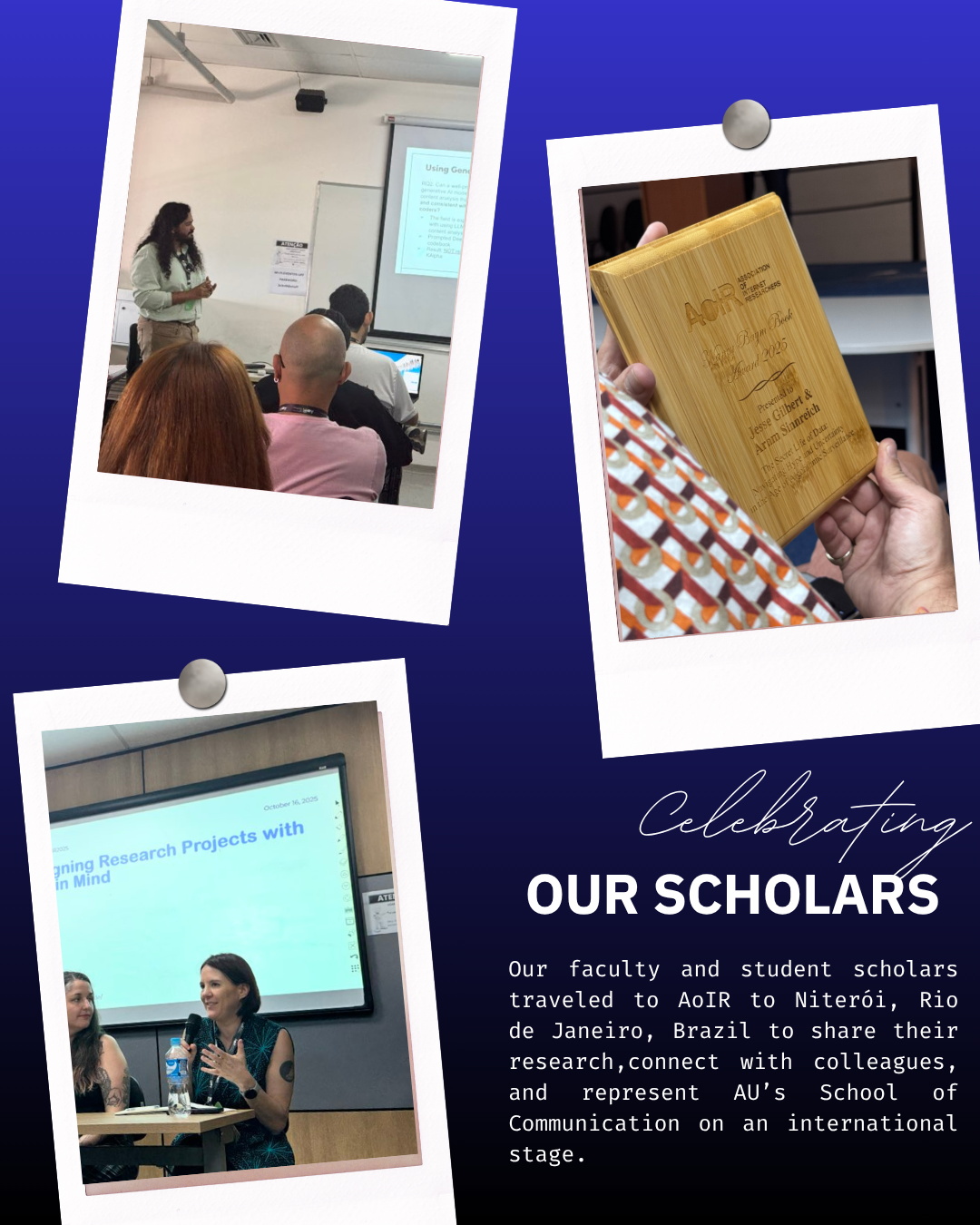
What is behind a recent faculty trip to Brazil for AoIR — the Association of Internet Researchers? In this interview, you’ll find a call for strategy in our field, and how our research connects with this set of international scholars. Two are featured: Profs. Adrienne Massanari and Aram Sinnreich.
———
Eunice Kim (interviewer): What was different about AoIR this year? Any favorite moments?
Adrienne Massanari: I have a lot of favorite moments… I loved that this was the first AoIR conference held in the Global South. That felt really important and exciting for so many reasons. I got to meet so many scholars doing really amazing work that doesn’t always get elevated in the same way.
AoIR typically rotates between places in the Global North—North America, Europe, and sometimes Australia—so this created an opportunity to experience scholarship coming from different places and contexts. My personal favorite moment was actually talking with some of the students who came to a panel I was on about game studies and internet studies. They were doing really interesting work on gaming in the Brazilian context, which looks very different from the U.S. or Europe. Hearing them talk about those differences was fascinating. I generally love hearing student work, but it was especially meaningful to hear from students in places I’m less familiar with.
Aram Sinnreich: About a third of the attendees were local to Brazil, and many of them were students. People who would never attend an AoIR conference in another country, let alone another continent. It was really great having them there and feeling like I was the visitor, rather than the center of the event, which Global North scholars often experience.
Being in Rio was fascinating. It’s culturally rich and transforming very quickly. Brazil has been through major political changes recently, and seeing the country hold a corrupt authoritarian former president accountable was inspiring—especially compared to other countries that have failed to do so.
From a cultural standpoint, I went out to samba almost every night. The local music scene is incredibly alive. On a personal level it was fun, but as someone who studies musical cultures, it was also intellectually meaningful. It demonstrated a healthy relationship to public art that we don’t currently see in the United States or much of Europe.
That contrast between vibrant public culture and serious social challenges like inequality, infrastructure issues, and public violence, really highlighted how every society has its benefits and its challenges. There are always trade-offs.
At the conference itself, what I enjoyed most was the pre-conference on creative laborers in the AI economy. I met many graduate students and early-career scholars working on questions I hadn’t even thought to ask yet. That sense of refilling my research tank and engaging with cutting-edge conversations was incredibly valuable.
Interviewer: I completely understand. I was working with students at Mason Korea on the playwright program called a 1,001 Plays as a faculty advisor, and the creative works coming from students in Brazil was unbelievable. I was amazed by the work produced by undergraduate students of digital artwork performed over Zoom. So, I’m not surprised that both of you found so much inspiration in Brazil yourselves.
…so what makes an international conference like AIR feel different from domestic ones? And do you think attending conferences abroad changes how scholars think about their field?
Sinnreich: Going abroad for a conference has many benefits that domestic conferences don’t offer. The biggest one is connecting with a different scholarly community. About a third of AoIR attendees were local, but even international attendees weren’t necessarily the same scholars you’d see at an American conference.
Brazil is also more accessible, politically and economically, for many Global South scholars. Right now, there’s strong evidence that people are avoiding the United States because of immigration policies and the real risk of being detained or denied entry. International conferences allow us to access networks and perspectives we might otherwise miss.
No matter how well-intentioned we are, we live inside a powerful U.S.-centric information bubble. One of the most effective ways to break that bubble is to travel outside the country and spend meaningful time talking with people who live and work elsewhere.
AoIR 2013 in South Korea was the only time I’ve been there, and I spent a lot of time walking around Daegu, absorbing civic practices and everyday life. That kind of immersion matters.
Interviewer: Do you think that changes how scholars think about their field?
Sinnreich: Yes.
Massanari: I’ll add to that. Aram and I have been attending AoIR for over a decade, and there are international scholars I see there whose work I deeply value but don’t often get to engage with otherwise. They’re connected to different networks and bodies of literature, and they often cite scholarship that doesn’t circulate as much in U.S.-based spaces.
The U.S., and Silicon Valley in particular, has had an outsized and often troubling influence on global tech narratives, but that’s not the whole story. Seeing how technology is understood and used elsewhere, whether through walking around cities, observing everyday practices, or talking with people, is incredibly informative.
It gives us concrete imaginaries for what alternatives could look like. It helps us reflect on our own biases and assumptions about the field and about the U.S.’s place within it. That’s one reason AoIR has thrived as it has become more global, it matches the global nature of the internet itself.
Interviewer: I’ve attended MLA [Modern Language Association] for years, and it remains very North America–focused. Even when it’s held in places like Toronto, it still feels geographically limited.
Massanari: Exactly. That limits perspectives, even though there’s excellent work being done. Especially now, many scholars literally cannot come to the U.S., which places responsibility on those of us who can travel to connect across borders.
Interviewer: That leads into my final question: why are conferences like AoIR especially important right now, and why should students, graduate students, and faculty feel encouraged to attend?
Sinnreich: Let’s start with the obvious: the internet is one of the most powerful forces shaping global society. There’s no other scholarly community that approaches it with the same interdisciplinary and critical depth.
Whether we’re talking about business decisions, geopolitics, ethics, or social harms, these conversations are happening first and most rigorously within the Association of Internet Researchers. Conferences like AoIR consolidate the cutting edge of the field and help scholars understand who’s saying what, where debates are headed, and how their work fits in.
They also build interpersonal relationships—webs of trust—that are essential for global knowledge production.
Massanari: I’ll add that there are conversations we increasingly can’t have in the U.S., especially given what’s happening in higher education and the rise of authoritarian politics. Certain topics like research on the far right are becoming harder to discuss safely here.
Those conversations are going to have to happen elsewhere, and AIR is becoming one of those spaces. The field has matured beyond seeing the internet as a purely democratic force for good, and there’s now a stronger sense of responsibility in how we study it.
These issues require global perspectives. They can’t be solved by any single country. That’s why conferences like AIR are so important right now, even if that reality is a bit of a bummer.
Interviewer (Eunice Kim): Thank you both so much for your time!