One unusual benefit of AU is world-class research centers on media, from games to social media. This post describes one intersection with the AU Game Center.
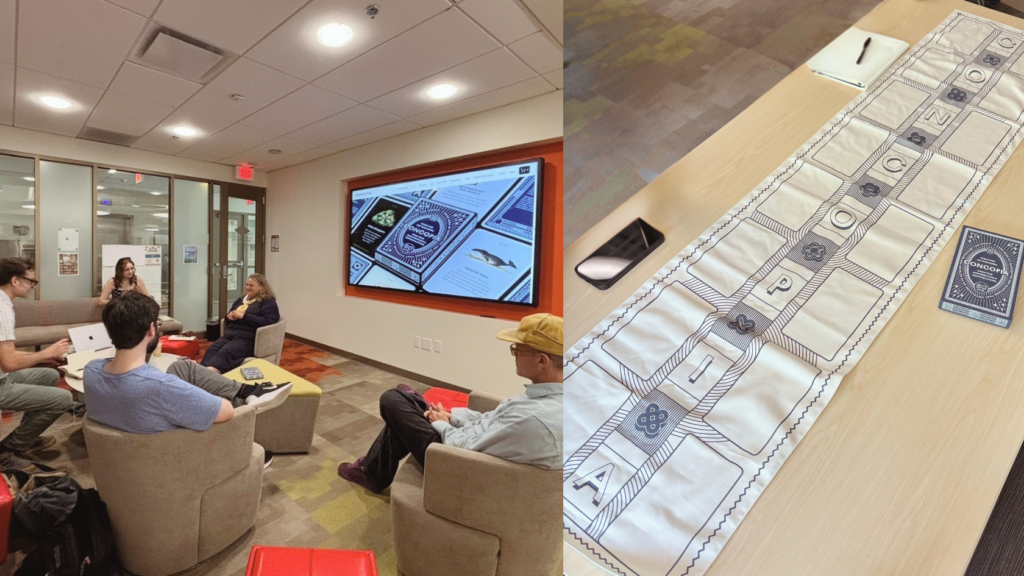
How can we open really new conversations about media, technology, and society? One strength of being in Washington DC is the way that people can physically have conversations across silos and lines of expertise―very different from policy Zoom meetings.
Last week, American University’s Game Center hosted Danish civic designer Nadja Pass for a demonstration and conversation about Concopia—a conversational card set featuring 50 cards that range from questions and stories to social issues of the day.
Pass was in town to present a larger Concopia exhibition currently on view at the Martin Luther King Jr. Memorial Library, where visitors can walk through the Concopian Chamber of Wonders, a labyrinth made from 33 giant Concopia cards.
The Game Center visit offered an opportunity to experience the ideas behind the exhibition in a much smaller setting. Pass walked our group through the Concopia Cards and invited us to consider how carefully designed questions can create space for people to listen, reflect, and connect across differences.
During the demonstration, Pass introduced students to one of her favorite ways of using the cards: “listening rounds,” in which one person responds to a card while everyone else listens without commenting. The practice, she explained, creates room for something that rarely happens in everyday conversation: “When they are not interrupted, then what comes in the second, third, or fourth wave of their thinking is usually much more interesting.”
The cards span five categories, or what Concopia calls five approaches: Civic Desires, Reenchantments, Endangered Skills, Pivotal People, and Wonders of Nature. While some cards prompt large-scale thinking and societal impact, others focus on personal reflection regarding our skills, relationships, and connection to nature. This is an intentional structure—one that allows us to pause, take a beat, and fully evaluate ourselves and the world around us.
This approach aligns with the work of Playful City Lab, which takes place within the Game Center. Our researchers explore how games and other playful experiences can create new ways for people to engage in civic life. In conversation with Professor Ben Stokes, who leads the Playful City Lab, Pass discussed how Concopia was inspired by a trend she noticed: people were finding it difficult to engage in everyday conversation. The cards fulfill a goal of connectivity, and implicitly, as a starting point for community-building.
Just as Concopia invites us to reimagine and rethink, it also offers a reframing to our question: how can we open really new conversations about media, technology, and society? Maybe the first step to answering is identifying how we design experiences to help people talk, listen, and learn together.
Concopia is on display at the Martin Luther King Jr. Memorial Library from September 9 through October 22.