Textual Descriptions of the Liberal Arts
Images of the Liberal Arts evolved from their initial beginnings in illuminated manuscript and print series. Deriving from the writers of ancient Greece and Rome, the traditional seven Liberal Arts that developed in Medieval, Christian studies were thought to provide an effective means for scholars to grow in their schooling, culminating with a closeness to God once they mastered all aspects of the disciplines. In the Italian Renaissance, a renewed interest in the depiction of the Liberal Arts was associated with the rise of humanism. As the Liberal Arts often had many Latin texts associated with each discipline, recognition of the allusions to each scholar and their source texts allowed humanist scholars to showcase their erudition through the identification of each discipline’s allegorical rendition. The allegorical figures of the Liberal Arts served “as a means to anchor attention and focus ”according to Fannie Lemoine, on each discipline, allowing scholars to deepen their study.[3] Vincent de Beauvais referred to the Liberal Arts as “the foundation of all the knowledge which the philosopher has to master.”[4] The Liberal Arts also served to help the soul towards the revelation of divine wisdom.[5] Comprised of the disciplines of the Trivium and Quadrivium, they were foundational to any individual’s growth of knowledge and were therefore essential to know and understand for any scholar. The Trivium consists of the disciplines of Grammar, Rhetoric, and Dialectics/Logic. The Quadrivium consists of Arithmetic, Geometry, Music, and either Astronomy or Astrology. The Quadrivium was slightly elevated in the hierarchy of the disciplines when compared to those of the Trivium. Because the Trivium served as the base and as a stepping stone to mastering the later four disciplines, it was perceived as less intellectually rigorous. As Paulo d’Ancona writes, the Trivium represented the arts of the word whereas the Quadrivium related to those of the sciences.[6]
Most scholars and theorists adhered to this classification of the Trivium and the Quadrivium and divisions between the disciplines. The foundational authors on the Liberal Arts were the ancient Roman scholar Marcus Terentius Varro in now lost manuscripts, Saint Augustine, Martianus Capella in the Marriage of Philology and Mercury or De nuptiis Philolgiae et Mercurii, Boethius in the Consolation of Philosophy or Consolatio, Cassiodorus in the Institutiones, and Alain de Lille in the Anticlaudian. Additionally, although not as fully discussed in these texts, scholars such as Vincent de Beauvais, Bishop Theodulf of Orleon’s poem “de Septeum liberalibus artibus in quadam pictura” wrote about the Liberal Arts as disciplines but did not give them descriptive attributes.[7] The most famous Early Modern account of the Liberal Arts, Cesare Ripa’s Iconologia, published in 1593, was heavily influenced by these earlier texts.
In the earliest description of the Liberal Arts, Varro included the disciplines of grammar, rhetoric, dialectic, geometry, arithmetic, astrology, music, plus an additional two of medicine and architecture.[8] This initial set of disciplines was then altered by Seneca, who added medicine, and Quintilian, who reduced the list to solely geometry, music, astronomy, and grammar.[9] St. Augustine adapted Quintilian’s division of education but maintained that faith was superior, and “reason followed as a natural consequence”; therefore the purpose of education was always to strengthen and grow one’s faith.[10] As such, Augustine was one of the first Christian theologians to incorporate the disciplines of Philosophy and Theology into the Liberal Arts by presenting the seven disciplines as handmaidens of Theology and Philosophy.[11] According to his model, one had to master the seven base Liberal Arts in order to be considered a philosopher, which ultimately was preparation for the study of theology. He thereby established a new knowledge hierarchy, with Theology at the pinnacle.[12]
Augustine’s model was important for the three most influential Medieval texts that followed: Martianus Capella’s Marriage of Philology and Mercury (c. 420) (figure 1), Boethius’s Consolatio (c. 524) (figure 2), and Alain de Lille’s Anticlaudian (c. 1128) (figure 3). These three authors altered the perception of the Liberal Arts from a series of disciplines, void of personality or attributions, to vivid and persuasive allegorical figures, which would subsequently inspire visual depictions. Within each text, the author personified each of the seven Liberal Arts, as well as either the Muses, Philosophy, or Theology, as women. Through a semi-narrative story in which a central figure journeyed and interacted with each discipline, the reader was immersed in and taught from the individual discipline. These figures served as propaedeutic and heuristic devices, providing an initial entrance into their respective discipline.[13] However, as we shall see, certain scholars and philosophers are referenced more in relation to each discipline and therefore had greater importance to the symbolic elements associated with, and reflected in, personifications of the Liberal Arts.
Boethius’s Consolatio was the first text that fully separated the disciplines into the Trivium and Quadrium. Although he is best known for his text Consolatio or The Consolation of Philosophy, only his writings on the disciplines of mathematics and arithmetic survive. In his Consolatio, Boethius introduced the various disciplines of the Liberal Arts, primarily led by Philosophy. In his introduction to Boethius and the Liberal Arts, Michael Massi described Philosophy as an individual who “continuously invigorates and stimulates the arts.”[14] Boethius included many instances of the metaphors between the various levels of the world which imply, according to Myra Uhlfeder “the mental ascent and the interrelationships of man, the physical cosmos, and God.”[15] This notion of hierarchy and a mental ascent to understand the interrelationships between man and God, is important in understanding and examining the differences in figures representing the respective disciplines of the Liberal Arts especially as displayed on Sixtus IV’s tomb. Specifically, in this model, the arts of the Trivium served as the base for building up to those of the Quadrivium. Only once those disciplines have been mastered could a scholar ascend to the mastery of philosophy.
The most important and frequently referenced work that describes at length the seven Liberal Arts is Martianus Capella’s Marriage of Philology and Mercury. Fannie Lemoine connected Boethius’s writing with Capella’s text, maintaining that both used the Liberal Arts to “act as symbolic guides to the ascent and ultimate attainment of the human pilgrim in search of enlightenment.”[16] In a series of ten books, Martianus Cappella recounted the marriage between Philology, the goddess of learning, and her soon-to-be husband, the god Mercury, in a council of Olympian Gods. One by one, the Liberal Arts were introduced to Philology as if to quell her nerves before her marriage. First introduced is the figure of Grammar, followed by Dialectic and Rhetoric, completing the arts of the Trivium. After each of the arts of the Trivium’s lengthy presentations regarding their discipline, Capella moves on to introduce the arts of the Quadrivium, beginning with Geometry who is followed by Arithmetic, Astronomy, and is concluded with Harmony/Music. In this chapter, we are also introduced to Philosophy who is described as “the mother of so many scholars and men so illustrious.”[17] However, Philosophy does not play as significant a role in the proceedings of the council on Olympus as compared to the Liberal Arts. Capella briefly notes that Medicine and Architecture were present at the council of the Gods but did not give them any further attributes. Capella’s account of the Liberal Arts became the most popular source for traditional depictions of the Liberal Arts, particularly because he devoted a significant portion to the appearance of each art, while clearly summarizing the overarching themes and lessons of each subject. However, as I will further discuss, many images of the Liberal Arts deviated in some respects from Capella’s descriptions, and instead, drew from the writings of other well-known philosophers and scholars, especially Boethius and Alain de Lille.
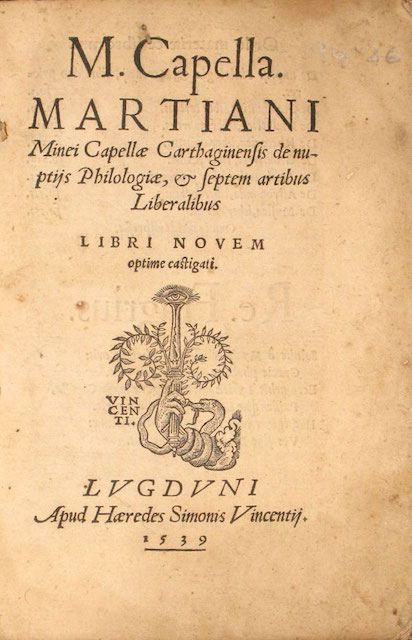
Figure 1. Martianus Capella, Marriage of Philology and Mercury or De nuptiis Philolgiae et Mercurii, 5th c., Printed 1539, Lugduni, Whipple Library, University of Cambridge
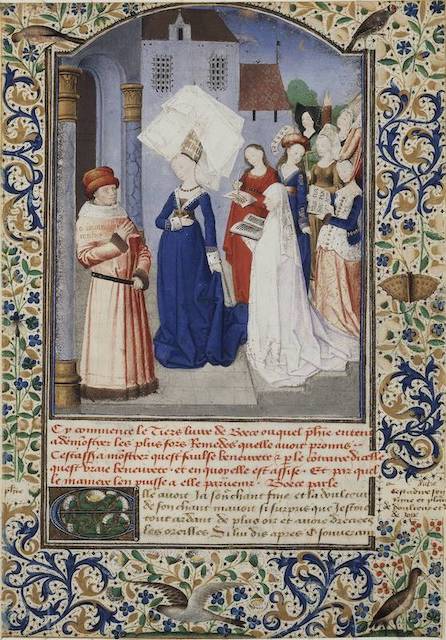
Figure 2. Attributed to the Maître de Coëtivy, Frontispiece of Book III Boethius’ ‘De Consolatione Philosophiae’, c. 1460-70, France, 241 x 165 mm, Wallace Collection
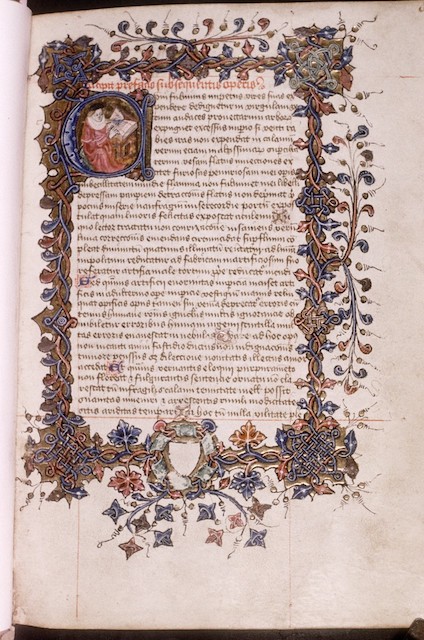
Figure 3. Alain de Lille (Alanus de Insulis), Anticlaudian, c.1400, fol. 006r, Manuscript, 210 x 141 mm, Oxford Libraries, Bodleian Library MS. Canon. Misc. 110