Prospectiva
The figure of Prospectiva (figure 45) has been the most elusive in establishing textual or visual relationships, as her discipline is not one of the traditional seven; or Philosophy, the head of all the arts; or Theology, the last discipline to master before Divine wisdom is achieved. However, in Sixtus IV’s tomb, she is given a prominent place next to the figures of Grammar and Rhetoric, seemingly completing the Trivium as she is placed across from Dialectic. Although literally translated into Perspective, the discipline as understood through the inscription more closely corresponds to the study of visual perception and optics. She holds an astrolabe and the della Rovere heraldic oak branch in one hand while her other holds open a book (figure 46), inscribed that “nothing can be seen without light. Vision comes about through radiating lines perpendicular to the eye. A ray of light always runs straight unless deflected by a change of medium. The angles of incidence and reflection are equal.”[121] This comes from the Perspectiva Communis written by John Peckham in the 13th century. The inscription could also reference the Arab mathematician Alhazen’s Book of Optics or Perspectiva.[122] The selected inscription indicates the importance of perspective within the panel, with Prospectiva reflecting the rise in visual arts as an ingenious and worthy discipline, in comparison to the manual labor as previously considered. Although not literally interpreted as perspective, Prospectiva evokes the rediscovery of linear perspective that allowed for developments in the visual arts, bringing greater naturalism, illusionism, and depth.
Sitting on a pedestal and the intricately carved table is a lit candelabrum (figure 47). The inclusion of the light indicates there was a source of light that the figure seems to be looking away from. However, her gaze is to the right, in the direction of the figure of Theology and the divine rays emanating from the head representing the Trinity. This connection is further established through the astrolabe she holds which visually establishes a horizontal connection between the torch on the left, her body, and the representation of Theology. As Prospectiva is quite literally the discipline of optics through vision, this interaction reflects the importance of divine light and its role in imparting divine wisdom. Prospectiva quite literally is shown with light through the representation of the candelabrum to her left. Prospectiva’s inscription additionally supports the connection to Theology as it can be understood that light can be understood as a metaphor for the divine, bringing the knowledge of God.[123] Further, their poses echo each other in reverse, establishing the interplay between the two disciplines.
Ettlinger argued that the inclusion of Prospectiva is derived from the writings of Aristotle, Euclid and Thomas Aquinas on the theories of optics and is therefore related to all disciplines underneath Philosophy. Aristotle divided Philosophy into the four areas of geometry, astronomy, astrology, and perspective, and separated music and arithmetic into their own disciplines.[124] Thus, although this figure of Prospectiva is unique when compared with Aristotle, it can be understood that this discipline was integral to the establishment of the Liberal Arts as vision and optics was required for study of geometry, astronomy, astrology, and perspective. Further, by including Prospectiva on the tomb, Pollaiuolo indicates the shift in traditional understandings of the Liberal Arts from the seven disciplines to other areas of study. Not only is physical vision reflected within this panel, but through optics, Prospectiva conveys foresight or spiritual vision.[125] The addition of this figure communicated the desire to update the Liberal Arts, reflecting the current innovations and scholarship and serves to further establish the Liberal Arts within Christianity, referencing their importance in understanding the divine.
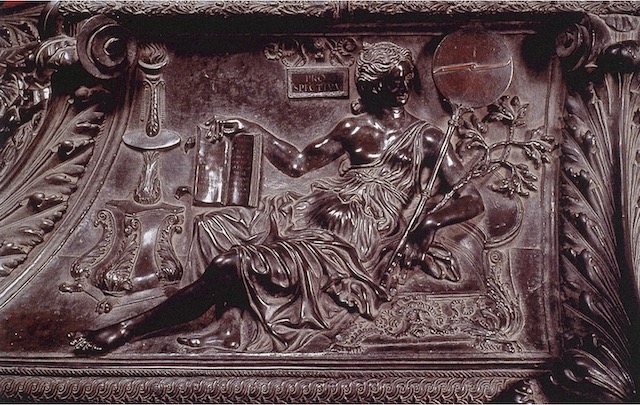
Figure 45. Antonio Pollaiuolo, Tomb of Sixtus IV, Detail of Prospectiva, c.1484-1493
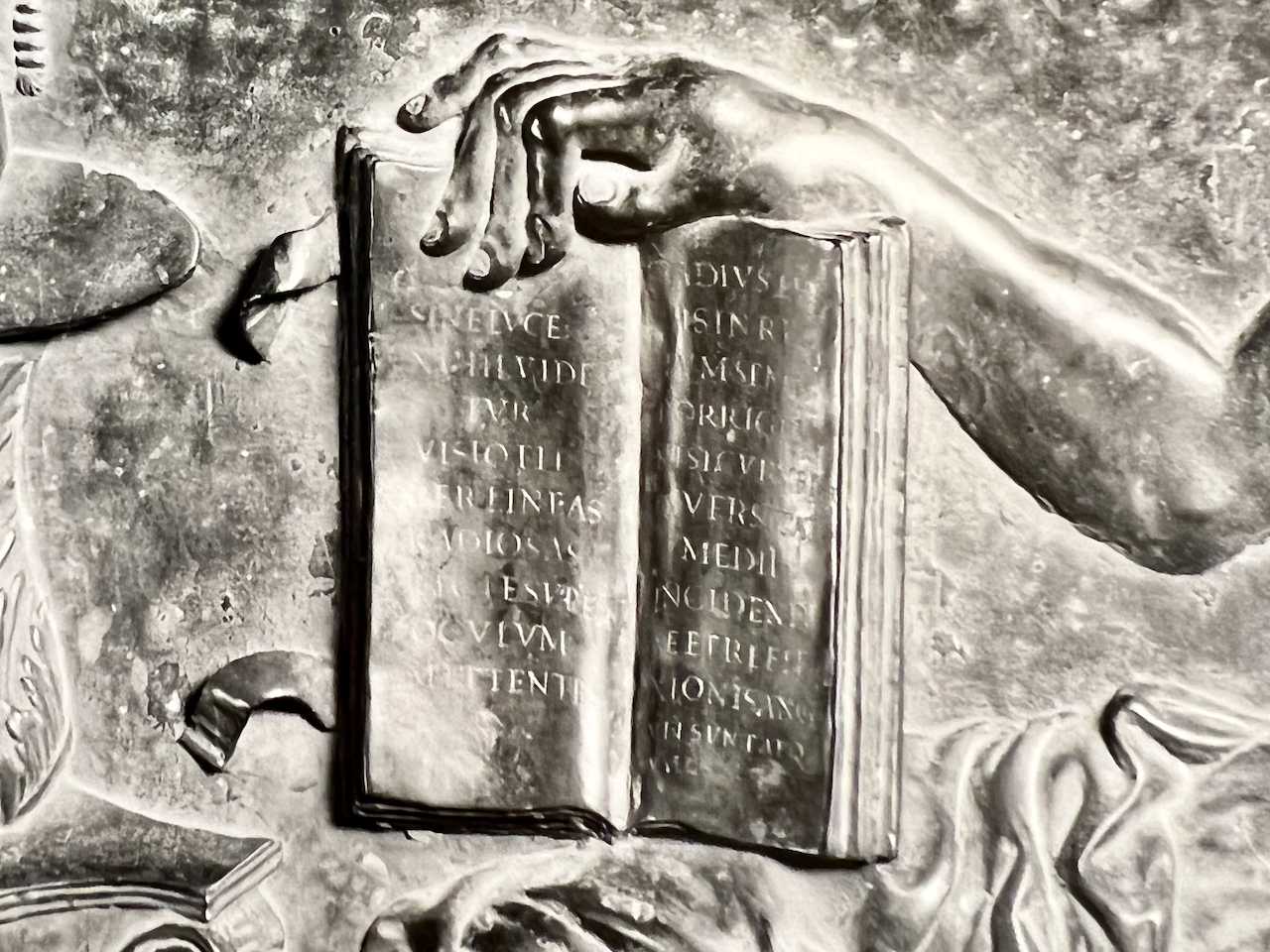

Figures 46 and 47. Antonio Pollaiuolo, Tomb of Sixtus IV, Details of Prospectiva Inscription and Candelabrum, c.1484-1493