Present

PRESENT

This selection of works grounds the viewer in the present moment. Certain pieces are physically activated, such as in response to shiftinng air currents. Others require mental activation through consideration of racial struggle and the ceaseless movement of migrant bodies, as well as the visual untangling of an endless knot. Collective engagement by artist, viewer, and the work is required to grasp this selections commitment to movement in the present moment.

Click the images below to engage with each artwork.  

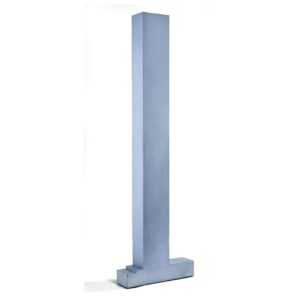
A ceiling-height, slim, silver-blue, crisscross-textured rectangular prism intersects a short, identically colored and textured rectangular prism base at a ninety-degree angle.
Anne Truitt, Summer Snow, 1974
White paper almost fully filled with abstract black and gray ink strokes that alternate between short and long curved lines and large circles. Elliott’s signature and title are written in pencil at the bottom.
Ronnie Elliott, Hommage a Charlie Parker, 1973
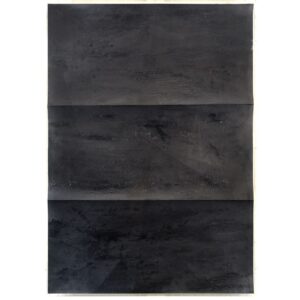
One large, dark grey rectangle divided into three horizontal sections. Each section has a texturized surface with folds and scratches.
Louise Nevelson, Untitled, 1971
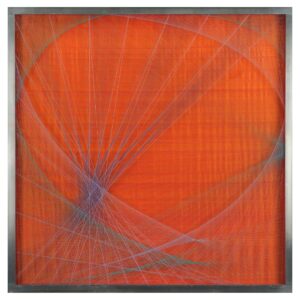
Underneath a square framed plexiglass, a geometric construction of string suspended above an orange background. Strings overlap, creating web-like structures while others form grid-like patterns.
Sue Fuller, String Composition #144, 1967
White paper covered in clusters of faint ink dots spaced systematically across the piece. Some dots are larger and more visible, some almost entirely invisible.
Patrick Ireland, Dots, 1972
A black and white drawing of overlapping lines that create a circular object.
Anni Albers, Line Involvement VI, 1964
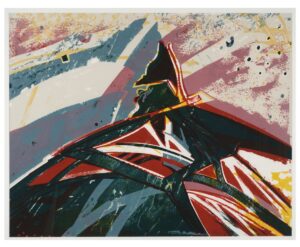
A landscape of a mountain actively erupting. Red and yellow lines break through the mountain as though its lava.
Richard Hunt, Mountain Shift, 1985
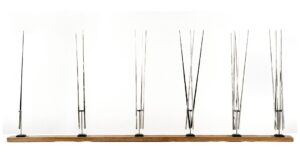
Twenty-one stainless steel blades, just over three feet tall each, rest atop six metal hinges on a long wooden block.
George Rickey, Peristyle III, 1966
Black paper with a dark gray two by four grid in the lower half. A gold, upside down, right triangle is in one of the grid’s rectangles on the left side.
Taro Ichihashi, Wajima II, 1980

Lorem ipsum dolor sit amet, consectetur adipiscing elit. Ut elit tellus, luctus nec ullamcorper mattis, pulvinar dapibus leo.