Forging Community with the Gee’s Bend Quilters

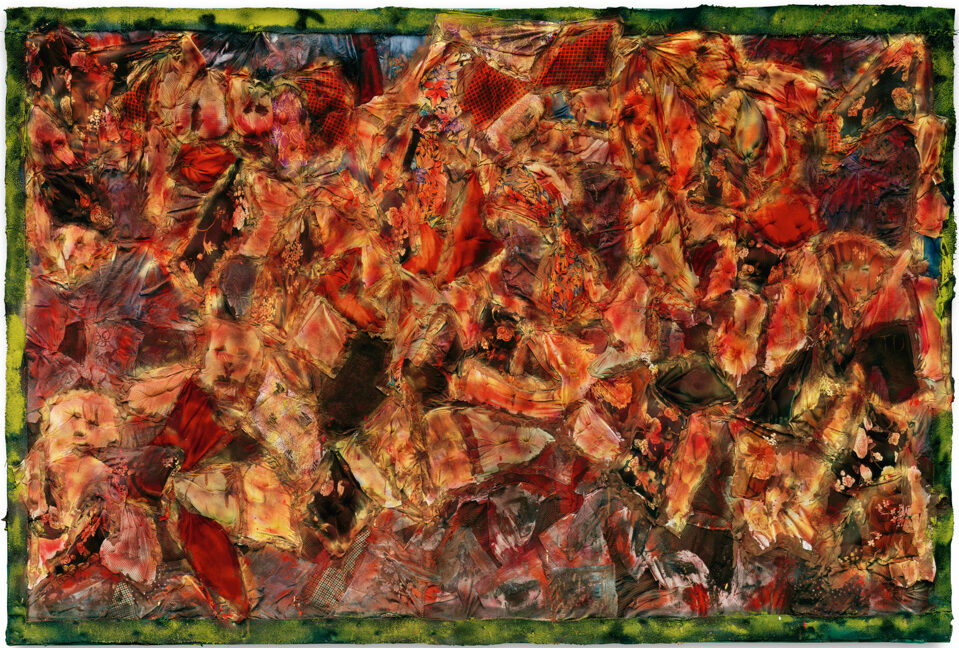
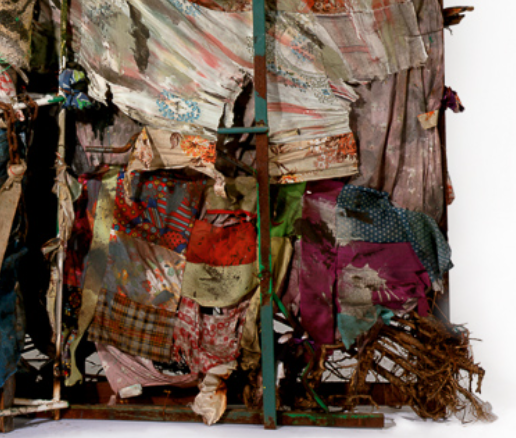
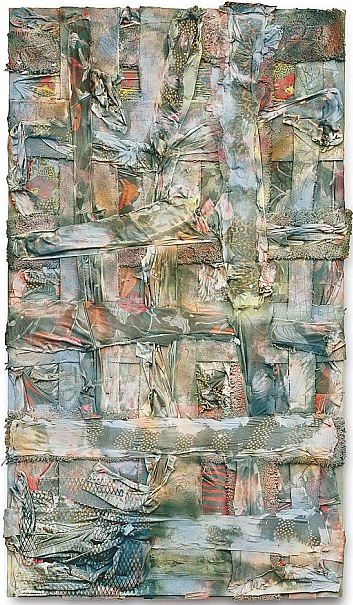
Integrated into the harder materials of metal, wood sticks, and roots are Dial’s quilts and clothing pieces. Normally, he would paint over his assembled sculptures after placing and fitting each piece together, which created a muddled visual scene.[99] For example, Dial’s In Honor (2002) (Fig. 17), Memory Of The Ladies That Gave Us The Good Life (2004) (Fig. 18), and Freedom Cloth (2005) (Fig. 19) all show uniform color schemes and are direct references to the Gee’s Bend quilters. History Refused to Die departs stylistically from In Honor, Memory Of The Ladies That Gave Us The Good Life, and Freedom Cloth since there is more exposure to the quilt’s true patterning, which points to Dial’s interest in the unique traditional patterns of Gee’s Bend quilts. Added pieces of used denim jeans and other clothing materials are selected and attached to the quilts and imply the artist’s value in reusability. Dial was captivated by the women’s ability to practice quilting from old, used pieces of clothing. He references a piece-by-piece method, which aligns with the quilting process as described by Bendolph. In a conversation with anthropologist Johnnetta Cole, Dial explained that he “looked at the ladies and things and how they were doing stuff and how their sewing was working.”[100] Herman also explains, “Dial mimicked the quiltmakers’ tradition of recycling.”[101] Quilting to him was not only about the artistic and expressive components, as scholars previously noted, but also about the individual ideas that grew from sewing and using specific pieces of clothing that belonged to family members and close friends. This is evident in History Refused to Die, where there are little marked changes on the quilts and fabric strips, which were possibly found in his immediate environment. It is unclear if Dial applied any sewing techniques to History Refused to Die, but his fabrics attach as if they are a quilt. While there are quilts placed all around History Refused to Die, the most noticeable ones appear in the lower right half of the work. Beneath the rusted, white metal framing, these quilts peek out with varying patterns. Dial had pieced together various squares of fabric that allude to the Gee’s Bend patchwork process of quilting.

Cubbs also associated the quilts in Dial’s work with the financial and practical hardships that lead to repurposing pieces of clothing. The exhibition catalog, Creation Story: Gee’s Bend Quilts and the Art of Thornton Dial, specifically investigated the relationship between Dial and the quiltmakers of Gee’s Bend. In Cubbs’s contributing essay, “The Poetry of Castaway Things”, she states that Dial and the Gee’s Bend quilters bonded through their shared artistic practice of recycling pieces of clothing and the history of living in impoverished areas of Alabama. For example, Cubbs explains in her essay that “like the women of that community, he uses old, leftover objects to create his art, not only because of their ready availability but because of their expressive potency.”[102] The painted wall assemblage is thus a specific reference to the contribution of Southern women that quilted and contributed to other domestic roles.

Dial’s interaction with the quilters was not only about using found objects and creative expression, but it was also about the manual labor invested in creating quilts. Cubbs asserts that the artists’ shared hardships produced expressive quilts with vibrant patterns and varied shapes.[103] Art historian Anna C. Chave also explains, “Gee’s Bend quiltmakers generally emphasize that the arduous, perennial labor of assembling their families’ covers and was done out of an abject need on top of the backbreaking labor of farming and running households.”[104] While hardships played a vital role in both artists’ works, there are additional components that push beyond the aesthetic and practical financial purposes of using found textiles. The quilters of Gee’s Bend and Dial still remained dedicated to their practice of using found textiles even when they had the financial security to buy newer fabrics. Such an aesthetic choice between Dial and the quilters of Gee’s Bend indicates the more incredible message of what using found objects has. Using found old, worn fabrics is what many Gee’s Bend quilters were used to sewing, and it reveals their autobiographical significance.

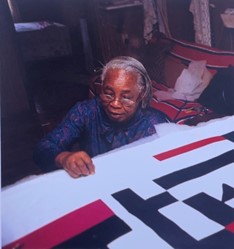
The quilts of History Refused to Die also speak to the close relationship between Dial and Bendolph. In the book Mary Lee Bendolph, Gee’s Bend Quilts, and Beyond, Bendolph recounted her story of learning how to piece strips of clothing together which is similar to Dial’s assemblage style. A needle and thread were provided and given to Bendolph by her mother so that she could begin to quilt. Bendolph would sew each piece of old clothing until they achieved the likeness that she wanted and would only sew with used clothing to reduce wastefulness and maintain the life of the person who wore them.[105] According to the National Endowment for the Arts, Bendolph’s mother did not allow her to use a sewing machine, forcing her to make each stitch by hand. Her mother’s decision forced Bendolph to take her time while quilting and, in that process, she learned how therapeutic it was (Fig. 20).[106]

Both Dial and Bendolph bonded on this aspect of domestic labor that was born from financial struggle. Women and labor left a positive impact on the his life. He viewed women as the “creation of the world”, which was a reference to their nurturing and labored efforts.[107] Quilting was primarily done by women in the Gee’s Bend, and it was essentially a female-dominated line of work, yet Dial joined his own stylistic method with the quilters. In History Refused to Die, gender binaries become unified throughout the work, ultimately giving credit to both women and men workers for their shared spaces of labor (Fig. 21). History Refused to Die shows that women were an integral part of Dial’s life and oeuvre. Dial had grown up mainly in the care of women and greatly admired their contributions as domestic laborers. He has explained, “Women back then was picking cotton, doing hard time fieldwork, cooking, making, and providing. All the children back then had to respect grown ladies.”[108] One of his painted works titled Mrs. Bendolph (2002) (Fig. 22) credits Bendolph and the larger community of Gee’s Bend quilters.[109] Based on the work’s surface appearance, Dial suggestively took an interest in the geometric formations that are one of the defining characteristics of a Gee’s Bend quilt.

Figure 21: Detail of Dial’s quilts in History Refused to Die, 2004. Photo: Stephen Pitkin/Pitkin Studio.
Figure 22: Thornton Dial, Mrs. Bendolph, 2002, Clothing, bedding, carpet, enamel, and spray paint, on canvas on wood, 84 x 50 x 4 inches. High Museum of Art. Photo: Stephen Pitkin/Pitkin Studio.

Yard Art

Another feature in History Refused to Die is its borrowed practice from Black vernacular yard art traditions. Dial participated in this tradition in his own backyard in Bessemer where he publicly displayed yard art outside of his house as a form of communication and connection with his neighbors and family members. This art form’s specific intertwined materials were once part of outdoor spaces where his family conducted chores in the fields and in his home. Dial’s close friend and yard artist, Holly, recognized that he created works of art from his objects of labor in his workshop. As Dial created things from found objects, he did not call them artworks until he met Holly.[110] Holly was Dial’s first encounter with a self-taught artist. When Dial met Holly in 1987, he switched the terms that he used to describe his work, so descriptions such as “stuff or things”, became replaced with the term “art”. It is likely that after this interaction with Holly, Dial was more acquainted with yard artworks and their material makeup of objects of everyday life. Still, History Refused to Die maintains its status as both an assemblage work made from everyday utilitarian things and as an artwork. Dial seems to emphasize both of these qualities for History Refused to Die since he displays rustic heavy objects that are characteristic of yard art objects.

Yard artworks in the American South originated from an African American vernacular commemorative tradition that evolved from a history of communication with distant family members and ancestors.[111] This form of art existed out of the lack of resources and Black cultural suppression in a predominantly white Southern region.[112] The curator, Timothy Anglin Burgard, explains, “The very existence of a Southern yard show publicly declares its creator’s autonomy and identity.[113] History Refused to Die illuminates Dial’s autonomy not only through its objects but the title as well. The work closely aligns with Dial’s personal history of labor, and he used these experiences as a form of public expression and agency.[114] The artist did not only create the work for the purpose of commemoration or to specifically communicate his African ancestry but to suggest a lifetime of labor within multiple industries.

Figure 20: Mary Lee Bendolph quilting her quilt top in her home, 2005. Photo by David Raccuglia.
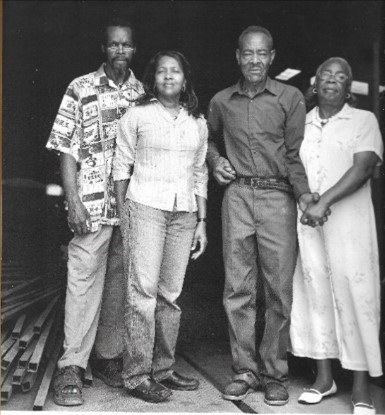
Figure 2: [left to right] Lonnie Holly, Louisiana P. Bendolph, Thornton Dial, and Mary Lee Bendolph at Dial Metal Patterns, Bessemer Alabama, 2006. Image by Matt Arnett.

[99] Thornton Dial,” Souls Grown Deep,” https://www.soulsgrowndeep.org/artist/thornton-dial.

[100] Thornton Dial, interview by Johnnetta Cole, National Visionary Project, 70.

[101] Dial, Arnett, and Cubbs. Thornton Dial in the 21st Century, 217-218.

[102] Scala, Creation Story, 2.

[103] Scala, Creation Story, 2.

[104] Anna C. Chave, “Dis/Cover/ing the Quilts of Gee’s Bend, Alabama,” Journal of Modern Craft, 1:2, doi/https://doi.org/10.2752/174967808X325514.

[105] “Mary Lee Bendolph, Lucy Mingo, and Loretta Pettway Quilters of Gee’s Bend,” National Endowment for the Arts, accessed November 28, 2023, https://www.arts.gov/honors/heritage/mary-lee-bendolph-lucy-mingo-and-loretta-pettway.

[106] Matt Arnett, Paul Arnett, Joanne Cubbs, Dana Friis-Hansen, and E. W. Metcalf, Mary Lee Bendolph, Gee’s Bend Quilts, and Beyond, Atlanta, Georgia: Tinwood Books, 2006, 32.

[107] Thornton Dial,” Souls Grown Deep,” https://www.soulsgrowndeep.org/artist/thornton-dial.

[108] Thornton Dial,” Souls Grown Deep,” https://www.soulsgrowndeep.org/artist/thornton-dial.

[109] Dial’s assemblage painting, Mrs. Bendolph. is a specific homage to Mary Lee Bendolph. The work is bound together by spray paint, clothing, bedding, carpet, and enamel on a canvas. See Mark Scala, Creation Story: Gee’s Bend Quilts and the Art of Thornton Dial, (Frist Center For The Visual Arts: Nashville, Tennessee, 2012). 20.

[110]  “Mary Lee Bendolph, Lucy Mingo, and Loretta Pettway: Quilters of Gee’s Bend,” National Endowment for the Arts, https://www.arts.gov/honors/heritage/mary-lee-bendolph-lucy-mingo-and-loretta-pettway.

[111] Bernard L. Herman, Unfinished Business of Unsettled Things, UNC Press Books, 2022.

[112] William Arnett, Souls Grown Deep, Volume One.

[113] Bernard L. Herman, Unfinished Business of Unsettled Things, 110.

[114] Lampkins-Fielder, Souls Grown Deep Like the Rivers, 13.