
“You Can’t Handle the Truth”:
A Few Good Men and the Reality of Unethical Leadership in the United States Military
Aaron Butler, Jr.
Conference Paper Presentation
Introduction
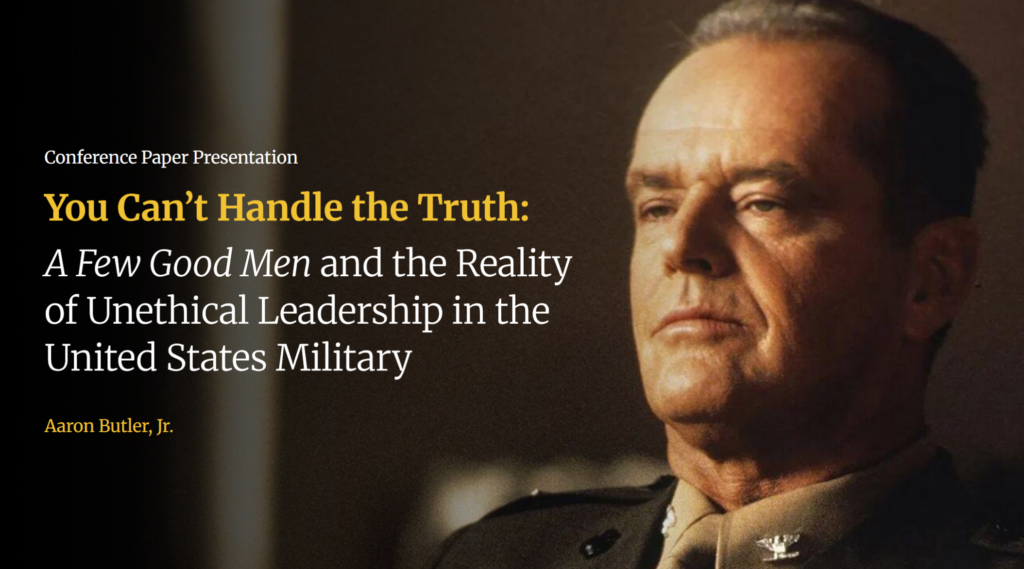
A Few Good Men is one of the most culturally significant movies to come out of Hollywood in the last 30 years. The star-studded cast, including Jack Nicholson and Tom Cruise, and their fiery on-screen dynamic still captivates audiences today. But beneath the surface of this fictional story lies a real issue: poor leadership and its detrimental effects on the nation’s fighting force. The film, focusing on a specific hazing incident under the watch of a corrupt leader, opens a broader conversation of what makes up the classification of bad leadership and its real-life consequences. To consider the effects of hazing in the United States military requires the consideration of the reasons hazing occurs in the first place. I will first examine the military’s understanding of the term “hazing,” and then discuss scholarly findings regarding the lack of reporting of hazing incidents. I will then expand the scope of this discussion to highlight what kind of leadership system fosters this dangerous culture, as well as how military culture plays a role in how comfortable victims feel in reporting such incidents of violence compared to the developments within the film itself. Through this analysis, it will become clear that this film is more than just a typical Hollywood blockbuster, but a tool for critical insight that permeates the military and civilian culture divide to create necessary change and exposure of dangerous leadership qualities.
Addressing Hazing in Scholarly Work and Film
In Berry-Cabán et al., three key traits of “hazing” are identified: the goal of accumulating and keeping membership in a group, actions that pose human risk, and disregard for one’s consent (800). The introduction to Berry-Cabán et al. additionally lists the Department of Defense’s position on hazing as harassment that poses a threat to both the physical and psychological health of a soldier (800). For the authors of this article, reporting such incidents is crucial to overall safety and environmental culture, as well as raising the standard of accountability and providing an opportunity to develop preventative measures (801).
In the film, the viewer is immediately thrown into a distressing scene in the barracks of Naval Station Guantanamo Bay. Two Marines, Lance Corporal Harold Dawson and Private First-Class Louden Downey, are seen breaking into Private First-Class William Santiago’s room while he is asleep. There, they would constrain him in his bed with duct tape and force a rag into his mouth while attempting to shave his head. Ultimately, this hazing would lead to Santiago’s death, and a court martial would be opened to try Dawson and Downey for murder, conspiracy to commit murder, and conduct unbecoming of a Marine.
The YouTube channel “LegalEagle,” run by lawyer Devin Stone, reviewed A Few Good Men and the intricacies of military law that it gets right and wrong. Stone’s guest, Spencer, a former Judge Advocate General lawyer who held the real-life occupation of the film’s defense counsel, provides insight that helps contextualize this military legal drama. Since the base in Cuba is under Naval jurisdiction, the defense counsel would consist of Navy lawyers including Lieutenant Commander JoAnne Galloway (Demi Moore), Lieutenant Sam Weinberg (Kevin Pollack), and Lieutenant Daniel Kaffee (Tom Cruise) (Stone and Spencer). When the case file is first presented to Galloway, the audience is given the impression that these hazing orders are routine forms of discipline within the military that are kept as quiet as possible.
Throughout this trial, the audience learns the two Marines were ordered to perform a “Code Red” by their superior, Lieutenant Jonathan Kendrick (Kiefer Sutherland) and his superior, Colonel Nathan Jessep (Jack Nicholson). A “Code Red,” as Spencer explains, is not known to be an actual order within the U.S. military and was most likely created for the plot of the film itself. However, Spencer says that such an order would be generally known as “hazing” in the modern-day military, something the institution is working to take out of the equation of its culture. The film’s approach to hazing is grim, sudden, and disorienting — an accurate depiction of how real soldiers have described their experiences.
The Problem with Reporting Incidents
In an online survey of 227 servicemen and women at Fort Bragg in North Carolina, 70% of all respondents had experienced a form of hazing at least once (Berry-Cabán et al. 802). These experiences included being verbally abused by peers, consuming large amounts of alcohol, “blood pinning,” and being hung upside down (Berry-Cabán et al. 802). The subsequent revelations from most respondents about their actions after being hazed showed that an overwhelming number of victims chose to stay silent about what they had endured.
The numerous perspectives on these results share either a sense of discouragement in the chain of command or a sense of internal vs. external conflict. For the service members in units where hazing is tolerated, reporting a hazing incident may seem unproductive because of a deep lack of trust in the military’s ability to adequately investigate it (Berry-Cabán et al. 803). Additionally, service members may distrust the handling of such an investigation so much that they become concerned with how their involvement in a report will hurt their advancement within the military (Berry-Cabán et al. 803).
This report by Berry-Cabán and others gives invaluable insight into the individual soldier’s perspective in terms of their confidence in the institution’s ability to properly handle, investigate, and provide a just outcome in a case involving the harm of a service member. Paralleled with the developments of the film, we can see some aspects of their findings within the letters of PFC Santiago, who wrote to multiple superiors desperately asking to be transferred from Guantanamo Bay. When Colonel Jessep reads the last letter Santiago had written before being killed, his utmost concern is not of Santiago’s condition, but the fact that he broke the chain of command. Santiago had proposed that in exchange for his transfer, he would provide details on an “illegal fenceline shooting” on base that involved Lance Corporal Dawson.
Later, we hear from Dawson himself in conversation with Lt. Kaffee that the Marines follow one code: “Unit, Corps, God, Country.” This just emphasizes the importance of a shared code within the military, and the severity of Santiago’s attempt to “rat out” a fellow Marine as Colonel Jessep described. The military’s cultural landscape of loyalty and uniformity also dampens the motivation to file a report of hazing or sexual assault (Berry-Cabán et al. 803). For National Guardsmen, in 2009-2010 studies referenced by Sadler et al., the “good old boys” system deterred guardsmen from reporting sexual assaults due to the conflict of interest that contaminated the chain of command (13). One enlisted National Guardsman admitted that if someone was close with their commander, any report against him or her would likely be put to rest and the soldier who spoke up could even face backlash, courtesy of a lack of anonymity (Sadler et al. 13, 14).
Sadler et al. additionally acknowledge the victim blaming that predominantly occurs in the conversation of sexual assault in males. Many of the responses in the focus groups comprised of active duty, reserve, and National Guard soldiers shed light on the toxic culture of different military settings that all put blame on the man for falling victim to such an assault (Sadler et al. 11). One participant was quoted saying, “everybody’s got a gun,” implying the expectation in the military that every soldier should be capable of fighting back in a moment of vulnerability (Sadler et al. 10-11). This sort of victim blaming can be seen in various points of the film, but one that stands out is when the defense counsel, hosted by Lt. Kendrick, visits the crime scene in Guantanamo Bay. When Lt. Cdr. Galloway asks Kendrick if he believes Santiago was murdered, he first makes a point to announce his deep Christian faith before saying, “he is dead because he had no code, he is dead because he had no honor, and God was watching.” It’s as if Kendrick is trying his best to imply that within the Marine Corps this film portrays deviation from uniformity deserves to be paid for, whether through a Code Red or divine intervention.
The Significance of Leadership Roles on the Soldier and the Institution
In his final letter, PFC Santiago admitted that he had fallen behind during group runs with his company and had been shoved 30 feet down a hill by his commander for his inability to keep pace. Colonel Jessep mocks Santiago’s confession, saying “he is a U.S. Marine, and it would appear he can’t run from here to there without collapsing from heat exhaustion.” In this meeting with Lieutenant Colonel Matthew Markinson and Lieutenant Kendrick that took place before the Code Red order was given, Jessep makes it clear that his priorities rest in the “business of saving lives,” meaning Santiago would remain in Cuba and be conditioned to meet the physical standard of the rest of his company. “We as officers have the responsibility to the country to see that the men and women charged with its security are trained professionals,” said Jessep in one of his many self-gratifying monologues. And if he didn’t meet the quota in the next physical exam? Jessep warns Kendrick, “I’m going to blame you, then I’m going to kill you.”
It’s a rather dramatized take on what a toxic leader would act like in a military setting, but the Hollywood element of shock conveys the message clearly enough so that the casual viewer understands just how consequential such harsh leadership is to a soldier’s psychological state. Dr. Benjamin Trachik and others examined the possible correlations between the behavior of leaders and their influences on suicidal thoughts and depression in a study of just over 2,000 soldiers. Soldiers were anonymously surveyed at three different times: during deployment, one month after deployment, and three months after deployment all within the years 2013-2014 (Trachik et al. 317-318).
With questions targeting different aspects of sense of community and self-worth, the authors concluded that changes in “suicidal/death ideation” (SI/DI) were negatively impacted by the amount of time after deployment in which a soldier completed the survey (Trachik et al. 319). Subsequently, the authors found that for every increase of two points in “leader-provided purpose,” the SI/DI decreased by one (Trachik 320). The understanding that leaders are able to illustrate the purpose of military service after “stressful experiences,” in addition to the feeling of unit solidarity, also proved to successfully predict a later change in SI/DI and symptoms of depression (Trachik et al. 320). The authors were able to conclude through the results of this study that only the perceptions of leader-provided purpose and unit cohesion predicted the outcomes of SI/DI at the end of the three months following deployment (Trachik et al. 321). This outcome was slightly different from those of the surveys completed during deployment, which included leader-provided sense of meaning as well in the successful prediction of SI/DI (Trachik 321).
Diving into the dynamics of leadership roles within the military and their effects on mental health and mission focus, it seems necessary to look at the broad overview of the Army’s change in classifications of negative leadership. Captain Alan H. Kennedy and Major Kevin J. O’Neil discuss the legal implications of the Army’s transition from using the term “toxic leadership” to “counterproductive leadership” (Kennedy and O’Neil 44). The authors first investigate the meaning of toxic leadership, which they define as the “combination of self-centered attitudes, motivations, and behaviors” that hurts individual troop and collective morale, and the overall confidence in a mission (Kennedy and O’Neil 45). They further add that a leader who exhibits such toxicity “lacks concern for others,” which can prove detrimental in both the short and long-term (Kennedy and O’Neil 45).
Kennedy and O’Neil additionally discuss the new use of “counterproductive leadership,” defining it as behavior that violates any of the Army’s “core competencies” or Army Values (45). Their definition warns that such leadership will leave an organization in “worse condition” than when the counterproductive leader had taken authority (Kennedy and O’Neil 45). Outside of the legal analysis, Kennedy and O’Neil make a very blunt point about the Army’s general perception of unsatisfactory leadership standards: if leaders fail to create environments where “trust and cohesion” are evident, then they have failed in creating an environment fit to accomplish any mission (Kennedy and O’Neil 46).
This definition of “counterproductive leadership” sounds exactly like that of Colonel Jessep, which is a crucial point when analyzing the deeper elements of this film. Jessep attempts to appear as though his motivations lie in the betterment of the individual soldier, but over the course of the story we see these ambitions turn into the desire for all men and women under his watch to fall into his standard. A perfect encapsulation of this is when Jessep hosts the defense counsel for a meal on the base in Cuba along with LTC Markinson and Lt. Kendrick. When Galloway asks Jessep if Code Reds are still given by officers at Naval Base Guantanamo, Jessep bluntly remarks that if he were on the record, he would say he disapproves of the practice “in accordance with the Commander’s directive.” Off the record, however, Jessep admits that he believes this hazing process is “invaluable” to training, and that he runs his unit how he wants to, daring the defense counsel to challenge him in military court.
Caroline Walsh’s analysis of the ethical contents of a “military hierarchy,” however, works against Jessep’s goal. As a Coast Guard veteran with a PhD in Leadership Studies, Walsh wanted insight on how younger enlisted service members perceived unethical incidents that they experienced (55). In discussing higher profile instances of leadership failures, Walsh brings up the topic of commanders being punished “too easily” for incidents that developed at lower levels (57). In a series of interviews with five service members, one enlistee recalled an instance where a Marine got lost during a training exercise, and the battalion commander was relieved of command because it happened “within his ranks” (Walsh 57-58). The enlistee had said that he was “pretty sure” the particular Marine and the commander that faced consequences had never interacted with each other because of the sheer number of Marines the commander oversaw (Walsh 57-58).
Experiences like these supported the perception that low and mid-level leaders were more consequential to discipline and the upkeep of an “ethical environment,” as opposed to those at the top of a unit’s chain of command because of their distance and limited interactions with subordinates (Walsh 58). Walsh added that the general theme in the answers she was getting was that commanders covered things up because acknowledging an issue would end in their relief from command (57). The service members seemed to point to the rash firings of commanders as preventative to address and solve the issues at hand (Walsh 57).
We can see this with LTC Markinson, the Executive Officer of PFC Santiago’s unit, who throughout the film serves as the one ‘good’ commanding Marine in the film. Markinson suggests Santiago be transferred off the base after reading his last letter, worried that he would be harmed by his unit members after word got out that he broke the chain of command. Markinson would have prevented Santiago’s death if it wasn’t for Jessep’s stubbornness. Markinson also knew how Jessep covered his tracks by creating a fake transfer form, making it look like Santiago truly was ordered to transfer off the base. Yet, the consequence of going forward and exposing Jessep’s true leadership in court was too heavy of a burden to bear; Markinson would take his own life just before he was scheduled to take the stand. In his letter addressed to Santiago’s parents, Markinson blamed the Marine’s death on himself, saying, “your son is dead for only one reason: I wasn’t strong enough to stop it.” Here, Markinson is taking the fall for Jessep but in a much more dramatic manner compared to the consequences highlighted by Caroline Walsh.
It is worth acknowledging that, with Walsh’s work in mind, it could be argued that Jessep wanted to strike down this notion to prove just how powerful he could be. But in the killing of PFC Santiago and subsequent revelations of life on Guantanamo Bay in the trial, it became clear that Jessep was not in control of as much of the base as he thought he was, and that was his breaking point. Cornered by Lieutenant Kaffee in cross-examination, Jessep finally admits that he ordered the Code Red on Santiago, and the house of cards on which Jessep built his corrupt system of authority crumbles. It’s a classic Hollywood ending, but it shows that the military is no exception to the presence of corruption when one is given power.
Conclusion
Both the film and scholarly work show that not only is the military ridden with violence that causes both physical and mental turmoil, but it is also infested with bad agents who exploit the chain of command as a ‘quick fix’ to underlying issues that are heavily suppressed from the public. And with this come grave consequences: the real, visible, and undeniable damage that the military suffers when the health and safety of its men and women are not prioritized and simply disregarded. Santiago’s death, though fictional, is unfortunately not pure fiction.
In 2020, Army Specialist Vanessa Guillén was murdered by a fellow soldier and had been missing for two months before her remains were found (Diaz et al.). In the aftermath, 21 soldiers and officers would face punishment for having failed to act on sexual harassment complaints (Philipps). Another 14 officials faced discipline following another Army investigation into the culture at Fort Hood, including two generals who were dealt “potentially career-ending blows” (Mervosh and Ismay). That same investigation would reveal that Fort Hood had “higher levels of crime” compared to other bases, and they were “neither identified nor addressed” (Mervosh and Ismay).
A Few Good Men hands us an example of bad leadership on a silver platter, and with just this snapshot of scholarly research, it is already apparent that real leaders like Colonel Jessep provoke a culture that fosters this harmful behavior. So, as hard as it is to talk about, it is imperative that we handle this truth: toxic leadership structures and practices in the military have proven to be fatal, and through the lens of this film, we can finally start that conversation.
Works Cited
A Few Good Men. Directed by Rob Reiner, Columbia Pictures, 1992.
Berry-Cabán, Cristóbal S, et al. “Service Members’ Attitudes Toward Reporting Hazing Incidents.” Military Medicine [US], vol. 189, no. Supplement_3, August 2024, pp. 800–05, https://doi.org/10.1093/milmed/usae281.
Diaz, Johnny, et al. “What to Know about the Death of Vanessa Guillen” The New York Times, 30 Nov. 2022, www.nytimes.com/article/vanessa-guillen-fort-hood.html.
Kennedy, Alan H., and Kevin O’Neil J. “Leadership Has Changed from Toxic to Counterproductive.” The Army Lawyer, no. 2, 2021, pp. 44-47. ProQuest, https://www.proquest.com/trade-journals/leadership-has-changed-toxic-counterproductive/docview/2608509621/se-2.
Mervosh, Sarah, and John Ismay. “Army Finds ‘Major Flaws’ at Fort Hood; 14 Officials Disciplined.” The New York Times, 8 Dec. 2020, www.nytimes.com/2020/12/08/us/fort-hood-officers-fired-vanessa-guillen.html.
Philipps, Dave. “Military Missteps Allowed Soldier Accused of Killing Vanessa Guillen to Flee.” The New York Times, 30 Apr. 2021, www.nytimes.com/2021/04/30/us/vanessa-guillen-fort-hood-aaron-robinson.html.
Sadler, Anne G, et al. “Servicemen’s Perceptions of Male Sexual Assault and Barriers to Reporting During Active Component and Reserve/National Guard Military Service.” Journal of Interpersonal Violence [Los Angeles, CA], vol. 36, nos. 7–8, April 2021, pp. NP3596–623, https://doi.org/10.1177/0886260518780407.
Stone, Devin and Spencer. “Real Lawyer Reacts to A Few Good Men (with Real JAG!),” LegalEagle, YouTube, 18 June 2022.
Trachik, Benjamin, et al. “Military Suicide Prevention: The Importance of Leadership Behaviors as an Upstream Suicide Prevention Target.” Suicide & Life-Threatening Behavior. [New York,], vol. 51, no. 2, Apr. 2021, pp. 316–24, https://doi.org/10.1111/SLTB.12707.
Walsh, Caroline. “The Military Hierarchy Experience: Ethical Leadership Issues from the View of the Lower Ranks,” The International Journal of Ethical Leadership: Vol. 10, Article 7, 2023. https://scholarlycommons.law.case.edu/ijel/vol10/iss1/7.