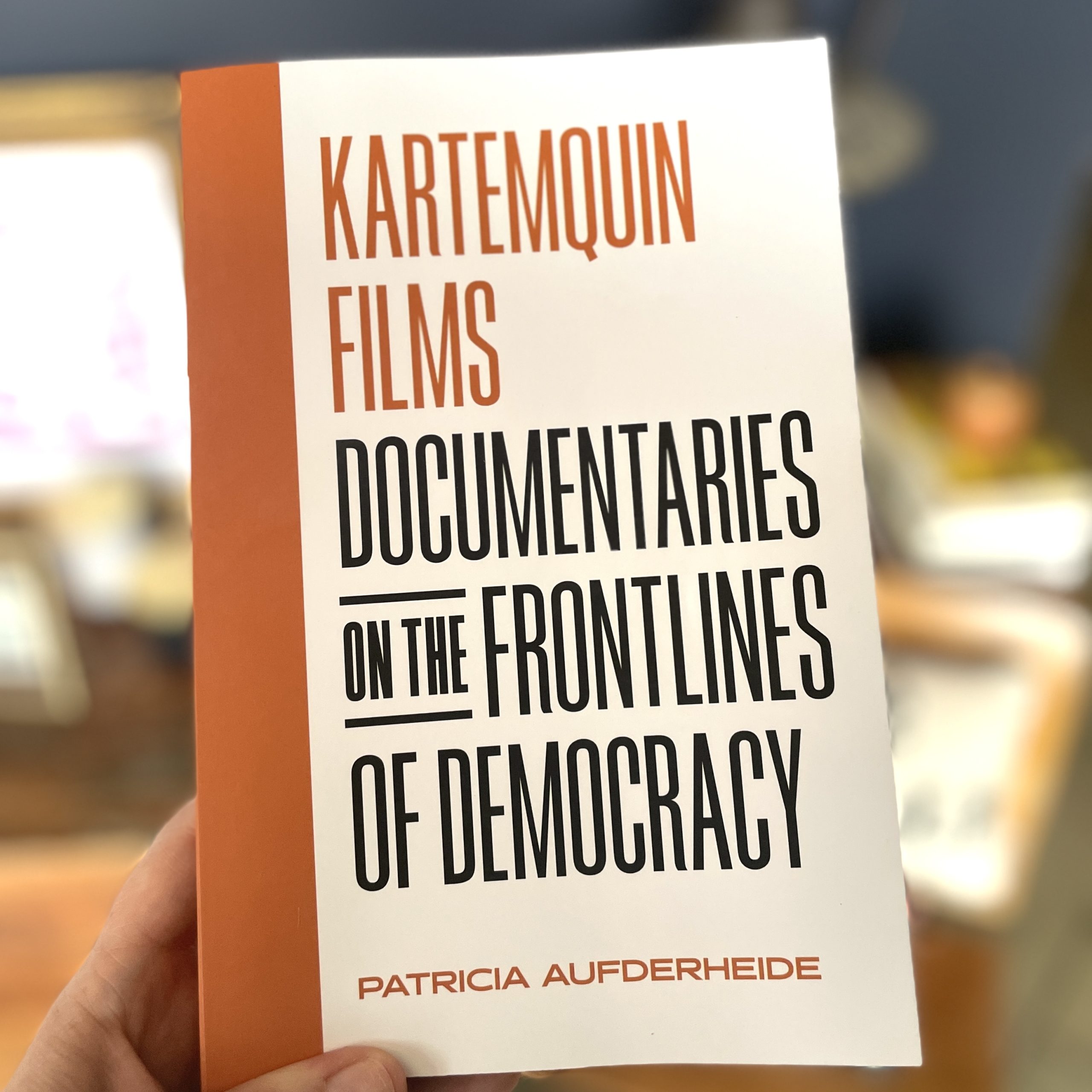
Eunice Kim (EK): Today I will be interviewing Dr. Patricia Aufderheide, University Professor of Communication Studies at American University and the author of Kartemquin Films: Documentaries on the Frontlines of Democracy.
I also wanted to congratulate you on your Shorenstein Center fellowship for Fall 2025 Documentary Film and the Public Interest Initiative. That’s such an exciting and well-deserved opportunity.
Patricia Aufderheide: Thank you, I’m excited.
EK: Since you also have such a direct connection to Kartemquin Films, I’d love to start by asking: what was the moment when you thought, “Kartemquin’s story needs to be shared”?
Aufderheide: I wanted to write about them for a long time. Initially I thought it would just be an article, but life kept getting in the way. Eventually, I realized I finally had the time. And honestly, my whole generation is passing. I thought, “Let me talk to these people while I still can.”
I knew that I wanted to use a cultural-production focus to analyze the history. This way of understanding social change puts communication in the center of the process, and looks at how communication is shaped by and shapes larger systemic forces, to affect what people understand to be normal, or even reality. It’s a longstanding approach of cultural Marxism; it’s the core of the Birmingham school of cultural studies, which was led by Stuart Hall; it’s the way theorists such as Pierre Bourdieu understand how culture shifts and changes; and it’s core to the thinking of American pragmatist philosopher John Dewey.
As I started interviewing, I realized an article wouldn’t be enough. Kartemquin’s history needed more room, a book’s worth, to explain how something so unlikely survived for so long, through constantly shifting economic and political conditions. I also knew almost everyone involved. Well—of course not everyone. There are still people who say, “You should’ve interviewed me!” and they’re absolutely right.
But I also had the advantage of being a writer with a job that pays me to do this kind of work. Documentary filmmakers don’t have that luxury. They do extraordinary things, but they rarely get time or institutional support to document their own history. I felt an obligation, given my access and resources, to get this story down.
Eventually, I asked friends who the right publishers might be. A friend connected me to his editor at the University of California Press. She didn’t need convincing at all. When I asked if I could send a proposal, she said, “Oh, you’re the perfect person to write that book. Just do it.”
Of course I still had to submit a formal proposal, but her enthusiasm reassured me that this story mattered to more than just me. And once that door opened, the process was surprisingly easy. I already knew the people, interviewing them was fun, and my job allowed me time to work on it. I feel incredibly lucky I got to write it.
E.K.: I’m curious—were there behind-the-scenes stories that didn’t make it into the book?
Aufderheide: Absolutely. Some people I didn’t get to interview still appear in the book, and they deserve credit for shaping Kartemquin. Each person’s story–where they came from, why they joined, why they left–is connected to larger social and economic forces. Bourdieu describes those forces really well.
Some shared things with me that were deeply personal; feelings toward colleagues, how relationships shaped their experiences. Those insights were crucial for me to understand the bigger picture, but they didn’t need to be public. They weren’t necessary for the analysis I wanted to do.
Early on, I made two ethical commitments. First: when people share intimate parts of their lives, they deserve control over how, or whether, those details are made public. Second: strategically, I needed them to feel safe enough to be honest. Kartemquin, and indeed the whole documentary scene, is a small world. Everyone knows everyone. If interviewees thought every comment was on the record forever, people would shut down—or worse, create permanent enemies. So, I promised interviews were for my understanding only, not for public record, and that I would destroy the raw material. I also told each person they could review the parts about them. No one ever changed facts, but I did remove details that weren’t essential when asked. As long as I felt the truth was preserved, I didn’t mind leaving out the rest.
EK: Kartemquin is both an artistic and activist institution, creating films that are visually powerful but deeply tied to democracy and social justice. How have they balanced those roles? And have there been clashes between art and activism?
Aufderheide: That’s the central question of Kartemquin’s entire history. How do you communicate what’s important using such a powerful, immersive medium? Over time, different people answered that question differently, but always within the Kartemquin vision of documentary for democracy.
The original group was deeply influenced by cinéma vérité and by John Dewey’s ideas about democracy and public life, especially the importance of cultivating informal but meaningful public spaces that hold power accountable. They believed cinéma vérité could do exactly that, by experientially sharing people’s experiences. The Deweyan philosophy of democratic process, with the formation of publics around shared problems at its core, is rooted in communication. This vision of democracy infused everything they did and I think was key to their survival.
Kartemquin quickly became a collective during a time of enormous political organizing like the Vietnam War, anti-draft movements, and second-wave feminism. Women activists began joining the group, and the founders welcomed them: “You may not know how to make films, but we do and we’ll help you make films that support your organizing.”
They collaborated closely with movements like Fred Hampton’s Rainbow Coalition. The Rainbow Coalition, made up of ethnically-based social movements working together, was anchored in the notion that we work with the communities we know (in the U.S., they are typically deeply racialized ones) but for common democratic socialist goals because they shared common problems that could be addressed that way. Fred was “we are the 99%” long before Occupy Wall Street.
For about a decade, Kartemquin’s artistic choices were guided almost entirely by political organizing goals. They saw showing people’s lived experiences on screen, letting audiences feel they were sharing life with the subjects, as the most powerful way to connect viewers to broader issues. When the collective fell apart–amicably–the founders continued to work with labor movements.
Then in 1994 came Hoop Dreams, their breakthrough film, which won the Best Documentary Award at Sundance. Hoop Dreams’s success from Oscar nominations, Emmys, to top awards at Sundance, wasn’t just because it was well-made. The film followed two Black families, and many Black audiences embraced the film too. Because they felt that the filmmakers respected them, and understood their families and what they’re trying to do.
It emerged during a time when public broadcasting and cable created new spaces for independent documentaries, some of it created by filmmakers’ social organizing in which Kartemquinites were leaders. Hoop Dreams became a calling card for Kartemquin. Now, instead of making films with social movements, they were telling stories for national audiences. They were the people who could say, “We know how to tell long-form, immersive stories about people you’ve never imagined what their lives are like.” And we’re bringing you into that world with credibility and trust from these people. Extending that trust and respect to you as a viewer.”
But as these kind of storytelling practices became popular, many films shifted toward sentimental “uplift” narratives—stories about heroic individuals pulling themselves up by their bootstraps. Others became sensationalist–”we’ll take you into the gang conflicts of the inner city.” Kartemquin resisted that trend. They didn’t want to romanticize or exoticize struggle; they wanted to show how social issues and systemic forces shape real people’s daily lives.
Hard Earned for instance is a great example. It is a cable series following people working minimum-wage service jobs. It captured everyday labor and stress in a way rarely seen in American media.
Kartemquin also worked hard to expand representation behind the camera, investing in emerging filmmakers of color. That paid off—Bing Liu’s Oscar-nominated Minding the Gap, which grew out of this effort, offered an intimate portrait of working-class life and received major acclaim.
Art and politics were never separate at Kartemquin. Early members even rejected the term “art,” calling themselves cultural workers. Working-class people using creative practice for political purposes. Later, some embraced the artist’s identity with joy. Jerry Blumenthal always saw himself as an artist; Gordon Quinn eventually realized art and politics didn’t have to be in tension. They drew inspiration from people like Leon Golub, who couldn’t imagine art that didn’t confront power.
In Dewey’s view, artists are heroes because they help society imagine alternatives, and that’s what Kartemquin has always done.
EK: That makes sense. I wonder if their refusal to separate art from activism is part of why they’ve endured so many cultural and political shifts.
Aufderheide: Over and over, people told me some version of the same thing: “I was there because it meant something.” The work mattered. It was about accountability and purpose.
People came and went, but they left with a sense of respect for each other and for the work. They carried that spirit with them.
One woman who later worked in Hollywood told me she couldn’t tolerate the bad behavior she saw there, and this was pre-#MeToo, because Kartemquin had shaped her expectations. She said, “You couldn’t behave like that at Kartemquin.”
EK: Last question: documentaries have always shaped how we understand society. But now that so many people watch through Netflix, YouTube, or TikTok, how do you see documentary filmmakers shaping democracy today?
Aufderheide: I think the issue is bigger than social media habits. Social media is just the latest example of how culture keeps shifting, and how people keep fighting over what reality is going to look like.
Filmmakers can and do use social media creatively. But I’m worried about the political infrastructure that guarantees freedom of expression, which is being torn apart by disinformation and misinformation as political tools.
Freedom of expression isn’t just the First Amendment, it’s the entire ecosystem that makes expression possible. Defunding public broadcasting is huge. Weakening the Voice of America is huge. Those structures supported global and domestic access to information.
Community media is also fragile. Public-access cable was a gift of the cable industry, negotiated city by city. But as cable revenues decline, those agreements disappear. C-SPAN still exists, but it’s voluntary, and no one is required to maintain it.
All these systems make democratic communication possible, and documentary filmmakers rely on them. When they erode, our democracy erodes with them.