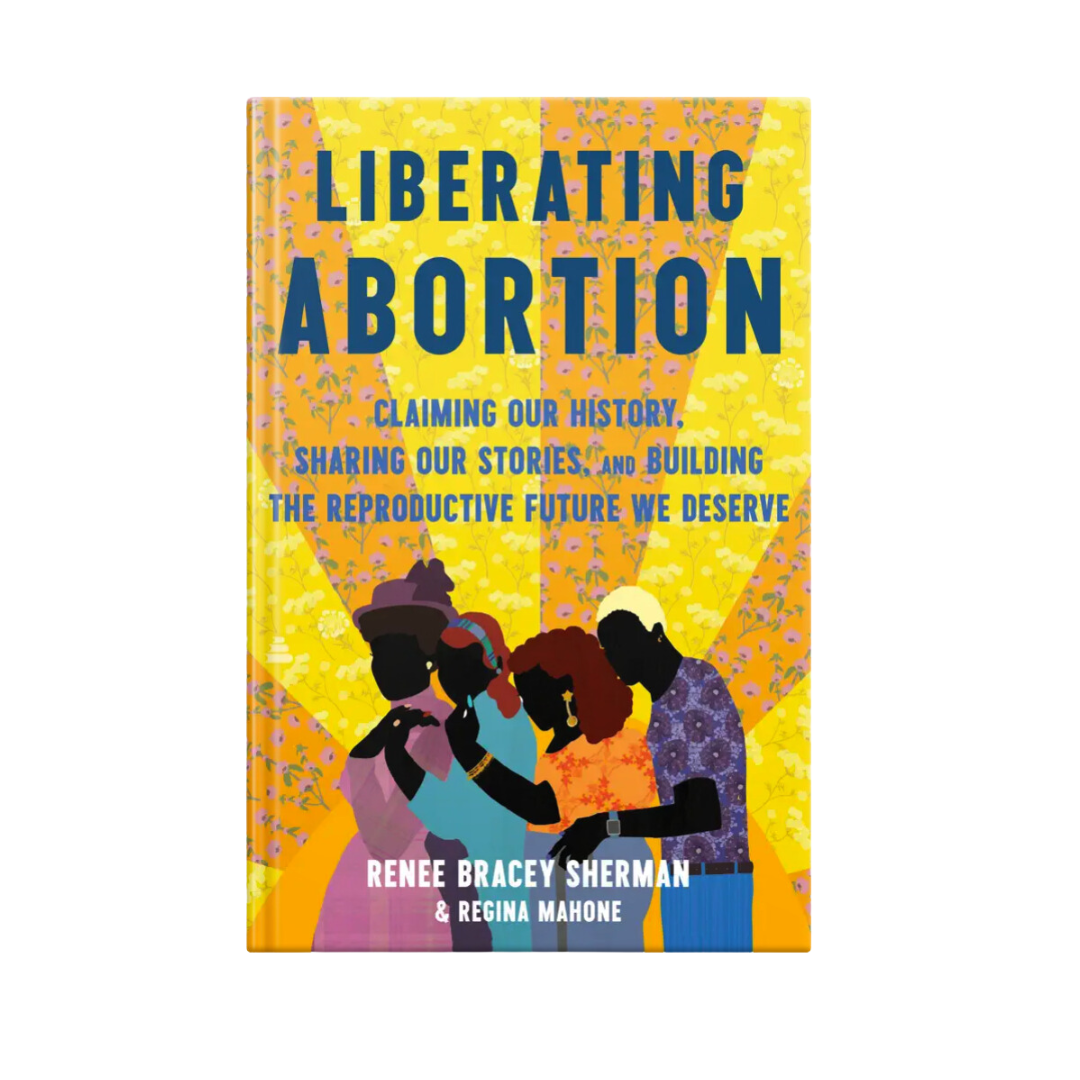
Some of our students already have amazing books ready when they enter our PhD program! This interview features a conversation with Renee, in which we discuss her work, experiences, and perspectives in her own words. Renee Bracey Sherman (she/her) is part of our cohort in the PhD program in Communication, and the author of Liberating Abortion: Claiming Our History, Sharing Our Stories, and Building the Reproductive Future We Deserve with Regina Mahone, senior editor at The Nation; previously, Renee ran an organization called We Testify for abortion storytellers.
The transcript below captures the flow of our discussion and highlights key moments from our conversation.
———
Eunice Kim (EK): Hi, Renee. Thank you so much for your time. It’s amazing to be able to talk to you about your book. Go ahead and introduce yourself!
Renee Bracey Sherman (RBS): Hi, my name is Renee Bracey Sherman, she/her. I wrote Liberating Abortion: Claiming Our History, Sharing Our Stories, and Building the Reproductive Future We Deserve with Regina Mahone, senior editor at The Nation. The book builds on my 15 years of work with people who have abortions—especially people of color—and the histories and systems shaping reproductive injustice, white supremacy, and capitalism. For 10 years, I ran We Testify, an organization for abortion storytellers. I’ve contributed to other books, to the documentary Ours to Tell, and now I’m excited to be in a PhD program.
EK: Amazing~ So, your book brings in historical struggles for abortion rights. How did you decide which histories to highlight, and what can today’s movements learn from them?
RBS: When we started writing, we were drawn to this idea of unearthing and re-sharing the stories of people of color histories. We’d read lots of abortion histories, but many ignored people of color or mentioned them briefly, as if Black and Brown people weren’t having or providing abortions before the 1960s. But we know Black and Brown people are in the past, present, and future, and we’ve always cared for ourselves. We narrowed our focus that way, but there was so much to include, which is why the book is as long as it is.
We wanted every marginalized community to see itself somewhere, whether in ancient practices or recent movements, so readers could say, “There’s a lineage of my people caring for one another and ensuring access to abortion care.”
We also wanted to show how white supremacy, migration, enslavement, and genocide shifted relationships to pregnancy, reproduction, abortion, and health. It was difficult to sort through, but exciting, but exciting, and we were allowed to keep writing to include as much as we could.
EK: Yes! And I loved flipping through it. I struggle with design, but the mixed forms, visuals, and the bolded page numbers—I recommend everyone buy this book.
RBS: I love that you brought up the design because we thought about it deeply. I love reading, but I struggled in school because I’m a visual learner and learn by discussion. I think what’s beautiful about delving into history is when we learn from it to understand the future. We wanted visuals to bring the past to life.
One example is the 100-year-old typed note from a conversation with Margaret Sanger about the Negro Project. She’s complicated and often misrepresented, especially by the anti-abortion movement. Rather than just tell you my interpretation, we included the document so people can read it themselves. That transparency felt important: here’s my perspective, now you can see the source too.
We also included photos of Black and Brown folks protesting for abortion access because we wanted people to be in the moment and to see images not typically shown, and history is often presented as white women, white feminists protesting. The history is there; you have to find it and show it, or else you create a narrative by showing only one part. History is fun and creative, and we deserve beautiful history books with illustrations and photos. Some photos I took myself like me holding abortion herbs in Colombia. Readers deserve to see what they’re being told about.
EK: Most definitely! Much like the images that you incorporated throughout your book another central part of your book is storytelling. What do you see as the value of storytelling in shaping abortion rights and advocacy? And how do visuals support that?
RBS: I’ve been thinking a lot about this. In my graduate assistantship with Professor Rohan Grover’s, we read about epistemic injustice and testimonial justice—what counts as knowledge and expertise. In so many of our communities, information is passed by word of mouth. But white supremacy prioritizes only written knowledge and devalues oral histories. In Professor Chelsea Bukowski’s Advanced Methods class, we read Robin Wall Kimmerer on different ways of knowing, and that resonated deeply.
Stories let us share, teach, and connect. They move people differently than data does, especially now in an era of surveillance, where stories can be harder to track and easier to pass along. I started in abortion storytelling because for so long, people weren’t encouraged to share their abortion stories. Telling a story is an act of resistance, power, and art.
EK: Yes. And we talk about that a lot in class how lived experiences are data.
RBS: Exactly. Data areis important, but not at the expense of what we know in our bones, in our ancestors, in our communities. White supremacy tells us those forms of knowledge don’t matter. Our book shows that this knowledge exists across thousands of years. When it’s stolen, it takes generations to reclaim. In times of crisis, we turn to those who hold this knowledge. That’s power.
EK: You’re known as the “Beyoncé of abortion storytelling.” And, I noticed nods to Beyoncé in the book. Like the chapter titled “Feeling Ourselves.” Beyoncé uses personal and political storytelling in her art. As the Beyoncé of abortion storytelling, what do you hope readers take from that weaving of culture, politics, and narrative?
RBS: She is such a master. Beyoncé makes you want to release the wiggle, while teaching you about culture—particularly Black origins. She researches deeply, brings different people into her work, and references Black cultural roots while creating new stories. That sparked so much of my creativity while writing—her albums, and Solange’s too.
The nickname started as a joke, someone said, “Be the Beyoncé of what you do.” Then another storyteller called me the Beyoncé of abortion storytelling. Then someone introduced me that way at a panel. Then outlets like Harper’s Bazaar used it. It stuck. But beyond fandom, it speaks to showing up fully, sharing knowledge widely, and modeling creativity.
I think of this book as a kind of “APESH*T” music video moment when Beyoncé and Jay-Z were filming in the Louvre, placing Black bodies in spaces that historically excluded us. Our book says: here is abortion history—it is ours. Here’s where we are, even as they try to erase us. These are the places we’ve made change.
EK: And, what do you hope readers, especially young people, take with them after finishing your book?
RBS: There’s a lot in the book: abortion on screen, ancient medicine, reproductive justice, sexuality and pleasure. I hope people find at least one chapter that speaks to them and opens something up in them. Maybe you love gardening and learn about abortifacients. Maybe you’re nervous about masturbation and see its connection to liberation. Maybe you’ve had an abortion and want stories like yours. Maybe you want to learn about your cultural lineage—Taíno traditions, ancient Chinese medicine, Egypt.
Mostly, I want readers to feel connected to ancestors who fought for reproductive freedom. This is generational work. We’re carrying the torch forward.
EK: Thank you so much again! I really appreciate your time.