
Building DC’s Iconic Buildings: Capitol & White House:
When George Washington and Thomas Jefferson set out to build the nation’s Capital, they did so without considering the challenge of the task. These men embarked on this project without a clear source of funding. Washington’s plan also included the appointment of three enslavers as the city’s first commissioners and those commissioners turned to slave labor to carry out these plans. These choices made the construction of D.C. heavily dependent on slavery. Despite this, there is only one existing account of enslaved labor on the Capitol, written by a Polish tourist visiting the city. Putting social class above training and experience resulted in years of inadequate work that was left to the hands of free and enslaved laborers to fix.
“Temple of Liberty,” the United States Capitol, was built by enslaved people who were “rented” from their enslavers. Renting enslaved individuals was a common practice in the Potomac area. Black enslaved laborers worked alongside freed Black laborers in trades like masonry, roofing, plastering, carpentry, glazing, and painting, while the activity of sawing was reserved exclusively for enslaved people. Like its exterior façade, the White House’s history has been white washed, and the stories of those who were enslaved in the White House have gone ignored and largely forgotten. Enslaved labor was used in both the construction of the White House and in its day-to-day operations under the first twelve of fourteen presidents. To this day, there are no monuments or memorials dedicated to the freed and enslaved Black people that constructed the United States Capitol, the White House, or the National Mall.
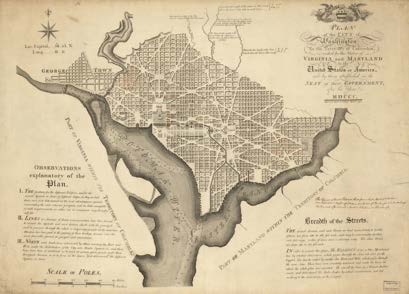
Thackara & Valance, Plan of the City of Washington in the Territory of Columbia; 1792; cloth, leather, ink

Peter Waddell; A Vision Takes Form: The White House Under Construction, 1796; 2007; Oil on canvas
Benjamin Latrobe; The White House (“President’s House”) Washington, D.C. South front elevation; watercolor, wash, ink; 1817
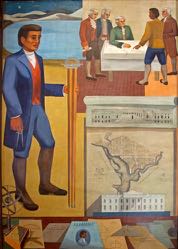
Maxime Seelbinder, Benjamin Banneker: Surveyor- Inventor- Astronomer, at the Recorder of Deeds building, built in 1943. 515 D. St., NW, Washington, D.C., 2010.
Maxime Seelbinder’s mural commemorates Benjamin Banneker. As an astronomer and mathematician, Banneker was approached by the abolitionist Andrew Ellicott to survey the land of what would be the U.S. Capital. Due to his experience, Banneker used mathematical calculations to establish boundary points for the District of Columbia and contributed to the design of the federal city in significant ways. This mural depicts Banneker as an author through the inclusion of Banneker’s Almanac, as a skilled architect through the early plan for the city of Washington, and, most importantly, as an equal. Standing around four white men, Banneker is positioned at the foreground of the composition showcasing his intellect. Banneker’s participation in the construction of Washington, D.C. directly challenged the existing racial hierarchy.
Emancipation & Black Abolitionists
Throughout the country, the fact that slavery was occuring in the United States’ Capital city was highly debated. How could the Capital of the Union also support slavery? On April 16th, 1862, the District of Columbia Compensated Emancipation Act, originally sponsored by senator Henry Wilson from Massachusetts, became law. The law freed almost 3,000 enslaved individuals by paying their enslavers $300 per enslaved person. Despite the emancipation of enslaved people in Washington, D.C., Virginia and Maryland both remained slave states. Victims of slavery were still being transported though D.C. and slaves were sold on the district borders. Enslavers were so determined to keep slavery alive in the district that formerly enslaved Black citizens from D.C. were kidnapped, transferred out of D.C., and sold. Only a year after D.C.’s emancipation, on January 1, 1863, President Lincoln signed the Emancipation Proclamation during the third year of the bloody Civil War. The Union needed soldiers, and freed slaves’ labor could be used to fight against the Confederacy. The thirteenth amendment to the Constitution assured freedom for all for current and future states, while the fifteenth amendment allowed men of color to vote. Emancipation brought the hope for equality and equity, but unfortunately no reparations to this day have been paid to the ancestors of the Black men and women who helped construct D.C. and the United States.
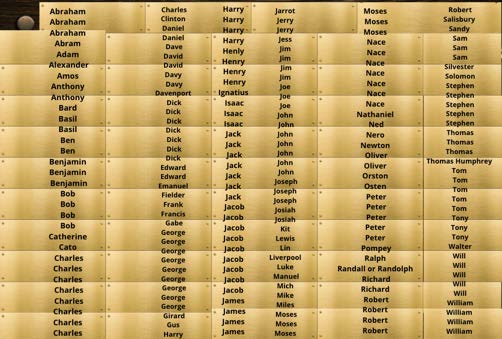
Index of Enslaved Laborers associated with the construction of the White House and the Capitol Building:
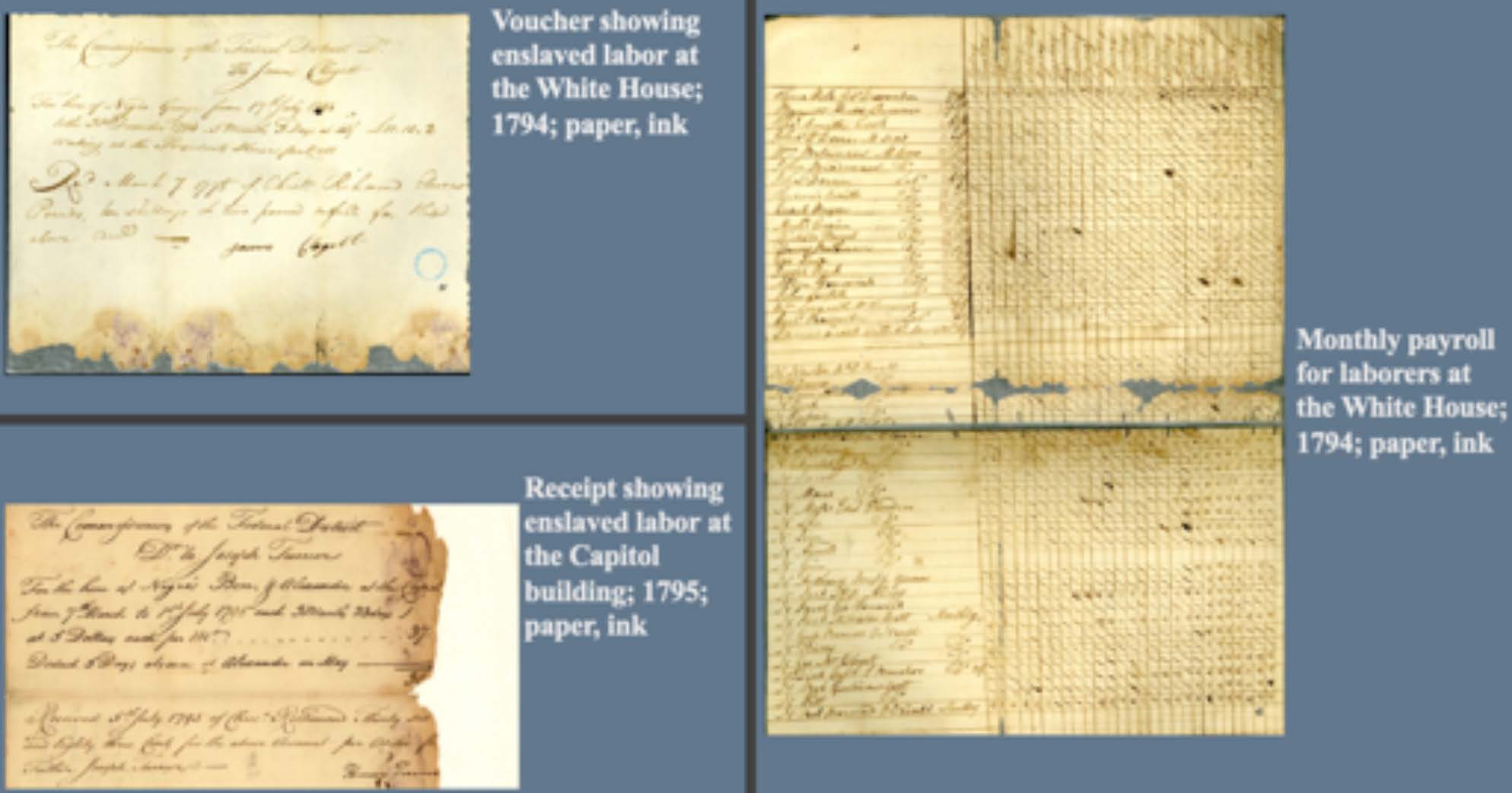
Research conducted by historian Bob Arnebeck provides us with the names of at least 201 enslaved laborers that worked on the construction of the Capitol, the White House, and the Federal City itself. When construction began, Capitol Hill as we know it today was a wooded area. Pierre L’Enfant, the man tasked with designing the city, used these men to clear the sites for both the Capitol and the White House. These men were kept on site to further assist in carpentry, masonry, brickmaking, stone-cutting, plastering, and painting. These jobs required a great amount of skill and incredible endurance. These men worked six days a week, from sun-up to sun-down, a routine which undoubtedly took a toll both mentally and physically. For years, this work went without any compensation or recognition. Although this history of exploitation cannot be undone, it is our duty to learn their names and acknowledge their role in the creation of our nation’s capital.
Collection of Labor Documents, 1794-1795, Paper, ink
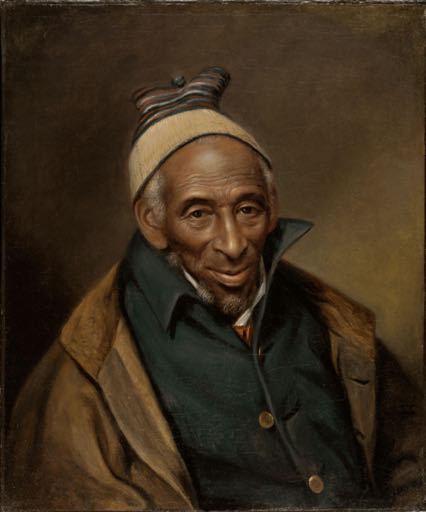
Charles Wilson Peale, Yarrow Mamout (Mamadou Yarrow), 1819, Oil on canvas

Joseph Trammel, Tin box handmade and carried by Joseph Trammell to hold freedom papers, 1852, Tin.
After an enslaved person was set free at the will of their enslavers, a certificate was given to the freed individual to prove their new status as a legal free person of color. The document includes an extremely detailed description of Trammell’s physical appearance to identify him. Freedom papers became family relics to individuals who were once enslaved; the importance of such papers can be seen in the handmade tin box made to hold Joseph Trammell’s papers. Most likely, Trammel kept the box in his pocket as a way to identify himself and to protect himself against people who would question his status.
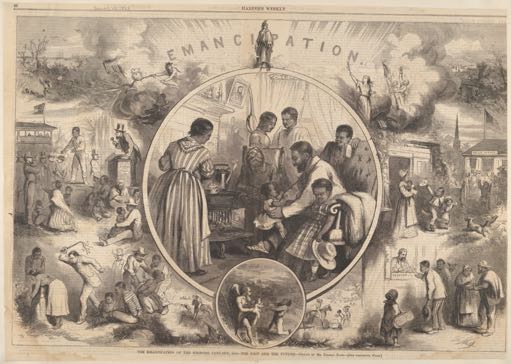
Thomas Nast; Emancipation of the Negroes - The Past and the Future, from Harper's Weekly; 1863; Wood engraving
Famous cartoonist and Harper’s Weekly illustrator, Thomas Nast’s, depiction of the Emancipation of the Negros – The Past and The Future shows the horrors of slavery, but also depicts the hope of familial prosperity emancipation could bring. The two-page spread depicts multiple generations of African Americans, young and old, embracing one another after manumission. However, emancipation did not and could not amend the trauma inflicted upon generations of Black Americans or prevent the racist legacy of slavery from being enshrined within American society.