Posts in Category: SISOlson
Meeting with Professor Hardig
I met with Professor Hardig on Wednesday, April 4th for about 15 minutes to discuss the analysis section of my research paper. Beyond struggling with structural issues, I was mostly concerned that I simply had not done enough research. I felt that there was so much more information out there that was fundamental and important to my research that I had not yet had the time to explore. Professor Hardig, after looking over my analysis briefly, assured me that this is the plight of all researchers and academics, and that rather than focusing on the breadth of research I was able to compile in a semester, I focus on organizing and working through the research I did have.
Research Portfolio Post 5: Grappling with the Division of the Sciences
Bacon’s distinction between the spheres of science and those of ethics, religion, and morality takes on a very religious tone. Unlike Nietzsche’s blatant disregard for religion, Bacon acknowledges the significance of religion and cautiously warns against turning away from God and creating one’s own laws.[1] Though knowledge of moral dilemmas such as that between good and evil are God’s alone, Bacon recognizes the importance of cultivating human knowledge in order to improve the human condition and life and conduct charity.[2] The divide, for Bacon, is a divide between the knowledge that humans can obtain through the scientific method and that which humans can obtain through religion.
Although at some point the goal of science may have been to pave the path toward art and nature and God, according to Weber, this is no longer the case.[3] Science cannot, by its very nature, lead us to God.[4] Science cannot give us the answers to the moral questions and those questions concerning the meaning of life. Weber states quite explicitly that the spheres of science and the spheres of “the holy” are unbridgeable, and that such spheres, or gods, will be in constant battle with one another.[5] Weber writes that humans can tackle the scientific questions that demand to be answered in our physical, present world, but that the questions of true value, that seek to explain the human condition and life, cannot be answered through the scientific method. Science inherently does not take on normative inquiry. Though science can do some things, such as offer power, methods, and clarity, it cannot do all things and therefore is limited in its scope.
Both Bacon and Weber believe that knowledge is attainable in some form, though they acknowledge that not all knowledge can be attained through science alone, and that some simply belongs to God. Thus, they accept some moral facts and religious claims as true and objective and beyond human manipulation. In this respect, the divide offers the ability to pursue research using scientific methods from the standpoint of normative claims which themselves do not require scientific proof. Thus, we are able to situate our projects within specific moral spheres. The divide is also useful in that we are not required to recreate the world according to our own desires and morals as Nietzsche may desire. In my own project, I take on many normative assumptions such as the value of protecting minority rights, the importance of democratic societies, and the need to have positive societal behaviors among groups. Without the divide, such as in a Nietzschian world, such assumptions would have to be verified and created on my own accord.
[1] Francis Bacon, “The Great Renewal,” in The New Organon, n.d, 12.
[2] Ibid., 13.
[3] Max Weber, Science as a Vocation, n.d, 6.
[4] Ibid.
[5] Ibid., 11.
Meeting with Professor Field
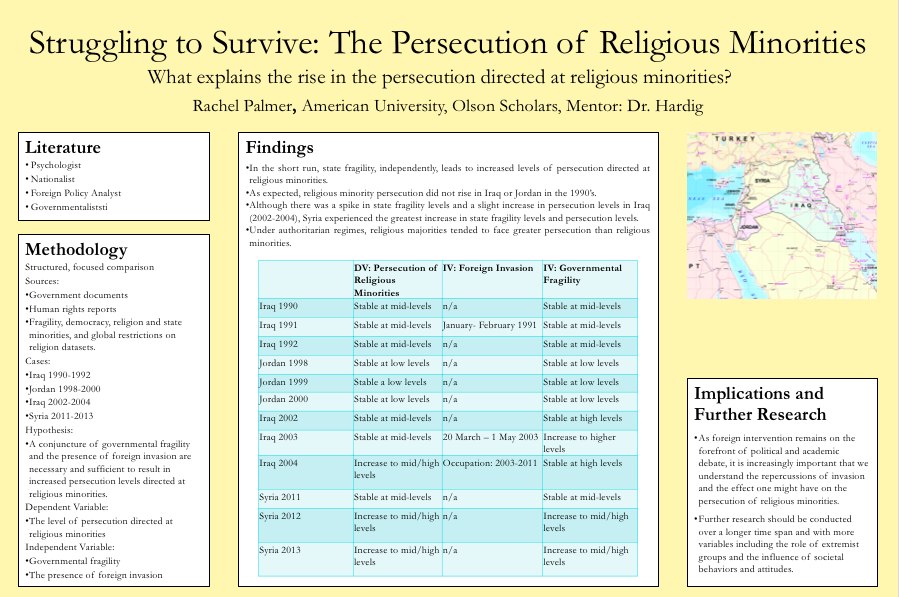
I met with Professor Field on February 23rd for about thirty minutes. I was still grappling with my case selection. I had followed Professor Hardig’s advice and researched cases where there was increased persecution and where there was not. My cases, though, were all over the world and, as Professor Field noted, it would be very hard to justify such case selection without it looking like I simply cherry picked the results I wanted. She suggested that I focus my cases regionally in order to control for other variables. Since my original focus was in the Middle East, she suggested I focus there, with about four cases that had different outcomes on the dependent variable. She also noted the importance of the minority group I was proposing to research, as persecution levels could differ between ethnic or religious minorities. I ultimately decided to focus only on religious minorities so as to control for variance among the persecution of different groups. She really helped to me outline my project, what I was hoping to achieve with my research, and all the factors that I had to control for, or at the very least, note in my research.
RPP 2: Culture, Politics, and Science
Plato and Tocqueville, in their writings on democracy and freedom of thought under such government, argue that democratic citizens rarely, if ever, question the underpinnings of their own values and morals. Plato argues that people tend to live their lives in accordance with the structure that has been established; thus, if we are born in democratic societies we will hold the same values of them without question, as that is what is held by the multitude. The very foundation of democracy, equality, applies to more than humans themselves, but the values and ideals they hold as well. All values are honored on equal footing with one another.[1]
Tocqueville’s argument follows a similar line of thought. In the democracy, there is no permanent leader or class for the majority to follow and believe, rather there is freedom of thought among people. But such freedom inclines us to submit ourselves to the will of the majority. For how could most people believe in something and it be wrong? Tocqueville acknowledges that we cannot justify every truth in which we believe. Even the best philosophers have neither the time nor the mental capability to justify every truth. Thus, it is only natural to hold some truths as true merely because that is what the majority of the people around one says. Tocqueville specifically highlights the importance of religion, Christianity being the foundation of American society, as the basis of what we believe. Religious values are rarely, if ever, questioned, held to such high moral standard that triumphs over society.[2]
Both Plato and Tocqueville highlight that democracy, rather than expanding human thought and breaking the chains that aristocratic or authoritarian rule may have imposed on it, limit the ability of people to make normative or ethical arguments. Each philosopher’s thoughts are very similar to those of Dr. Johnson. Using “lazy relativism” we are able to discuss values and morals without ever really doing so; values are values because that is what democratic society tells us and if we disagree, it is still a democracy and we can agree to disagree.[3]
Most people in America understand that they hold a certain set of values, but they do not necessarily understand why and thus, are at a loss to defend the things in which they believe. I think Christians are particularly guilty of this. Arguments tend to stop at the “word of God,” regardless of how outdated or unethical they may seem. Christians often fall into the trap of plucking a verse from the old testament or simply following the rules of the church without critically understanding those values or their real origins. Christians simply absorb values from their group, much like Americans in the democratic society of which Tocqueville speaks. Questioning normative assumptions of the church can lead to great backlash, much like questioning the assumptions of the democratic, American society. Much like the multitude, or popular opinion, trap that Tocqueville mentions, many Christians blindly follow the church without understanding the normative implications of their beliefs.
[1] Plato, Republic: On the Character of Democracy and Democrats, n.d.
[2] Tocqueville, Democracy in America, 1st ed., vol. 2 (Mansfield and Winthrop, 2000).
[3] “Lazy Relativism,” n.d., accessed February 7, 2018, http://www.readmorewritemorethinkmorebemore.com/2009/11/lazy-relativism.html.
Mentor Meeting 1/31
I met with my mentor, Professor Hardig, on January 31st for about fifteen minutes. He read over my introduction draft and was especially impressed with the organization of it. For the most part, he thought I was making a solid start with my research. He did, though, have a suggestion regarding my case studies. Originally, I had planned to do a case comparison between Iraq before the US invasion and then Iraq after the US invasion, researching the change in the level of persecution directed at religious minorities as a result of this invasion. Professor Hardig suggested that rather than having Iraq as my case studies, I research other instances of foreign intervention that may or may not have led to increased persecution levels. Thus, instances of foreign intervention would become my cases. He suggested looking at a minimum of three cases, perhaps after the Cold War, and using the presence (or absence) of some of my intervening variables to assist in my case selection. This would change my research somewhat, but I agree with professor Hardig that such research would be more meaningful than simply researching the cases in Iraq. I hope that by our next meeting I will have expanded on my literature review and selected my cases.
RPP 1: Exploring Motivations and Assumptions
I have chosen to research the persecution of religious minorities in Iraq, particularly the persecution directed at the minority Christian groups, for a number of reasons. My interest in Iraq stems from my great interest in the Arab World, and my desire to understand this a complicated region. With my language focus being Arabic and my regional focus being the Middle East, I wanted to direct my research project at understanding at least one of the complexities present in the region. Iraq proves to be an interesting case for me as much of my research revolves around the role my own home country played in the increased persecution levels. The case of Iraq also proves particularly important as the US continues to intervene, or in some cases, refrains from intervening, in foreign affairs. I was particularly interested in the persecution directed at Christians in the country as I am Christian myself and have a great interest in studying the plight of Christians abroad, but I also think it would be valuable to research the persecution directed at all religious minorities. Researching various minority groups will allow me to broaden my research while still focusing on Iraq and give me a greater understanding of persecution levels across the country as a whole as levels may vary from group to group. Such interests and beliefs have led to my desire to research this puzzle.
In order to really understand the two cases, levels of persecution in Iraq before the US invasion and levels after the invasion, I have chosen to do a small n case study comparison. Although there are certain tradeoffs associated with this choice such as my inability to generalize the findings of my research and being unable to look at the discourse of certain actors, the small n case study comparison is the best tool for me to deeply understand these two cases and show the causal mechanisms that led to this specific outcome. Using a typology is especially important to my research as these two cases present an array of variables that have led to increased persecution levels. A typology will allow me to analyze each of them.
My research does contain certain normative assumptions, and is directed at some “good” that may not be universally held.[1] My research assumes that peace is a good thing and that minority rights should be protected. It assumes that the persecution occurring in Iraq is in violation of certain human rights. Though the assumption of the goodness of peace and human rights could be disputed in a world with no moral truths, I hope my research will recognize the normative assumptions I make in my research and highlight the real “truth” that exists in these assumptions.[2]
[1] Aristotle’s Nicomachean Ethics (Chicago and London: The University of Chicago Press, n.d.).
[2] Ibid.; Justin P. McBrayer, “Why Our Children Don’t Think There Are Moral Facts,” The New York Times, March 2, 2015.
Research Portfolio Post #10: Mentor Meeting
I met with Professor Hardig this morning, December 8, for 25 minutes from 10:05 to 10:30. I discussed with him my decision to select the interpretivist methodology for my research project. Originally, I thought I would research discourse on how the Bush Administration constructed their role of morality and security on the Iraq War before it began. I was specifically interested in the years between 9/11 and the start of the war, focusing on government discourses and how the Bush Administration perceived their role in the world.
Professor Hardig suggested I research discourse of the Bush Administration after the war on the reconstruction and rebuilding process, and how the US government constructed the identities of Iraqis and defined sectarian dynamics in Iraq. He mentioned how identity politics are formed, as they are not a naturally occurring phenomenon, and compared this to his own work in Lebanon. Dictators, like Saddam, are often seen as the lid over which sectarian violence is boiling, yet Professor Hardig argues such sectarian divisions are created, not naturally formed. Thus, I could research the discourse of the Bush Administration on sectarian divisions and violence of Iraqis.
Looking ahead, I need to more clearly define what discourses I will analyzing within the Bush Administration. There is the puzzle of why sectarian violence happens after an intervention and the removal and powerful dictator, but what explains this and how can the discourse of the US government shed light on how such identities are formed? I will need to read quite a bit more, although the discourse of the Iraqis themselves may be hard to research as I would be unable to understand the subtleties in the language. Though it may not be required to read over winter break, it would probably be a good idea to continue reading and cementing my methodology.
As I look ahead to SISU-306 I am concerned about formatting my methodology correctly and researching enough discourse while remaining reflexive to my own position.
Research Portfolio Post #9: Qualitative Data Sources for Interpretivist Research
I will be researching the discourse of the Bush Administration on how the administration perceived their role in the world: as freedom fighters, protectors and promoters of democracy. When discussing the war in Iraq, US government officials highlighted the geopolitical scene, the crimes of the Saddam regime, the War on Terror and retaliation for the 9/11 attacks, and the threat of weapons of mass destruction. Yet rarely were the Iraqi people factored into war calculations; Iraqi’s were seemingly erased from the war narrative completely. This erasure of identity on behalf of the US government led to a great misunderstanding of Iraqi social and religious dynamics and would ultimately lead to the vast persecution of religious minorities in the country.
Numerous speeches by President Bush highlight this rhetoric. Staples of President Bush’s speeches were mentions of Iraq’s illegal weapons of mass destruction program, Saddam’s link to al Qaeda, and the brutality of the Saddam regime that was oppressing the Iraqi people. In his State of the Union address, President Bush went so far as to describe the torturous methods used by Saddam, ironic given the US’ enhanced interrogation methods at Abu Ghraib. Yet practically no attention was given to the Iraqi people, the religious and social dynamics that shaped Iraq, and the impact a foreign invasion may have on the Iraqi population.
Such discourse by the Bush Administration is indicative of how the US views its own role in the world and such discourse reflected actions taken by the US. In speeches by President Bush, Iraq is seen as a feeble nation that needs the coalition’s help to obtain freedom and democracy. The US is seen as the leader of the free world, leading Iraq out of dictatorship and into a utopia of freedom. Speeches like these can be connected to other speeches within the Bush Administration, to government documents outlining the goals of the invasion, to the discourse of the Iraqi people, to actions taken by the US, and to other writers and scholars of the time.
“Excerpts from the State of the Union Regarding Iraq.” Accessed November 21, 2017. https://georgewbush-whitehouse.archives.gov/news/releases/2003/01/20030128-23.html.
“President Bush Addresses the Nation.” Accessed November 21, 2017. https://georgewbush-whitehouse.archives.gov/news/releases/2003/03/20030319-17.html.
“President Bush: ‘World Can Rise to This Moment.’” Accessed November 21, 2017. https://georgewbush-whitehouse.archives.gov/news/releases/2003/02/20030206-17.html.