Strengthening Ties, Building Trust, and Leveraging Tactics
How “R1 the AU Sociology Way” Partners with Students as Researchers
By Nicole Angotti, Sarah Iverson, and Michelle Newton-Francis
Spring 2026
Sociology at AU functions as a learning community where faculty, graduate students, and undergraduates work together to co-produce cutting-edge knowledge addressing real-world problems. In this article, we reflect on how our department has long achieved R1 productivity within AU’s unique liberal arts heritage. We provide insight into how we have grounded our work in “three Ts”— ties, trust, and tactics — to produce high research output for over a decade while maintaining pedagogical excellence. In our experience, these commitments build community while simultaneously increasing productivity by synchronizing resources. Respectively, we embed the three Ts in our department’s curricular, extracurricular, and research center offerings, creating opportunities for students at different stages of training to co-produce sociological knowledge. Following AU’s 2026 Strategic Plan, we share our experiences as a starting point for other departments and AU centers to “meet our moment” and do R1 in their own way.
Ties Within Curricular Offerings
In our department, students work on research projects over multiple years, which increases their sense of social belonging and campus connection. For example, in our master’s Sociology of Research and Practice (SORP) program, we design research as a shared, sustained experience that connects students to one another, faculty, and the wider discipline. Working in small cohorts, students immerse themselves in collaborative research teams, setting them on paths of publication that they leverage to pursue future research opportunities in PhD programs and the workforce.
By navigating the ups and downs of the research process together, students build resilience and come to see research as a shared experience rather than an isolating task.
This emphasis on collaboration and community building begins in the classroom, where SORP students progress through a sequence of research courses, typically starting with a Social Research Practicum taught by Professor Sarah Iverson. In the Practicum, students design and execute an independent research project in a small, community-oriented classroom. Weekly peer-sharing practices—such as presenting analytical memos or discussing challenges—create an “open book” culture in which students feel equally comfortable troubleshooting obstacles and celebrating progress. By navigating the ups and downs of the research process together, students build resilience and come to see research as a shared experience rather than an isolating task.
Curricular integration is also evident in how our department weaves faculty-led research into course design. Recently, several SORP students worked with Professor Ernesto Castañeda to co-author a published book on narratives from immigrants, asylum seekers, and refugees. Each student authored a chapter of the book in Professor Castañeda’s Interpreting and Presenting Results from Sociological Research course. “My cohort has become a community of lifelong friends, with whom I’ve had the incredible opportunity to collaborate and publish,” as Katheryn Olmos (MA-SORP, ‘26) described the experience. “As a child of immigrants, it has been especially meaningful to be part of a community that conducts research and advocacy around migration.”
Another example is a multi-year research project on the experiences of college students living with endometriosis, led by Professor Michelle Newton-Francis, and supported by an inaugural Deputy Provost and Dean of Faculty Pilot Grant for faculty–student collaboration. The resulting qualitative interview dataset has served as the anchor for our master’s Qualitative Research Methods course. Students collectively shape research questions, develop manuscript outlines, and share their work publicly. Last year, students received the Best Social Sciences Presentation at the Mathias Conference for their project, “Endometriosis: The Crossroads of Healthcare and Internalized Ableism.” In addition, multiple manuscripts have emerged from this collaboration — including a recent journal article on how college students manage their endometrial pain and academics.

(From left to right) Sociology graduate students Montse Hernandez, Mubarak Alabi, Jessica Chaikof, Makenna Lindsay, Adrian Davis, and Professor Michelle Newton-Francis (at podium), presenting at an Eastern Sociological Society conference.
Trust Building Through Extracurricular Opportunities
Working with students outside formal coursework enables our faculty to pursue ambitious research agendas, experiment with innovative projects, and secure funding. This strategy requires trust between students and faculty. We know faculty may find it difficult to hand over the reins of their work to students. But in our experience, building this trust has led to fulfilling outcomes across the department.
For the last two years, Professor Iverson has worked with a team of students to study the impact of the overturn of race-neutral college admissions on how applicants write their college essays. Supported by the Russell Sage Foundation and a Racial Justice Research Seed Grant, our team collects data through interviews with applicants about their college essay writing process. Interviewees responded more candidly when interviewed by other students, so student researchers took the lead in recruiting and collecting data. Holding practice interviews and checking in biweekly created a structure that helped students feel supported and comfortable with the quality of the data collected.
Trusting student researchers to take ownership of the research has enabled our team to execute projects at a greater scale and quality than if we had worked from the top down.
Trusting students to take the lead extends beyond collecting data. One research team member, Sarah Mondesir (BA, Sociology ‘27), noticed that applicants took a different approach to writing essays depending on the type of institution they applied to. “Some of my interviewees mentioned they would tailor their college essays to historically black colleges and universities (HBCUs) where they felt empowered to discuss their racialized experiences,” Mondesir explained. By contrast, when applying to other institutions, “They would revise their personal statement or remove any racial component written in their essay that they felt could be misinterpreted.” While we had not planned to research HBCUs specifically, Mondesir’s insight quickly inspired a co-authored article, which will be presented at the 2026 American Sociological Association conference. Trusting student researchers to take ownership of the research has enabled our team to execute projects at a greater scale and quality than if we had worked from the top down.
Trust also cultivates creative research projects. At the beginning of the COVID-19 pandemic, Professor Nicole Angotti worked with a team of students to study how young adults navigated pandemic-related disruptions to their lives. The students were asked to keep journals of conversations about COVID circulating in their social networks and submit their entries before weekly Zoom team meetings. The students worked together on coding and analyzing the journal data, and manuscript development, which led to a presentation at the 2021 American Sociological Association conference and a co-authored journal article about journaling as a nimble methodological tool for conducting research during a public health crisis that centers the voices of affected populations. Trusting student researchers as participant-observers of their own lives not only empowered them; it also yielded novel data, insights, and outputs that would not have been possible without their openness and collaboration.
Tactical Engagement with Research Centers
Our department has leveraged research centers for myriad strategic purposes. One example is an undergraduate internship program Professor Angotti co-developed as Associate Director of the Center on Health, Risk and Society (CHRS). Although founded in the Sociology department, CHRS serves as an intellectual hub, bringing together scholars from across and beyond AU. To advance faculty research while also providing students with research opportunities, our program paired student interns with CHRS-affiliated AU faculty as research assistants.
We embedded the program within an innovative curricular model. All interns enrolled in the Internship course, which offered them academic credit. We also provided students with a workspace, monthly lunch meetings to discuss progress, and training opportunities (e.g., with social science librarians) and resources (e.g., with software specialists) to augment their research skills. In these ways, we intentionally created intern cohorts to foster connection to CHRS while providing peer support and accountability.
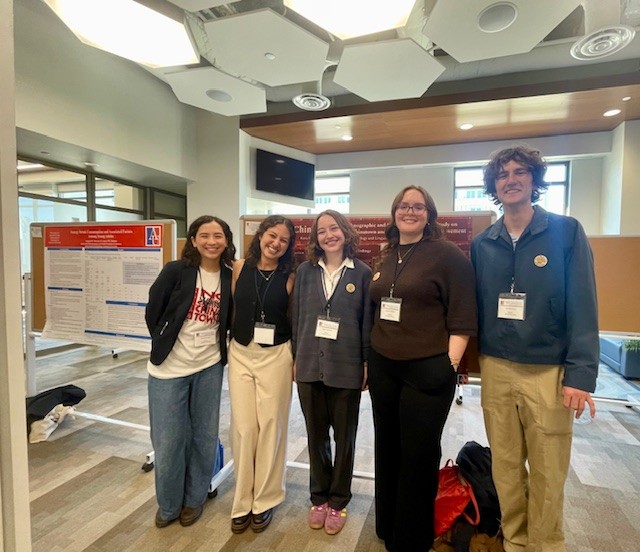
(From left to right) Undergraduate sociology students Kera McCarthy, Sophie Gerson (Undergraduate Poster Winner), Sadie Steinberg, Rachel Traband, and Eli Robinson, with their undergraduate posters at the 2026 CAS Robyn Rafferty Mathias student research conference.
We later developed a new course, Health, Risk, and Society, which we required students interested in a CHRS internship to take. The course, taught by Professor Angotti, was developed in tandem with CHRS’ weekly seminar series, which provided students with a unique opportunity to see how experts apply social science tools to health, equipping them with an academic foundation for the internship. In turn, it provided CHRS with a robust weekly audience for the seminars.
The internship served multiple strategic purposes: it trained undergraduates in research within a cohort tied to an AU center fostering community; offered funded research assistance to faculty with vetted student RAs while building students’ skills and knowledge; and, by requiring interns to enroll in courses, boosted course enrollment while simultaneously supporting CHRS’ signature activities. The CHRS internship program also kept students engaged with our department, with some former CHRS interns continuing their work as RAs with Sociology faculty long after their internship ended.
Conclusion
In our experience, the “three Ts” model has been a practical and strategic way to build community while strengthening the Scholar–Teacher ethos that defines AU as a research-intensive, student-centered university. Ties within curricular offerings build interdepartmental communities, Trust cultivates powerful scholarly collaborations through extracurricular opportunities, and Tactics strategically leverage center resources. We offer our experience in the spirit of shared learning and welcome how others might adapt or build upon them in their own departments and centers to “meet our moment” in their own way.
Author Profiles
Nicole Angotti, PhD, is an Associate Professor in the Sociology Department, Associate Director of the Center on Health, Risk, and Society, and Faculty Associate for research/grant writing with the Center for Faculty Excellence. Her research addresses social, cultural, and institutional dimensions of health and well-being. She teaches social research methods and several health-focused sociology courses.
Sarah Iverson, PhD, is an Assistant Professor in the Sociology Department. She teaches both graduate and undergraduate courses on research methods, race, and inequality. Her scholarship seeks to uncover taken-for-granted assumptions about the nature of race, work, and identity to strengthen organizational equity efforts.
Michelle Newton-Francis, PhD, is a Senior Professorial Lecturer and Director of Undergraduate Studies in the Sociology Department. Now in her thirtieth year in higher education, she regularly teaches courses focused on social research methods. Her research lies at the intersection of work, organizations, and embodiment.