

Figure 2. John Martin, Belshazzar’s Feast (half-size copy), 1820, oil on canvas, 80 x 120.7 cm, Yale Center for British Art, New Haven.
In 1821, John Martin exhibited Belshazzar’s Feast (1820; figure 1) at the British Institution’s annual exhibition.[1] This large-scale history painting, Martin’s second work in his trilogy on Mesopotamian themes, depicts a story from the Biblical book of Daniel, chapters 5:1 to 6:1. The painting depicts Belshazzar, King of Babylon and successor to Nebuchadnezzar, holding a grand feast in his palace. This lavish banquet angers God, as Belshazzar serves wine in cups he stole from a sacred Jewish temple. Suddenly, God’s disembodied hand appears in the sky and writes a cryptic death sentence for Belshazzar that only the prophet Daniel, pictured at the center of Martin’s work, can decipher. Martin depicts the moment after God’s hand has disappeared. Belshazzar’s attendants feverishly try to understand God’s words as masses of banquet attendees rush toward the exit. This scene is set in an apocalyptic landscape, with stormy skies brewing above, and a spectacular lightning bolt that would go on to become Martin’s painterly trademark. The picture, which immerses viewers in this dramatic story, met with immediate success amongst the general public. It was visited by so many people that the Institution placed a barrier to protect it from the crowds, and awarded Martin a prize of two hundred guineas for best picture of the year, propelling him to celebrity status.[2] However, the picture’s debut also spelled the demise of Martin’s relationship with the Royal Academy of Arts, then the dominant art institution in Britain.
In this capstone, I argue that Belshazzar’s Feast critiques King George IV by implicitly comparing Britain’s notoriously frivolous reigning monarch to the impious figure depicted in the painting. Such an unflattering comparison tallies with Martin’s well-known hostility to George IV, which stemmed from his connections to Queen Caroline, the King’s estranged wife, whom he had exiled and whose title he had infamously tried to revoke. Moreover, I contend that Martin’s anti-authoritarian statement extended to the Royal Academy (henceforth RA), an elitist institution whose power stemmed from its connection to the Crown, and whose members enjoyed privileges at its annual exhibitions to the detriment of non-members like Martin. In that regard, I take it as significant that Martin chose to exhibit Belshazzar’s Feast at the British Institution (hereafter BI), which, unlike the RA, did not enjoy official royal support. With the exhibition of Belshazzar’s Feast at the BI in 1821, Martin made a definitive break from the Royal Academy, a decision that would ultimately put the artist at the margins of the British canon.
Martin’s place in the public consciousness and scholarly literature has fluctuated since his explosion to fame in the 1820s. During his career, he was phenomenally popular, but also had many detractors: Royal Academicians, art critics, and connoisseurs undermined his success with the public and criticized his painterly techniques. John Ruskin, the foremost British art critic of the period, denigrated Martin as a “workman,” stating that he did not even consider him a painter.[3] By the time of Martin’s death in 1854, his reputation had fizzled out; this decline paralleled the loss of status for history painting, in favor of other genres, such as landscape.[4] It was not until over 70 years later that interest in the artist was reignited with the publication of two major biographies, Mary Pendered’s John Martin, Painter: His Life and Times (1924) and Thomas Balston’s John Martin (1789-1954): His Life and Works (1945). These authors both sought to restore Martin to prominence alongside his more renowned contemporaries John Constable and Joseph Mallord William Turner, and to emphasize his elevated position as Royal History painter to Princess Charlotte.
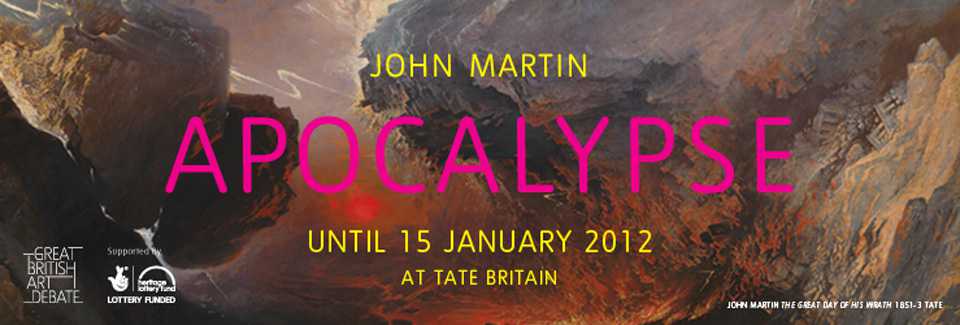
The turn of the 21st century witnessed a scholarly “rediscovery” of Martin that underscored his contributions to British Romanticism, which led museums—most prominently, the Tate—to collect and exhibit his work.[5] After the Tate Modern separated from the Tate Britain in 2000, the latter’s goal was to cultivate a comprehensive view of British art from the 1500s onward, part of which entailed the recovery of underappreciated artists, including Martin.[6] In 2011, the Tate staged the exhibition “John Martin: Apocalypse,” the artist’s first major retrospective, which included the original version of Belshazzar’s Feast, on loan from a private collection. Along with Barbara Morden’s related monograph John Martin: Apocalypse Now! (2010), the exhibition catalogue, edited by Martin Myrone, contextualized Martin’s work and reputation within the socio-political context of Georgian Britain. Both of these texts strive to resuscitate Martin’s career, making a case for the importance and relevance of his “apocalyptic” history paintings to nineteenth century audiences and modern media. Morden focuses on the sublimity of his works in relation to the public’s interest in apocalypse and social upheaval during the first half of the nineteenth century. Relatedly, Myrone argues that Martin’s value as an artist may have been minimized due to his entanglements with both “high” and “low” art. Together, these authors aim to overturn art-historical biases against “popular” artists, works, and genres.
Belshazzar’s Feast plays a key role in Morden’s reading of the way that Martin reinvented history painting by infusing it with the Burkean sublime. She argues that Martin’s biblical subjects resonated with contemporary viewers who vigilantly looked for signs of an apocalypse that they assumed was imminent.[7] This eager awaiting of an apocalypse was rooted in the idea that social upheaval would topple the social and economic elites and benefit the lower classes. Morden posits that the viewing public would have connected the subject of Belshazzar’s Feast to recent events, including George IV’s coronation feast and the famine spurred by the passage of the infamous Corn Laws (1815-1846).[8] Where Morden interprets Belshazzar’s Feast as a protest of the Corn Laws and their impact on the working class, I argue that the painting was intended as a broader critique of George IV and of the power wielded by the Royal Academy. My analysis depends in large part on Martin’s own account of these events in an autobiographical text published in The Illustrated London News in 1849, which illuminates the artist’s attitudes toward the Crown and RA. Morden presumes that viewers would draw connections on their own between Belshazzar’s Feast and George IV; my position, buttressed by Martin’s text and other primary sources, is that the artist himself encouraged such a reading of his painting.[9]
Insofar as it investigates Martin’s relations to the RA and BI, this capstone also adds to the conversation spearheaded by Catherine Roach and Leo Costello on the competitive “ecosystem” of exhibition culture in early nineteenth-century Britain.[10] In his 2016 book J.M.W. Turner and the Subject of History, Costello uses Turner’s behavior at the “Varnishing Days” held just before the opening of Royal Academy exhibitions to consider how the cutthroat atmosphere within the RA mirrored the competition for resources that resulted from Britain’s laissez-faire economic policies.[11] As Costello notes, Turner took advantage of his ability, as a member of the RA, to apply paint to his works after they had been hung in the exhibition: by making a spectacle of himself painting in the galleries, Turner gained in notoriety at the expense of other exhibitors. Roach’s essay, “The Ecosystem of Exhibitions: Venues, Artists, and Audiences in Early Nineteenth-Century London” (2019) builds upon Costello’s insights by tracing several artists’ decisions about where to show their work. Her analysis reveals how the conditions of display influenced the ways artists navigated the complex exhibition system. My analysis is indebted to these scholars’ depictions of the art world as a complex intertwining of artists, art institutions, and the political sphere. John Martin’s choices in navigating a contentious art world broaden our understanding of the consequences of artmaking and exhibition in a highly social and political institutional space.
To clarify Martin’s complex, fraught relationship with the Royal Academy, analysis of both Belshazzar’s Feast and Martin’s choice of exhibition venue are crucial. In sections one and two, I establish the dynamics of the Royal Academy and the British Institution, how they differ and how the Academy could make or break an artist’s career. Martin’s experience with the Royal Academy as a young artist set up the tumultuous relationship that led to the 1821 show, which was the culmination of a decade’s worth of exhausting exhibitions, a growing distaste for the establishment, and social backlash. In section three, I examine the public’s perception of George IV and discuss what we know about Martin’s political attitudes. I then turn back to the painting, showing through visual analysis and historical context that it deliberately compares George IV with Belshazzar. Finally, I suggest that the decline of Martin’s critical reputation was a consequence of this painting’s opposition to the King and the RA, resulting in his exclusion from the canon. Ultimately, my investigation indicates that an artist’s perceived status both during their lifetime and afterward is often a matter of their successful navigation of existing artistic institutions.
[1] The originally exhibited piece was 160 x 249 centimeters. This work is held by a private collection and is rarely shown. When Martin made this large-scale original, he also made two smaller copies. One of which is a half-size copy is held by the Yale Center for British Arts in New Haven, Connecticut (figure 2). The copies are nearly identical, barring some small changes to the figures and to the overall saturation of the work.
[2] Mary L. Pendered, John Martin, Painter: His Life and Times (England: Hurst & Blackett, 1923), 102.
[3] Martin Myrone, ed, John Martin: Apocalypse (London: Tate Pub., 2011),13.
[4] “History Painting,” Tate, Accessed April 26, 2025, https://www.tate.org.uk/art/art-terms/h/history-painting
[3] Laia Anguix-Vilches, “Rediscovering John Martin: Collecting the Apocalypse in Post-War Britain.” Journal of
the History of Collections 36, no. 1 (2024): 180.
[4] “About us,” Tate, Accessed April 2, 2025, https://www.tate.org.uk/about-us.
[5] Barbara C. Morden, John Martin: Apocalypse Now! (Newcastle Upon Tyne: Northumbria University Press, 2010), 38-40.
[6] Morden, John Martin, 29, 39-40; The Corn Laws were trade restrictive laws meant to increase the reliance on domestic food producers. It raised the prices of domestic food which severely negatively affected the working class while increasing profits for the upper class.
[7] Specifically, Gregory Dart and Barbara Morden decenter Martin’s intent and focus on the audience’s associations.
[8] Catherine Roach, “The Ecosystem of Exhibitions: Venues, Artists, and Audiences in Early Nineteenth-Century London “, British Art Studies, Issue 14. https://doi.org/10.17658/issn.2058-5462/issue-14/croach
[9] Leo Costello and J. M. W. Turner. J.M.W. Turner and the Subject of History. Farnham, Surrey, England: Ashgate, 2012.
[10] Catherine Roach, “The Ecosystem of Exhibitions: Venues, Artists, and Audiences in Early Nineteenth-Century London “, British Art Studies, Issue 14. https://doi.org/10.17658/issn.2058-5462/issue-14/croach
[11] Leo Costello and J. M. W. Turner. J.M.W. Turner and the Subject of History. Farnham, Surrey, England: Ashgate, 2012.