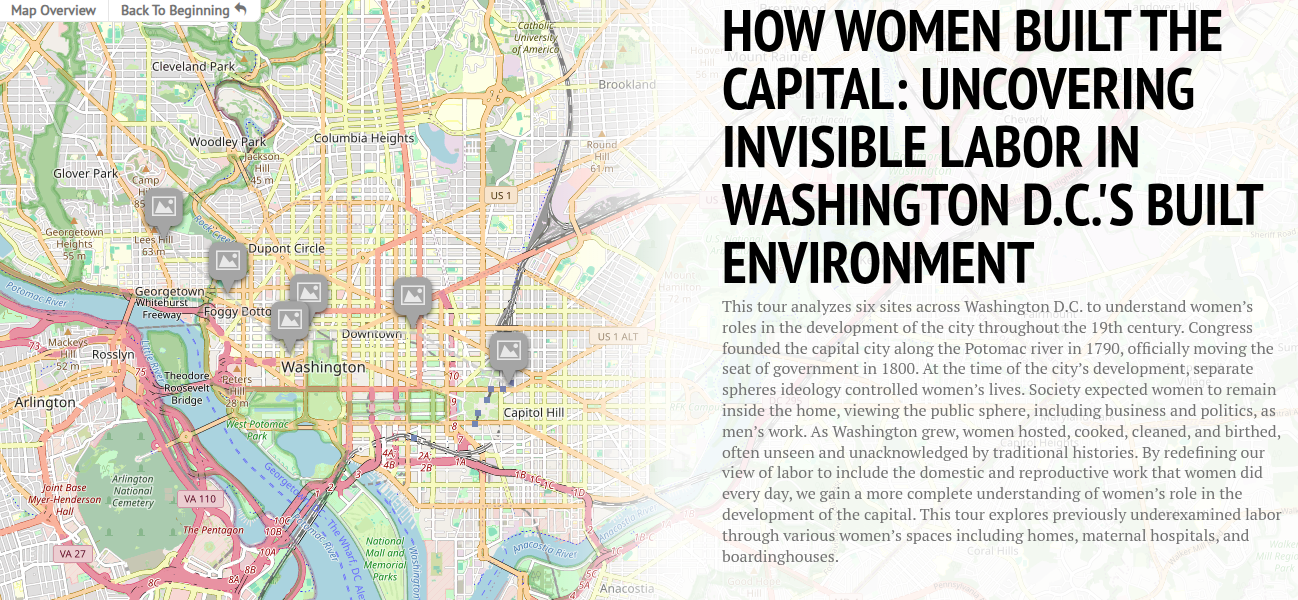
For a summer research project, AU Public History master’s student Meaghan Kelly created How Women Built the Capital, a fascinating tour through Washington, D.C. that introduces us to the women whose work helped build and sustain the capital city. This tour brings long-overlooked women’s labor into view—from raising children and practicing midwifery to running boardinghouses and hosting political gatherings. By tracing this often-invisible work through the places where it occurred, Kelly’s tour illuminates forms of labor that were essential to Washington’s development but have often been overlooked by historians. It also reveals how race, class, and legal status shaped the work women performed, how that work was valued, and whether it was preserved in the historical record. In this special feature, Meaghan Kelly sits down with Prof. Katharina Vester to discuss her work on this innovative tour:
Prof. Vester: What inspired you to create this tour? How does it connect to your interests in the early United States and the history of women’s labor?
Kelly: This tour was a culmination of my research interests after my first year at American. I took Dr. Rymsza-Pawlowska’s D.C. History course in the spring, I loved it so much and was so excited to use what I learned as a jumping off point for this project. My research interests have always been focused on women’s history, but this tour was really inspired by ongoing conversations in my own life about the valuing of domestic labor, traditionally, women’s work. I wanted to apply broader ideas about the work women do to D.C. history to better understand how women were integral to the founding of the capital.
Prof. Vester: Could you give us a brief overview of the tour? Which places and women will visitors encounter along the way?
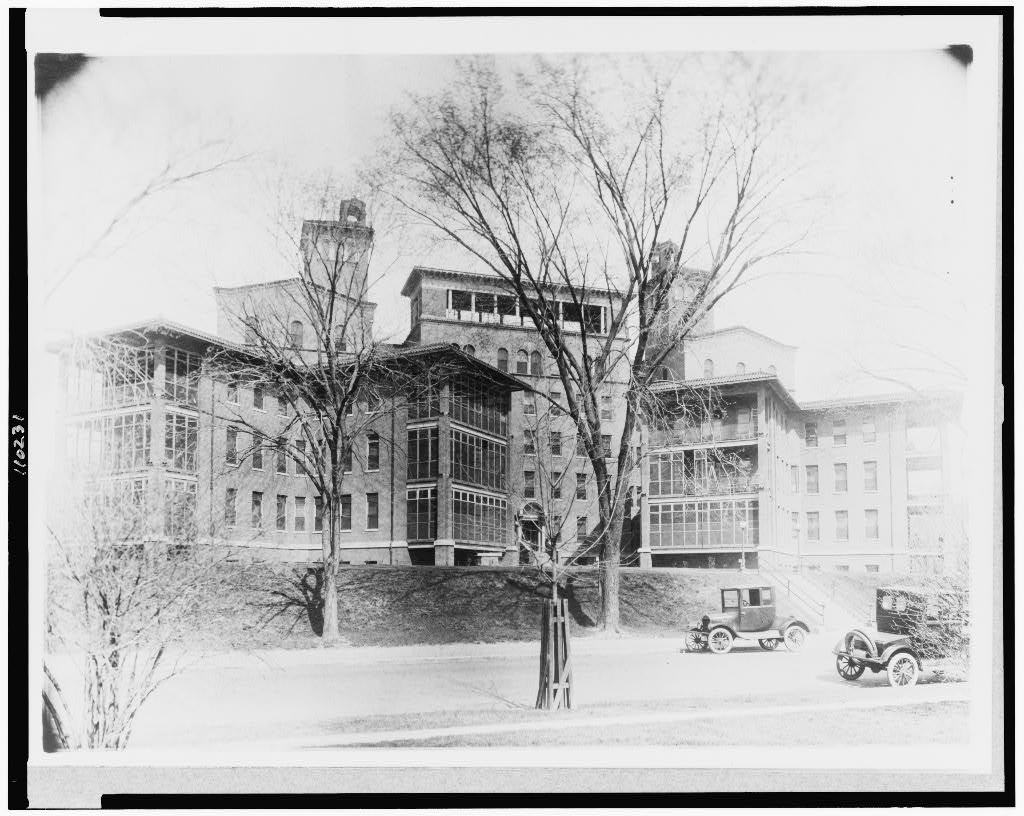
Kelly: The tour begins at Tudor Place in Georgetown with an introduction to D.C. in the early 19th century. It then goes to the former Columbia Hospital for Women, originally opened in 1866; unlike many other hospitals at the time, the Columbia Hospital was racially integrated from its founding and became a leader in maternal and infant medicine. Next are the Octagon House and the Decatur House, two house museums where the tour discusses hosting, politics, and slavery in the heart of the capital. The tour ends with the Mary Surratt Boardinghouse and the Belmont-Paul Women’s Equality National Monument, both exploring women’s experiences in the public sphere. One of my favorite women to learn about in doing research for the tour was Charlotte Dupuy, a woman who was enslaved at Decatur House and sued the man who owned her, Secretary of State Henry Clay, for her freedom.
Prof. Vester: Your tour encourages visitors to think expansively about what counts as labor. Why was it important to include work such as childbirth, child-rearing, household management, and hosting alongside more readily recognized forms of employment?
Kelly: Including domestic work like household management and hosting was necessary to understand women’s lives in early American history. While some women have always worked for wages, every woman did unpaid domestic labor in her home, regardless of her class. I included child-rearing and birth to discuss both the female-dominated jobs that came with each, like nurses and midwives, but to also discuss the labor of motherhood. In my research, I found a messy line between cultural histories exploring motherhood and medical histories of childbirth. This tour allowed me to start to think about these ideas, but I’m eager to do more research on this in the future!
Prof. Vester: What did your research reveal about how women’s labor was understood and valued in early Washington? Were there forms of work that were essential to the city but rarely acknowledged as labor?
Kelly: Enslaved women’s labor was unsurprisingly completely overlooked and devalued. Wealthy families went to great lengths to mask enslaved labor while hosting, hiding doors to servant stairs and building walls around their property to create a barrier between their house and the rest of the city. This labor was without a doubt integral to the growth of the city throughout the 19th century. Women were also involved in politics far before fighting for the right to vote. The wives and daughters of politicians played an important role in their family’s social lives, building alliances through the parties they hosted.
Prof. Vester: The lives of wealthy white women are often much better documented than those of Black women, particularly enslaved women. What challenges did you encounter while researching the lives and labor of enslaved women? What does including their experiences add to our understanding of Washington’s history?
Kelly: I was very lucky that a lot of incredible work has been done on enslaved women in D.C. I read Tamika Nunley’s work the first week of this project and it was foundational. My main struggle while making the tour was finding individual women’s stories to highlight. While every house I included had plenty of information about the elite white women who lived there and I had general information about the lives of enslaved women, it was rare to find exact names and stories. The stories of enslaved women like Charlotte Dupuy are so important for bringing history to life, but weren’t as readily available as the stories of women like Dolley Madison or Mary Surratt.
Click here to access an interactive version of the tour online.