by Osaevbie Samson
On April 8th, the Department of History hosted the annual Brandenburg Lecture and History Awards Ceremony. The awards ceremony honored new inductees to Phi Alpha Theta (the largest history honor society), recipients of the Anna Kasten Nelson Award for Excellence in History, and the two winners of the Dorothy Gondos Beers Scholarship: Julian Weiss and Scarlett Prendergast, who were recognized for their outstanding academic achievements and stellar GPAs. The Brandenburg Lecture is a part of 250+ at American, a campus-wide initiative that recognizes and celebrates 250 years of America through reflection and conversation.
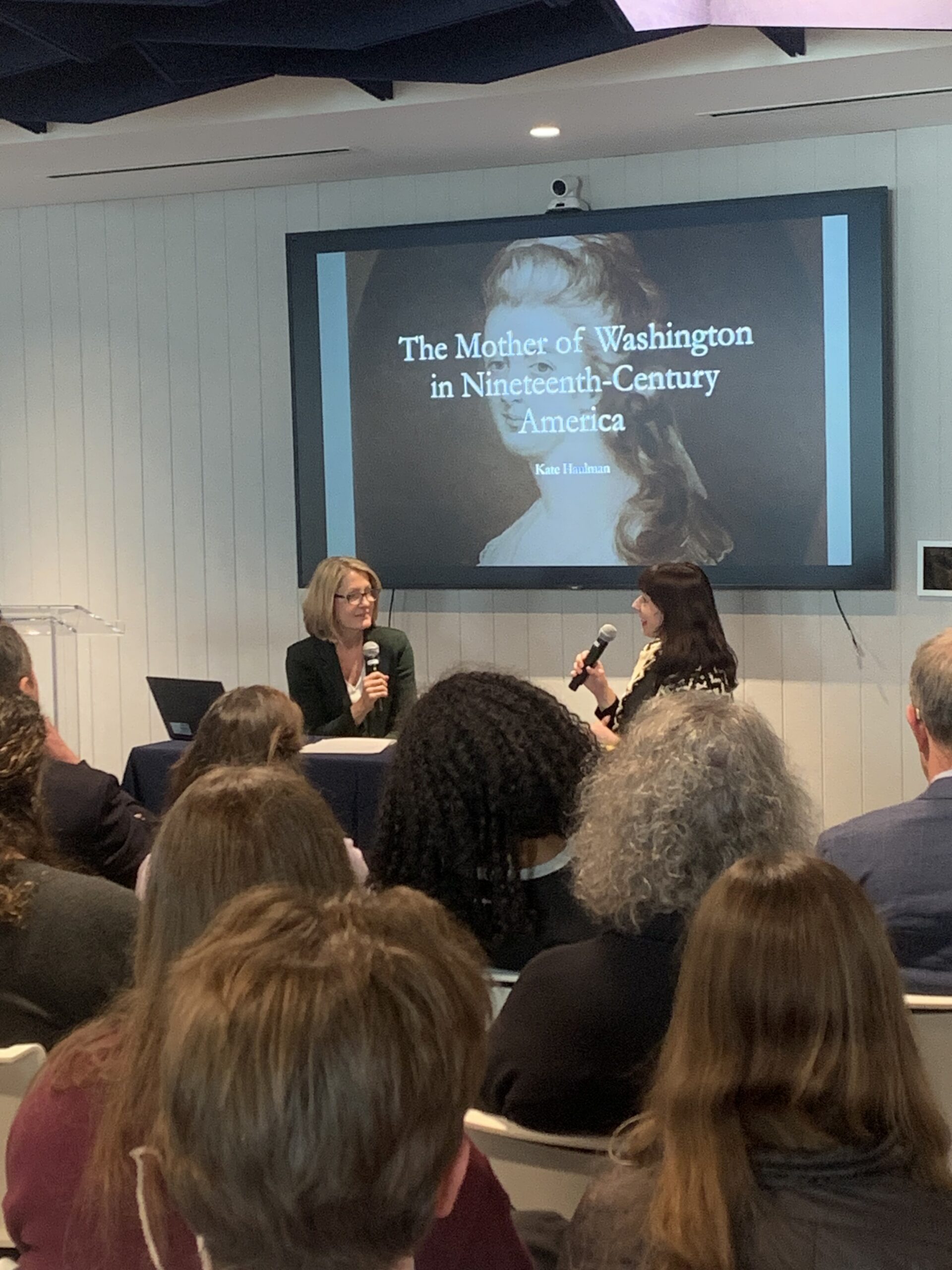
This year’s featured speaker was Kate Haulman, Professor of History at AU, who talked about her most recent book, The Mother of Washington in Nineteenth-Century America (Oxford University Press, 2025). Dr. Haulman’s research focuses on the history of early America, women’s and gender history, and public history. Her first book, The Politics of Fashion in Eighteenth-Century America (University of North Carolina Press, 2011), won the Berkshire Conference First Book Prize. The event also included a conversation with fellow AU history professor M.J. Rymsza-Pawlowska, a public historian of the 19th and 20th century and author of History Comes Alive: Public History and Popular Culture in the 1970s (University of North Carolina Press, 2017). Among the more than fifty attendees were a large number of AU students, whom Dr. Haulman paid tribute to during her opening remarks. “Among those who make this possible, of course, are our students,” she said. “They are really at the heart of what we do here.”

Rymsza-Pawlowska began the conversation that followed Haulman’s engaging presentation with a simple question: “Why Mary Washington?” Haulman explained that she initially considered writing a traditional biography but discovered that two biographies had already been published in recent years, and was also interested in the history of the Mary Washington Monument in Fredericksburg, Virginia. This caused her to move in the direction of how Mary’s story had been told over time, in her public memory. “There isn’t just one Mary Washington,” Haulman noted, pointing out that each version has expressed the cultural and political priorities of some groups in which it was written, reflecting contests over motherhood.
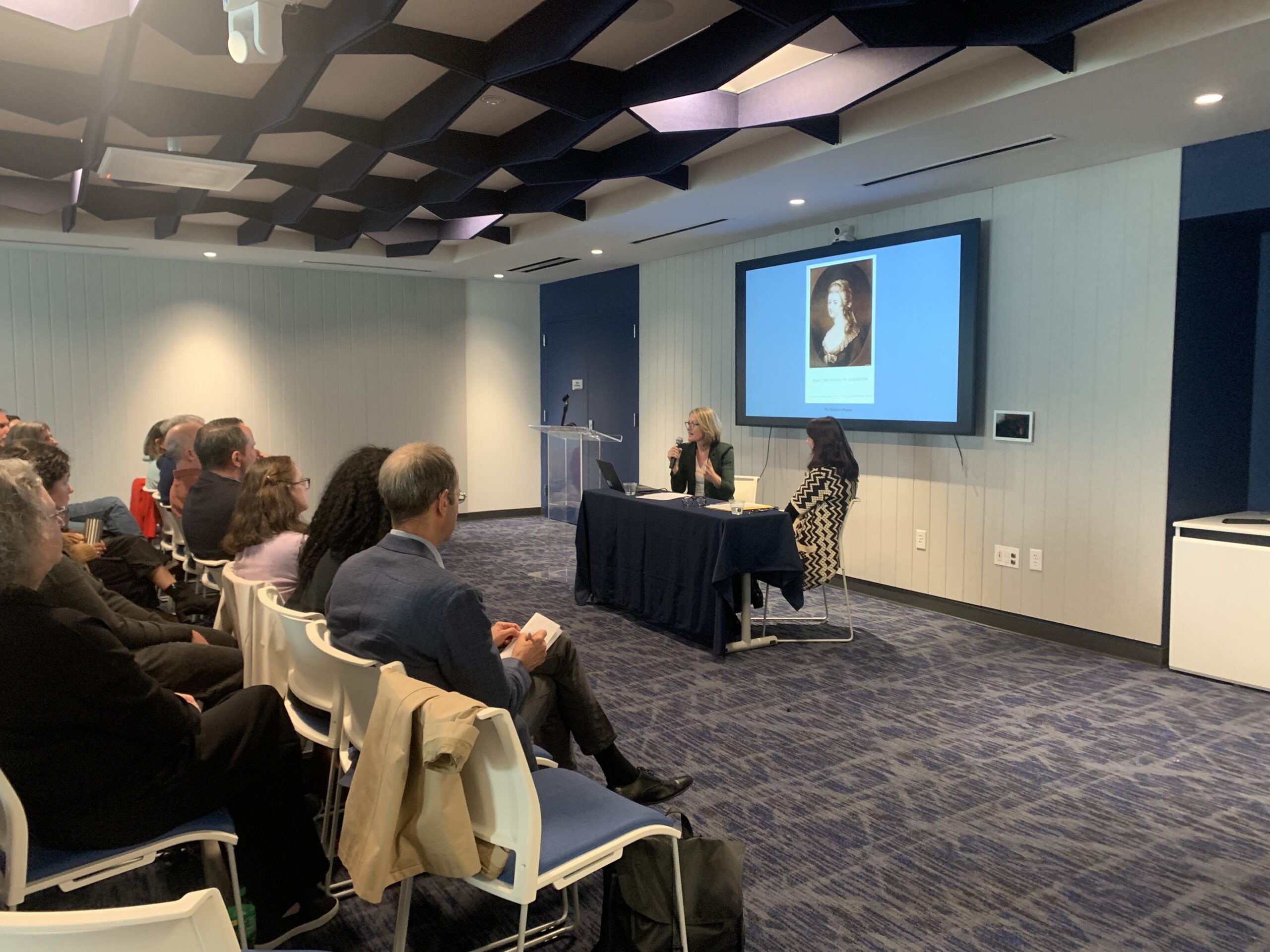
Throughout the conversation, Haulman also highlighted the broader implications of public memory, particularly through monuments and historical storytelling. She explained that monuments are not neutral representations of the past, but that they “reflect the values of the people who build them.” This insight offered a new way of viewing Mary Washington, whose legacy has been shaped by those seeking to define American identity, in part through certain visions and versions of motherhood. The discussion brought out the importance of questioning dominant historical narratives and recognizing the role of interpretation in our understanding of the past, challenging audiences to reconsider how and by whom history itself is constructed.
– Osaevbie Samson is a student communications assistant for the department and a freshman studying Political Science and Public Relations & Strategic Communications