Happy semiquincentennial! This week, as you just might have heard, the United States celebrates 250 years since its founding. On July 2, 1776, the Second Continental Congress passed a resolution affirming “that these united colonies are and of right ought to be free and independent states.” On July 4 they adopted a more famous document, authored primarily by Thomas Jefferson, laying out the reasons for the decision. Ever since, the actions and words of that week have remained key to Americans’ national identity.
Zachary Taylor, Millard Fillmore, and their contemporaries in the 1840s reflected often on the Founding Era. But seven decades after the Declaration of Independence, few of them actually remembered 1776. Taylor’s father and Fillmore’s grandfather had fought in the Revolution; neither future president had yet been born. Nathaniel R. Snowden, a seventy-nine-year-old who wrote to President James K. Polk in 1849, was rare in recalling his vote for George Washington. Most Americans in the mid-nineteenth century, as in the twenty-first, discussed the Revolution not as personal experience but rather as history and language that helped define who they were and to what they aspired.
With the 250th on my mind, I began wondering what Taylor’s and Fillmore’s letters say about the Declaration and the Founders. So I looked through our forthcoming volume of their letters from January 1844 to June 1848 (out on August 18! available for preorder!). I learned that Americans of the 1840s referenced 1776 both to celebrate the best of America and to find guidance in facing contemporary challenges.
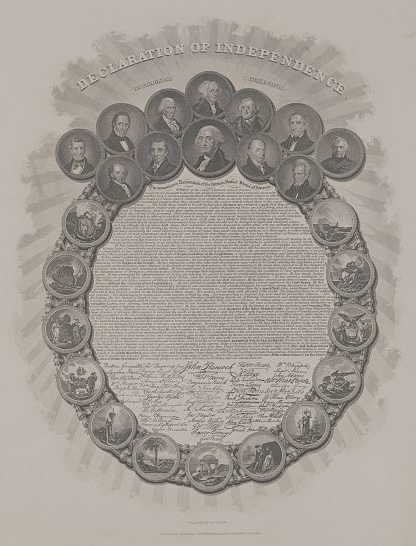
Engraving by George G. Smith, ca. 1850, of the Declaration of Independence and the presidents from Washington to Taylor. Library of Congress.
Many took pride in family associations with the Revolution. Nicholas Carroll, a New York City lawyer and merchant, proudly told Fillmore in 1844 of his ancestors’ “matyrdom . . . before & subsequent to ’76.” A Catholic at a time marked by anti-Catholic sentiment, he honored their sacrifices for “Liberty- civil & religious.” Four years later, Aaron Nash, an upstate New York farmer, wrote to Fillmore (who at the time was state comptroller) seeking information about Nero Goonian’s experience in the Revolution. Enslaved in New York, Goonian had become a prisoner of war in Canada. Nash apparently intended to share the information with the late Goonian’s son, possibly in the hope of obtaining a survivor’s pension.
Those without family connections, or not mentioning them, still celebrated or emulated the Founders. On July 4, 1846, locals met in Philadelphia’s Independence Hall to recognize Taylor’s accomplishments in the Mexican-American War and to urge his election as president. As they wrote to him on July 20, they had intentionally met in the building “where the Revolutionary fathers assembled . . . in the year 76, and sent forth the Declaration of Independence” (Daniel Montgomery Leisenring et al. to Taylor, in Baltimore Sun, September 9). In April 1847, Philadelphians again gathered to promote Taylor’s candidacy. In communicating their wish to “plac[e] you in the chair of Washington,” George W. McClellan and twenty-one others urged him on April 17 to make no policy pledges but to take “the declaration of independence and the constitution as your guides” (Washington Semi-Weekly Union, April 30).

Lithograph, published in 1893 by Knapp Co., of the cornerstone laying ceremony for the Washington Monument, July 4, 1848. Library of Congress.
Others drew links between the nation’s early and recent eras via specific leaders, living or deceased. Elizabeth Milligan, a Washington, DC, artist, wrote to Fillmore on June 5, 1844, after painting a portrait of Dolley Payne Todd Madison. She described Madison, the first lady of 1809–17 who remained active in the capital, and John Quincy Adams, the former president who was serving in Congress, as “the links that connect ours with a past age” (SUNY-Oswego, Millard Fillmore Papers). Taylor often cited early presidents as his models, promising to follow their interpretations of the Constitution. He particularly endorsed the politics of Thomas Jefferson and the noninterventionist foreign policy of George Washington’s Farewell Address. Only rarely did a correspondent portray a Founder in a critical or conflicted way. Richard K. Chamberlayne, an Alabama lawyer, did so for Jefferson. Writing to Fillmore in 1848 with a defense of slavery, he lamented the Declaration author’s “war against this institution.” Nevertheless, he acknowledged, Southerners “revere his memory.”
Taylor, meanwhile, wrote warmly of not only individual heroes but the Founders generally. To Jefferson Davis on September 18, 1847, he praised “the sages & heroes of the Revolution” who had won independence and framed the Constitution. He continued with optimism for the future. “Surely there is yet leven enough left among the descendants of those pure patriottes to preserve theat ark of our liverty made by them . . . to the end of time; I for one will not, nor never have despaired of the commonweath” (Princeton University, General Manuscripts Miscellaneous Collection). The Union, Taylor believed, would survive because the blood or patriotism of the Founders endured.
Others were less sanguine. John Dickson, an antislavery politician in New York, referenced the Congress of 1775–76 only to criticize that of 1845–46. He told Fillmore in August 1846 that the latter had been “the most memorable Session of Congress since that which dellivred Independence, the one memorable for deeds of usefulness & Glory, the other for deeds of infamy fraught with ruin to the best interests of the Republic.” Fillmore was a bit more hopeful in 1844, when he declined an invitation to an Independence Day celebration. He feared that “budding treason insists on extending the slave territory, and if it can not, threatens dissolution of this glorious union.” Hope, though, lay in the Whig Party, which he associated with the Revolutionaries: “The whig spirit of ’76 gave us Independence & freedom and the Whig spirit of 1844 must maintain that independence and freedom, or the blood of the Revolution was poured out in vain.”
After a quarter millennium of national existence, Americans continue to commemorate the Revolution, to explore its impact, and to contemplate its meaning. As documentary editors, we hope that you will take advantage of today’s unprecedented access to historical actors’ own words. The National Archives enables you to study the major founding documents. A new online exhibit from the Papers of Thomas Jefferson, at Princeton University, shows how Jefferson and Congress revised the Declaration of Independence from his original draft to the document we know. Our forthcoming volume will let you read the words of Americans in the 1840s, and numerous projects do the same for documents by diverse people across time and place. At the 250th, and always, we urge you to learn history from the documents that guided it and the people who made it.