
The Lefevre Gallery
Three Studies for Figures at the Base of a Crucifixion made its debut in 1945 at the Lefevre Gallery in London. Bacon’s relationship with the gallery was symbiotic. While it provided him with a platform and the affirmation he critically needed, his work added a raw, visceral dimension to the gallery’s repertoire. The sensational debut of his triptych at the Lefevre Gallery marked the beginning of a new chapter in his career. The gallery’s support propelled him from a state of professional limbo into the spotlight.
In the interwar period leading up to the 1940s, the Lefevre Gallery had firmly established itself as an epicenter of the London art scene. Known for its progressive stance, the gallery curated shows that often challenged the status quo, favoring innovative and avant-garde art. It provided an essential platform for British artists influenced by international modernist currents, showcasing works that might have been deemed controversial or too audacious for more conservative galleries. The Lefevre Gallery’s roster from 1920 to 1945 read like a ‘who’s who’ of modern art, featuring artists such as Pablo Picasso, Salvador Dali, Henri Matisse, Georges Braque, Degas and Amedeo Modigliani, alongside British artists like Matthew Smith, Paul Nash, Henry Moore, Graham Sutherland and Ben Nicholson[1]. The gallery’s exhibitions were not merely displays of individual talent but also signifiers of a burgeoning shift in the artistic narrative of the time—a shift toward embracing a more expressive, less representational form of visual language that could capture the complexities of the era.
As Britain was grappling with its identity amidst global conflict, the Lefevre Gallery stood as a bastion of progressive art, fostering a dialogue between the British public and the challenging perspectives of contemporary artists. The Lefevre Gallery’s significance in the wider artistic milieu of the time was underscored by its commitment to showcasing artists who were unafraid to confront and question through their art. In doing so, it provided a counterpoint to the prevailing trends of wartime art commissioned by bodies like the War Artists’ Advisory Committee, which focused on documenting the conflict and bolstering national morale through more representational works. During the early stages of the war, the Lefevre Gallery had curtailed its operations, opening only around two days a week. Additionally, its valuable collections were prudently relocated to the safety of the Mendip Hills. This decision proved fortuitous when, in spring 1943, the gallery’s longstanding location in King Street was obliterated during a German bombing raid [2]. Despite these challenges, by the time of Bacon’s display, the gallery was actively showcasing the works of prominent artists like Graham Sutherland, Frances Hodgkins, Henry Moore, and Matthew Smith (image 6). At the initial display of Bacon’s triptych in 1945, he was shown amongst the aforementioned artists, who were all working through life in the immediate aftermath of World War II through their art. The Lefevre Gallery, therefore, was not just a showcase for art; it was a catalyst for the evolving perception of art’s role in society. By aligning itself with artists like Bacon, who were pushing the boundaries of expression, the gallery played a crucial part in the post-war renaissance of British art, moving it towards a more introspective, psychologically profound direction that would shape the cultural landscape for years to come.

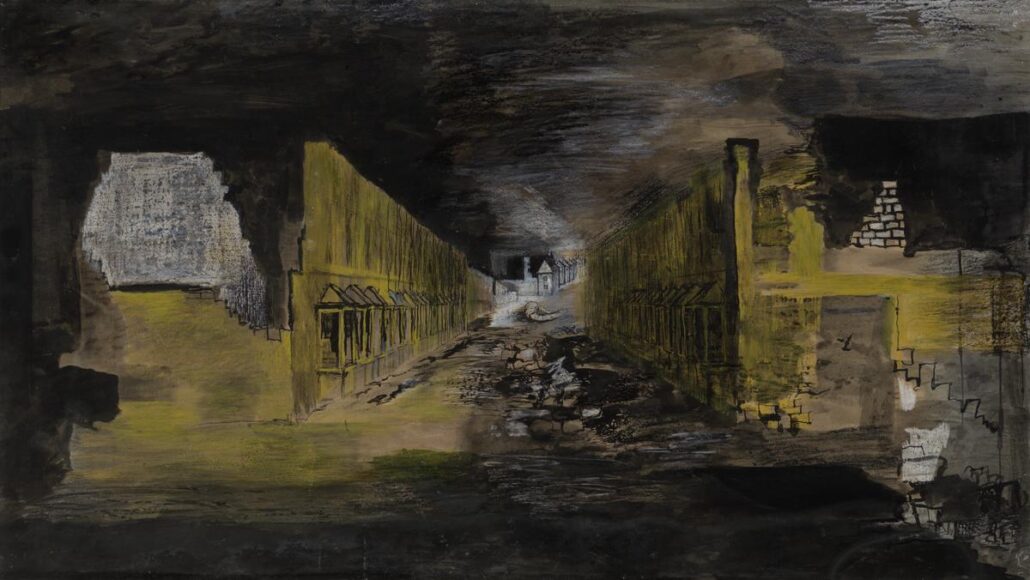
Graham Sutherland was an official war artist during World War II, appointed by the British government. Along with other artists, Sutherland was tasked with portraying various aspects of the home front. Some of Sutherland’s most notable works from this period include depictions of bomb-damaged buildings and the resulting landscapes of devastation in London. Sutherland’s work often retains a semblance of the recognizably real world, distorted but still comprehensible.These paintings captured the physical scars of the war and, through Sutherland’s unique style, conveyed the emotional and psychological weight of the conflict.
Henry Moore was another artist displayed with Bacon. Arguably the most iconic of Moore’s works during World War II are his “shelter drawings.”(Figure 5) During the Blitz, when German air raids terrorized London, many of the city’s residents took refuge in the Underground stations. Moore, moved by these scenes of Londoners huddled together, began to create a series of sketches and drawings that captured the shared humanity, vulnerability, and resilience of the people. His depictions weren’t just objective recordings but were imbued with an emotional intensity that brought out the poignancy of the moment. Henry Moore’s wartime drawings resonated with a somber realism. They captured the vulnerability of the human form against the backdrop of war. His figures often retain a sculptural, monumental quality, embodying a collective fortitude. The WAAC recognized the significance and power of Moore’s shelter drawings and subsequently commissioned him to produce works for the nation. The committee purchased many of his drawings, ensuring they became part of the national collection and were exhibited to the public, capturing the collective spirit and determination of wartime Britain.

Frances Hodgkins dealt with the war in a more indirect way, often focusing on the landscapes and the people that were altered by the conflict. Her work did not depict combat or its immediate physical toll, but there was a sense of melancholy, a muted color palette, and an austere approach to form that was reflective of the general sentiment during the wartime and immediate post-war periods. In comparison to Bacon’s more confrontational triptych, Hodgkins offered a more introspective look at the human condition under the pressures of global unrest. Hodgkins, with her vibrant watercolors, captured the landscapes and objects touched by war, infusing them with life and resilience amidst the turmoil. Her work was marked by a certain buoyancy and continuity with pre-war art traditions.

Sutherland, who had a profound understanding of the visceral impact of the war, recognized Bacon’s talent and advocated for his inclusion in the Lefevre Gallery’s exhibition[3]. Sutherland’s own works resonated with Bacon’s raw emotional intensity and helped to frame the younger artist’s work within the broader narrative of British art during wartime. When Ben Nicholson withdrew from the Lefevre Gallery showing, it was Sutherland who advocated for Bacon’s inclusion, stating “as for the painter to take BN’s place it seems there is not much choice other than Piper. I should really prefer Francis Bacon for whose work you know I have a really profound admiration. It is true he has shown very little; but nowadays with every Tom, Dick and Harry showing yards of painting without much selection or standard this is refreshing, & his recent things, while being quite uncompromising, have a grandeur & brilliance which is rarely seen in English art”[4]. The scholar Martin Hammer has noted the strong thematic similarities between the two in his writing “Bacon and Sutherland: Patterns of Affinity in British Culture of the 1940s”. Sutherland’s advocacy for Bacon’s inclusion suggests Bacon’s ability to represent ideas that were missing from the greater European art ethos at the time. Sutherland, who had completed around 150 different works for the WAAC during the period of 1940-45 was greatly preoccupied with these representations.[5] Bacon’s harrowing triptych reflected thematic interest in the human form distorted by psychological and physical trauma. While a jarring stylistic departure from the conventional war art of the time, the theme of Bacon’s painting had a curious resonance with the wartime and post-war ethos that the WAAC sought to document.
The debut of Three Studies for Figures at the Base of a Crucifixion in 1945 sent ripples through the British art community. Bacon’s triptych was a radical departure from the conventional narratives of heroism and valor often associated with wartime art. His work eschewed any glorification of the war. Instead, Bacon’s work presents a counter-narrative, one that is unflinching in its portrayal of the war’s harrowing impact on the human spirit. Critics of the time found themselves grappling with the stark differences in these artists’ approaches. Many lauded Bacon’s audacity, with Herbert Furst claiming that he was “so shocked and disturbed by the surrealism of Francis Bacon that I was glad to escape this exhibition”[6]. However, others found it excessively macabre, especially when placed alongside the more tempered responses of Sutherland and Hodgkins. Describing his art as works of horror, other reviews claimed that “these pictures expressing his sense of the atrocious world into which we have survived seems [to me] symbols of outrage rather than works of art.”[7] It challenges viewers to confront the psychological scars left by war, rather than its glories. This challenge extends to Bacon’s use of the triptych form, traditionally associated with altarpieces and religious art, which here invite a sacrilegious comparison that further intensifies the work’s provocative nature. By co-opting a format steeped in reverence and sanctity to present a tableau of torment and despair, Bacon subverts expectations and compels a re-evaluation of wartime narratives and the role of art in society.
[1] Lefevre Fine Art, The History
[2] Hammer, “Francis Bacon and the Lefevre Gallery”
[3] Martin Hammer, Francis Bacon and the Lefevre Gallery, 2010
[4] GS to DM, n.d. [mid-January 1945], LGA.
[5] Paul Gough, Graham Sutherland in Context: War, Art and the Commissioning Schemes
[6] Furst, Herbert. “Current Shows and Comments: On the Significance of a Word.” Apollo 41, no. 231 (1945).
[7] Mortimer, Raymond. “Three Studies for Figures at the Base of a Crucifixion”.” New Statesman and Nation, 1945.