
Triptych
The triptych format, traditionally used in religious art, particularly in altar pieces, inherently contains a narrative structure due to its three-panel layout: beginning, middle, and end. When Francis Bacon adopted this format for Three Studies for Figures at the Base of a Crucifixion, he infused it with a modern, secular, and harrowing context, leveraging the format’s intrinsic storytelling potential to craft a powerful sense of isolation. Each panel hosts a tormented figure, separated from the others. This physical partition enhances the sense of isolation, emphasizing the solitude of each figure in its anguish. Each figure, while displaying visceral emotion and torment, does not interact with the others. They are locked in their individual agonies, further highlighting the emotional and physical isolation inherent in the work. The triptych format in Three Studies for Figures at the Base of a Crucifixion is not just stylistic choice; it is a fundamental component of the painting’s narrative and emotional impact. By leveraging the division and structure of the triptych, Bacon masterfully enhances the sense of desolation and isolation that permeates the work.
Traditional triptychs, particularly those rooted in religious traditions, typically feature central panels that are iconic rather than narrative, with the main focus being on a significant sacred moment or figure, and the side panels often presenting saints or angels that complement the central theme. Narratives, when present, are usually relegated to the predella panels at the base. In this light, Bacon’s Three Studies for Figures at the Base of a Crucifixion can be seen as an inversion of this format. The title itself alludes to the figures traditionally found in the predella, suggesting that Bacon is drawing a parallel between these lower panels and his own work. In Bacon’s interpretation, the lack of a clear central focus and the absence of a linear narrative across the panels emphasize the isolation of each figure, reinforcing the feeling that they are caught in their own existential struggle. Rather than presenting a sequence or a shared narrative space, each panel in Bacon’s triptych confronts the viewer independently, creating a disjointed experience that reflects the fragmentation and chaos of the post-war world. The figures’ separation from one another mirrors the isolation of individual trauma, suggesting that each subject is profoundly alone with its suffering. Thus, Bacon’s work can be seen as a modern reimagining of the triptych format, one that reflects the disjointed nature of post-war reality and the individual’s place within it.
Discussions about Bacon’s art also reveal opposing views on his engagement with traditional religious motifs. In “Francis Bacon: Painting in a Godless World,”[1] Rina Arya explores Bacon’s subversion of religious symbolism. Conversely, John Russell, in “Francis Bacon,” suggests that Bacon’s engagement with religious themes underscores his continuity with art history. [2] Arya has defined Bacon’s work as an expressing of the “primal cry of horror” that is at the heart of human existence in her writing “The Primal Cry of Horror: The A-theology of Francis Bacon.”
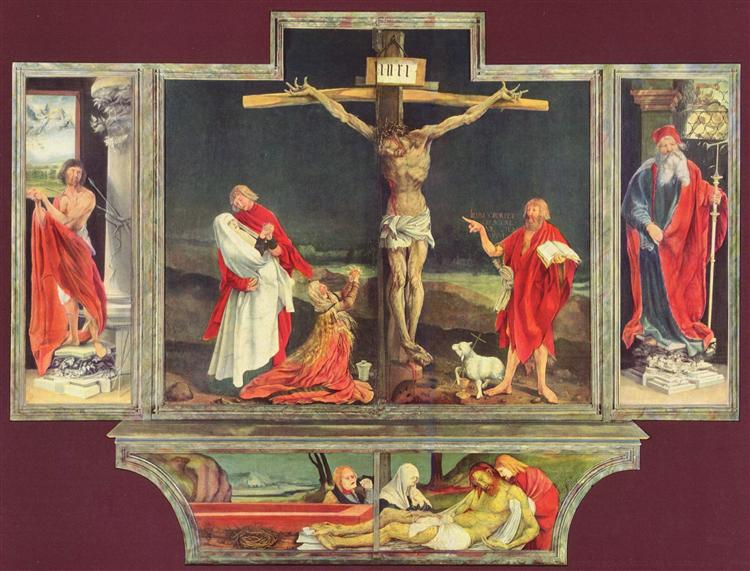
In the canon of religious art, the Crucifixion scene has always held a place of central importance, with the figures at the base typically serving as complementary to the primary event of Christ’s sacrifice. These secondary figures are often depicted in a manner that reinforces the main narrative, their grief and anguish contextualizing the enormity of the crucifixion. Bacon’s engagement with this convention is both direct and subversive. By elevating the figures at the base to the forefront, he challenges the viewer’s expectations and redirects the focus from the divine to the intensely human. In Three Studies for Figures at the Base of a Crucifixion, Bacon’s figures are not just prominent; they are overwhelming, almost confrontational in their presence. This deliberate shift in scale and focus can be seen as a modern inversion of traditional religious themes. Bacon’s interpretation places the emphasis squarely on the mortal experience — the visceral, the corporeal, and the existential. The figures’ exaggerated forms and raw emotionality take center stage, compelling the viewer to confront the suffering of the subjects instead of any divine intervention or narrative resolution. This inversion can also be read as a commentary on the human capacity for suffering and the search for meaning in the post-war era. Bacon’s choice to foreground the figures at the base of the crucifixion, traditionally seen as witnesses or mourners, elevates their experiences and, by extension, the human experience, to the level of the sacred event itself. In doing so, Bacon seems to suggest that the suffering felt in the waning years of World War II hold a significance that demands attention and reflection, much like the religious scenes from which he draws inspiration.
The handling of space within the painting and its effect on the viewer’s perception further intertwines with the mythological themes introduced by the Furies. The compressed, almost claustrophobic space that holds these towering figures creates a palpable tension between the viewer and the viewed, mirroring the inescapable confrontation with the forces of fate and justice that the Furies represent. This spatial dynamic forces the viewer into a position of detached witness, highlighting the isolation and despair of the figures while also reflecting on the immensity of the themes being tackled. The enormity of the figures, threatening to burst from the canvas, serves as a visual metaphor for the overwhelming nature of the subjects at hand—justice, trauma, and the human capacity for both cruelty and redemption. Thus, the inclusion of the Furies as a thematic and symbolic element in “Three Studies for Figures at the Base of a Crucifixion” creates a rich tapestry of meaning that bridges mythological and contemporary discourses. The spatial dynamics of the painting reinforce this connection, emphasizing the scale and intensity of the themes Bacon seeks to explore. Together, these elements forge a work that is both a reflection on the specific socio-political conditions of its time and a meditation on the fundamental aspects of suffering.
[1] Rina Arya. Francis Bacon Painting in a Godless World. Lund Humphries, 2012.
[2] John Russell, and Francis Bacon. Francis Bacon. Oxford University Press, 1971.
[3] David Sylvester, Interiews with Francis Bacon, 112