
Visual Analysis

In Three Studies, across the three panels, distorted, grotesque figures are set against a fiery, almost apocalyptic backdrop of burnt orange, suggesting a world consumed by anguish. This palette, a dirty orange marked by dark streaks with the bulbous ash colored figures, leaves no room for emotional nuance. The flesh of these creatures is cold and lifeless, as if they exist between dead and alive. These are not typical human forms but rather amalgamations of flesh and emotion, seemingly in various states of agony or desolation. The most evident human features are accentuated: mouths are agape in silent screams, the ribs protrude starkly against taut skin, necks stretch in abnormal angles, and heads, although deformed, are still recognizable. The juxtaposition of these human fragments with their twisted and tortured presentation serves to highlight the profound suffering and turmoil evident in each panel. The figures are humanoid but highly abstracted, distorted into shapes that only vaguely suggest corporeal forms. The anatomy is deliberately deconstructed, limbs are elongated, and bodies are twisted into forms that defy natural physiology. Despite this, or perhaps because of it, they evoke a potent sense of anguish. These are not bodies at ease or at rest; they are in states of extreme emotional and existential contortion. The absence of any significant background or environment within the frame intensifies the emotional focus on these writhing figures.
In the painting, the dominant feature of the middle figure is its grotesquely elongated neck and the wide-open mouth, almost as if it is letting out a deafening scream or cry. This could be interpreted as a juxtaposition to the “speak no evil” aspect of the proverb. Instead of silence or refraining from speaking, the figure seems to be communicating intense anguish or despair. It is as if the weight of witnessing evil or horror has pushed this entity to vocalize its pain, confronting and challenging the idea of staying silent in the face of what it has experienced. The figure in the right panel has a prominently displayed ear, almost as if it’s tuned in to something. The figure’s mouth is agape, possibly in a scream or shout. Rather than covering its ear to ignore or avoid, it seems to be reacting to what it has heard. This could represent the overwhelming barrage of traumatic news, sounds, or cries during times of crisis. In an insightful essay featured in Tate Britain’s 2008 catalogue for Francis Bacon, curator Chris Stephens reflects upon an interpretation presented by art historian Dawn Ades. Ades had previously drawn parallels between Bacon’s art and the writings of philosopher Georges Bataille. Both, it seems, were deeply engrossed with the intertwining themes of human and beastly nature. Stephens highlights Bataille’s observation on how a human scream often coincides with pronounced physical movement, with the neck stretching to emulate an animal.[1] This is eerily evident in the right-hand panel of Three Studies for Figures at the Base of a Crucifixion. The hunched figure in the left panel appears to be recoiling or sheltering itself, with its head turned away from the viewer. This could be seen as an attempt to avoid witnessing the horrors of the world. Yet, the very posture of this figure — one of distress and pain — indicates the impossibility of truly avoiding the evil that surrounds. It’s the embodiment of the trauma that comes with seeing too much.
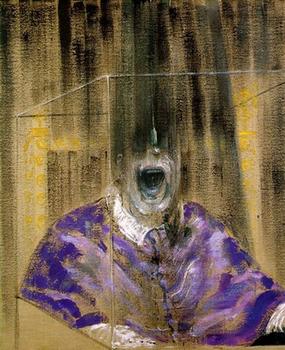
The motif of the exaggerated, almost agonizing mouth that dominates Francis Bacon’s 1944 triptych finds a recurring presence in his later works, most notably in the ‘screaming pope’ series, as exemplified by Head VI (1949) (Figure 2). This persistent theme not only underscores Bacon’s fascination with the visceral expression of torment but also serves as a bridge to explore his broader approach to painting as a medium of choice. This transition from the depiction of tortured bodies to Bacon’s methodological preferences reveals the artist’s deliberate engagement with painting as a vehicle for conveying the complexity of human emotions and experiences. Bacon’s choice of painting, particularly his technique and subject matter, underscores a commitment to exploring the depths of psychological distress and existential angst, pushing the boundaries of expressionism to articulate a raw and unfiltered vision of the human condition. While photography offered Bacon a certain immediacy and objective capture of reality, it was through the medium of painting that he believed he could delve deeper into the emotional, psychological, and existential truths of existence. Despite the clarity and precision of photographs, Bacon’s paintings were never mere reproductions of these images. Instead, he used them as starting points, “pulverizing” and reworking them to extract a more profound essence. He transformed these snapshots of reality into haunting, visceral, and often unsettling portrayals of mangled and abstracted forms. Bacon’s transition from the static immediacy of photography to the dynamic expressiveness of painting underscores a deliberate shift towards capturing the multifaceted layers of human experience. In moving from the depiction of his subjects’ physical forms to an exploration of the emotional and psychological depth achieved through his painting technique, Bacon bridges the gap between objective representation and subjective interpretation. This methodological evolution reveals his intent to not only represent the external realities but to penetrate deeper into the internal landscapes of despair and existential crisis. Through his distinctive brushwork and the blurring of boundaries between the figures and their environments, Bacon’s approach to painting becomes a conduit for exploring the profound emotional and existential undercurrents that photography alone could not convey.

The brushwork in the Three Studies is expressive, conveying not only form but also emotion. The strokes are neither meticulous nor refined; rather, they are erratic, almost violent, underscoring the tumultuous emotions depicted. Bacon’s painterly technique adds texture to the figures, making their twisted forms appear all the more tortured and agonized. There is a physicality to the brushwork that resonates with the emotional intensity of the subject matter.
The edges of the figures are not well-defined but instead bleed into their backgrounds, further complicating the viewer’s emotional response. This lack of clear boundaries may symbolize the figures’ emotional and existential turmoil, as if they are merging with or dissolving into their own despair. There are no crisp lines to separate the figures from their environment, adding to the sense of constriction and suffocation.
His brushwork and subject matter communicate an urgency of expression. His turbulent brushwork and the raw physicality of his painting process mirrored the emotional and psychological states he aimed to convey. Bacon once said, “I would like my pictures to look as if a human being had passed between them, like a snail, leaving a trail of the human presence and memory trace of past events”.[2] This sentiment encapsulates the weight he gave to painting as a medium – one that can viscerally capture the residue of human emotion and experience.
Adding yet another layer to Bacon’s work is the mythological symbolism, specifically the invocation of the Furies, ancient deities of vengeance and retribution. These mythical figures add an archetypal resonance to the deeply unsettling imagery in the painting, linking timeless concepts of justice and vengeance with the very real and immediate socio-political conditions of the time. The Furies act as both a mirror and a magnifying glass, reflecting and intensifying the violence and suffering witnessed by Bacon. In an interview with David Sylvester, Bacon states “Well, I thought of them as the Eumenides, and at the time I saw the whole Crucifixion in which these would be there instead of the usual figures at the base of the cross.”[3] The Eumenides were the more benevolent avatars of the Furies in Greek mythology . Bacon’s reference to these figures as the Eumenides, or the more benevolent forms of the Furies, introduces a nuanced layer of meaning, suggesting a transformation from vengeance to perhaps a form of justice or purification. This duality enriches the painting, offering a lens through which the viewer can interpret the figures not merely as symbols of torment but as agents of a deeper, perhaps moral or cosmic, reckoning. The significance of the Furies in the painting underscores a timeless struggle with themes of justice, suffering, and redemption. By anchoring these contemporary figures within the vast continuum of human mythology and history, Bacon doesn’t just present a snapshot of post-war trauma but engages with the very archetypes that have shaped human understanding of morality and retribution. This connection between the ancient and the modern, the mythological and the real, elevates the work beyond its immediate context, positioning it within a broader exploration of human nature and its propensity for both violence and compassion.

[1] Chris Stephens, Francis Bacon by Martin Harrison [and Others]. Edited by Matthew Gale and Chris Stephens. 2009
[2] Farson, Daniel. The Gilded Gutter Life of Francis Bacon. Pantheon Books, 1993. Page number
[3] David Sylvester, Interiews with Francis Bacon, 112