
World War II Britain
During the early years of WWII, the British populace was acutely aware of the atrocities committed by the Axis powers, both from news reports and the accounts of refugees who had fled the horrors in mainland Europe. Stories of concentration camps, mass persecutions, and the Holocaust began to trickle in, painting a grim picture of a continent under the iron grip of fascist ideologies. This was not just a military conflict; it was an ideological battle against a regime that threatened the very fabric of democratic and humane values. Bacon, like many of his contemporaries, would have been acutely attuned to these realities. The psychological and emotional scars left by the war, the haunting images of devastated cities and the whispered tales of unimaginable cruelties in distant lands, would indelibly shape the conscience and expressions of an entire generation.
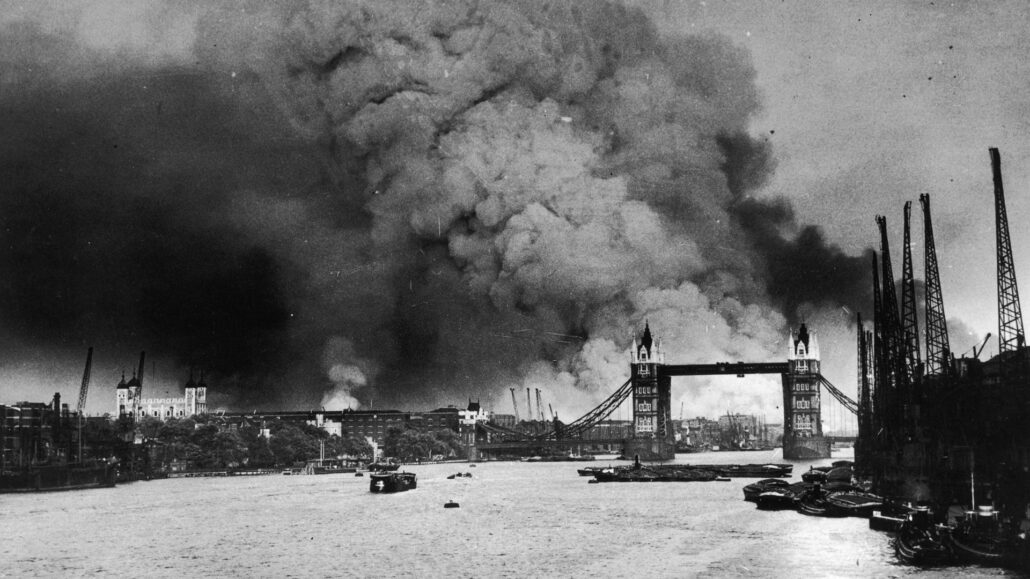
The British home front became an emblem of endurance, unity, and defiance against the looming shadow of fascism. As the war’s tides shifted across Europe, Britain found itself facing the brunt of Hitler’s ambitions, evident in the relentless bombing campaigns that altered the rhythm of daily life and cast a long shadow over the nation’s future. The Blitz, the German Luftwaffe’s intense bombing campaign against Britain, became a darkly iconic period from September 1940 to May 1941. Major cities, including London, were bombarded nightly, The nights were lit by the fires of incendiary bombs, and the days were filled with the rubble and ruin of once-familiar streets. The Blitz targeted strategic military and industrial locations, but the bombs did not discriminate. Civilian areas were often affected, causing significant casualties, the destruction of homes, and a tangible sense of fear among the populace.[1] The British government, anticipating aerial bombardments, had initiated measures to protect its civilian population. Air Raid Protection (ARP) wardens became a fixture in local neighborhoods, tasked with enforcing blackouts, providing air raid warnings, and helping to coordinate emergency services after attacks[2]. The blackouts, intended to make it difficult for enemy bombers to identify targets, also transformed urban life into a world of shadows and obscurity. Amidst the air raids and blackouts, life was a juxtaposition of mundane daily routines and the ever-present uncertainty of war.
Civilian morale and mental health was a significant concern for the government during these strenuous times [3]. The Ministry of Health was tasked with the job of propaganda, producing posters, films, and broadcasts to keep spirits high. The shared experience of rationing, the collective endeavor of ARP, and the ubiquity of propaganda forged a powerful sense of community and common purpose. As Britain navigated the perilous waters of the Second World War, the government recognized the potential of art as a cultural weapon and a means to bolster national morale. The War Artists’ Advisory Committee (WAAC) was established in 1939, under the chairmanship of Sir Kenneth Clark, with the mission to compile a comprehensive artistic record of Britain at war. The committee was tasked with commissioning artists to paint scenes of wartime Britain, covering the home front and military activities, ensuring that future generations would have a visual chronicle of the period’s trials and triumphs. The objectives of the WAAC extended beyond mere documentation; it aimed to sustain the cultural life of the nation during a time when the arts were under threat. The committee sought to provide employment for artists and to harness their talents in service of the war effort. The art produced under the auspices of the WAAC was intended to capture the spirit of the age, to depict the heroism of the armed forces, the stoicism of civilians, and the indomitable resolve of the Allies[4].

The narrative crafted through WAAC-commissioned art was multifaceted. On one hand, these works served as a form of propaganda, designed to inspire and to unite. They celebrated British tenacity, commemorated sacrifices, and offered a vision of a society undaunted by the specter of fascism. The art was disseminated through exhibitions, reproduced in magazines, and used in posters, playing a part in the information warfare that accompanied physical combat. Artists commissioned by the WAAC included some of the most prominent names in British art, as well as lesser-known painters whose work would come to be recognized through their wartime contributions. Figures such as Henry Moore, Paul Nash, and Graham Sutherland created some of their most enduring work under the aegis of the WAAC .[5] The WAAC did not dictate a particular style; thus, the body of work produced is remarkably diverse. It includes traditional representations of military heroism and sacrifice but also modernist interpretations of the war’s psychological effects. The WAAC art pieces range from pastoral scenes that evoke a rural idyll unaffected by war to stark images of industrial might and the machinery of conflict. Moreover, the WAAC collection serves as a testament to the role of women during the war, with artists like Laura Knight capturing the contributions of female military personnel and workers in munitions factories. The inclusivity of the WAAC’s commissions helped to democratize the narrative of the war, moving it beyond the front lines to include the experiences of all strata of society.
Through the lens of WAAC-commissioned art, the narrative of World War II becomes a tapestry of human experience. These works do not merely recount events; they evoke the emotional landscape of a nation under siege, the resilience of its people, and the pervasive hope for a peaceful and more just future. The WAAC’s legacy is thus one of profound cultural significance. It not only preserved the memory of Britain’s darkest and finest hours but also underscored the essential role that art can play in shaping and sustaining national identity during times of crisis.
[1] Mark Clapson, Air Raids In Britain, 1940-45, 2019
[2] Civil Defense, Air Raid Precautions, 1940
[3] Arthur Jersild, Mental Health of Children and Families in Wartime, 1943
[4] Roger Tolson, A Common Cause: Bitain’s War Artist’s Scheme
[5] National Portrait Gallery Official War Artists