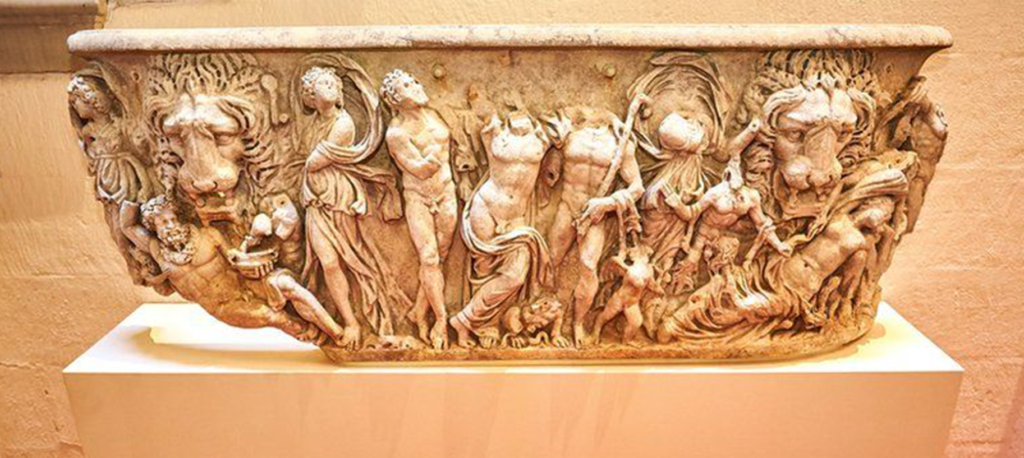
Figure 8. Unknown artist, Blenheim Sarcophagus, c. 300 AD. Marble. Blenheim Palace, Oxfordshire.
Source: https://www.bbc.com/news/uk-england-oxfordshire-39216040
Since it was Equicola’s job to conceptualize the iconographic elements for Alfonso’s Camerino paintings, the allusions to classical statuary would have originated from a combination of his own invenzione and the artistic freedom of the commissioned painters .[60] In 1993, Wendy Stedman Sheard published her own analysis on Alfonso d’Este’s collection, but with a focus on Titian, rather than Bellini. Sheard argues that the Blenheim Sarcophagus (Fig. 8) was of particular influence on Titian, though he “studied it by means of two graphic derivations.”[61] These “graphic derivations” were a drawing by an unknown Mantuan artist (Fig. 9) and an engraving by Jacopo Francia, both based on the Blenheim Sarcophagus, with the Mantuan drawing serving as a far more faithful representation of the sarcophagus’ subject matter and design.[62]
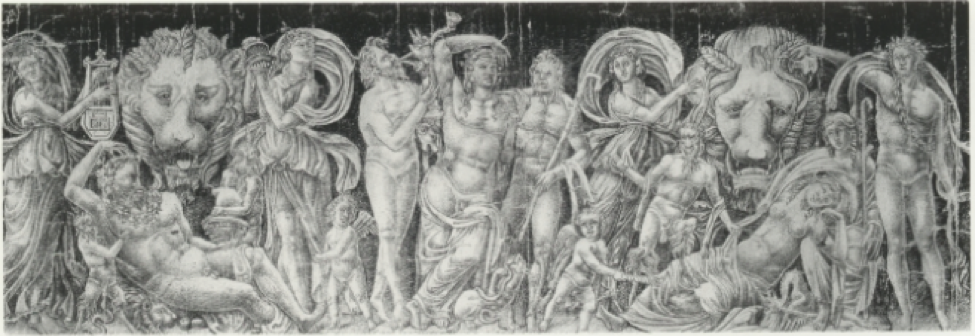
Figure 9. Sarcophagus with Bacchic Scene, Mantuan School, c. 1480. Pen and ink. Staatliche Museen, Kupferstichkabinett, Berlin.
Source: Wendy Stedman Sheard’s “Antonio Lombardo’s Reliefs for Alfonso D’Este’s Studio Di Marmi: Their Significance and Impact on Titian.”
Sheard suggests that while Titian’s Bacchus and Ariadne may have been inspired by the faithful Mantuan drawing, Bellini’s Feast of the Gods drew solely upon Francia’s depiction of Pan, a figure that does not appear in the Blenheim Sarcophagus nor the Mantuan drawing.[63] Sheard does not recognize Equicola’s involvement, nor does she explore the many similarities shared by Feast of the Gods and the Mantuan drawing, and by proxy the Blenheim Sarcophagus. Sheard is not alone, however, since not once in the scholarship has anyone noticed the parallels between the two. Building on and expanding Sheard’s analysis of Titian, I will be arguing that Equicola based his design scheme for Bellini’s Feast of the Gods on the Blenheim Sarcophagus by way of the Mantuan drawing.
The Blenheim Sarcophagus, which was in Rome during the 16th century before it was taken to Blenheim Palace in Oxfordshire, England, depicts a Bacchic scene.[64] Like many Roman sarcophagi, the Blenheim Sarcophagus was carved in high relief, with the overlapping figures positioned in a line reminiscent of a classical frieze. This complex and flat composition was standard for ancient Roman sarcophagi, especially for ones depicting scenes of Bacchus and his rambunctious retinue.
Due to its use as a flowerpot while at the Blenheim Palace, the Blenheim Sarcophagus, has received considerable wear over the years, with many of the figures appearing headless or missing various body parts. Despite the damage, the high-relief carving of this marble sarcophagus is still recognizable as a Bacchic scene thanks to the unmistakable presence of the reclining, drunken Silenus on the far left. The Bacchic theme is also emphasized by the two massive lion heads that frame the relief, which are a reference to Bacchus’ addition of lions to his thiasus during his Indian campaign.[65] At the center of the composition is a headless Bacchus supported by two, muscular male figures, who themselves are flanked by two female figures with long, swirling, mantles. Finally, on the far right, there is what appears to be a satyr pulling off the dress of a sleeping nymph figure.
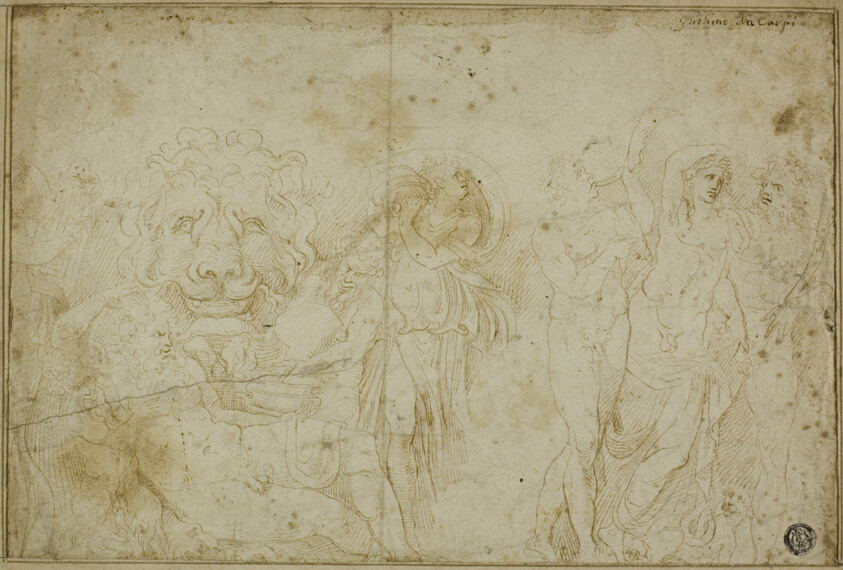
Figure 10. Blenheim Palace Sarcophagus: Bacchanale with Lion’s Head, Girolamo da Carpi, 1549-1553. Pen and brown ink on ivory laid paper. Art Institute of Chicago.
Source: https://www.artic.edu/artworks/112798/blenheim-palace-sarcophagus-bacchanale-with-lion-s-head
In her article, Sheard refers to two depictions of the Blenheim Sarcophagus as possible sources for Titian’s antique inspiration.[66] One is an engraving by Jacopo Francia that depicts the central group, with the addition of a hunched and seated Pan, who is not present in the sarcophagus. It was this extraneous Pan figure that Sheard suggested Bellini was inspired by, implying that the artist’s source material was not rooted in classical antiquity, but in sixteenth century engraving.[67] The other derivation, the 1480 Mantuan drawing by an unknown artist, depicts the Bacchic scene from the Blenheim Sarcophagus in full. All of the sculptural elements that are missing from the present-day sarcophagus are depicted in the drawing, which suggests that the Mantuan artist saw the sarcophagus intact while it was in Rome, and that this drawing is the most accurate depiction of the sarcophagus’ original composition. This is further supported by a drawing of the central figures (Fig. 10) of the sarcophagus made by Girolamo da Carpi while in Rome roughly seventy years later. The figures in the Carpi drawing are nearly identical to the ones in the Mantuan drawing, with both containing the same missing elements from the present-day sarcophagus, such as Bacchus’ arm and his follower’s horn. With two massive lion heads framing the composition, the drunken Silenus, a languorous Bacchus, the sleeping nymph with a mischievous satyr, and many other minor details, the Mantuan drawing presents the viewer with an image of what the Blenheim Sarcophagus looked like in its complete state. For this reason, the following comparative analysis will be between Feast of the Gods and the Mantuan drawing, since the current Blenheim Sarcophagus does not reflect what Equicola would have seen in the sixteenth century.
Feast of the Gods contains several allusions to the Blenheim Sarcophagus, the most obvious of which is the subject matter. Bacchic scenes have a long history as sculptural motifs for ancient Roman sarcophagi, and the Blenheim Sarcophagus is a perfect example of the subject matter associated with these sarcophagi. The presence of Bacchus, Silenus, and the various nymphs and satyrs that make up Bacchus’ thiasus engaging in drinking, revelry, and merrymaking is standard for classical Bacchic sarcophagi, and it’s no coincidence that they all appear in Feast of the Gods. When Equicola, whose knowledge of the classics was unrivaled in the court of Ferrara, was creating the design scheme for Feast of the Gods, he would have certainly known that the inclusion of these figures would elicit comparisons with Bacchic sarcophagi. This suggests that Equicola may have sought to allude to antique statuary even before Bellini was commissioned by the duke. It must also be noted that although it was Equicola’s instructions that determined the composition and subject of the painting, the iconographic elements of Feast of the Gods should be attributed to both the artist and humanist advisor, since it is probable that two collaborated on the selection of antique influences.
The most prominent similarity between the painting and sarcophagus is the flatness. We know from Walker’s x-rays that Bellini’s original composition for Feast of the Gods was even flatter than the current version, with the artist painting a row of trees parallel to the picture plane, eliminating any sense of depth or recession into space.[68] Bellini’s choice to flatten the picture plane completely and have all his figures overlapping in the foreground was no coincidence, as it accurately mimics the standard design of sarcophagi relief, particularly ones depicting scenes of Bacchus.
Though the flatness of the painting could have been an allusion to any number of Bacchic sarcophagi, there are several other formal elements that could only be in reference to the Blenheim Sarcophagi. To start with, the pose of Bellini’s Mercury figure is highly reminiscent of Silenus in the sarcophagi, with both sitting in a reclined position with outstretched legs. Above Mercury is the satyr holding a bowl on his head, whose bent right arm is nearly identical to that of the muscled figure to the right of Bacchus in the sarcophagus relief. The curve of the arm, the musculature, and the overall depiction of the body are remarkably similar, and even the expression on the satyr’s face mimics the look of the muscled figure as depicted in the Mantuan drawing. Next to the satyr is a nymph carrying a large, porcelain bowl, whose dress, bent arm, and turned head recall the nymph to the right of the muscled figure from the sarcophagus. It is also worth noting that in the Mantuan drawing, this nymph appears to be looking at Bacchus, while in Feast of the Gods, the nymph with the bowl is looking down in the direction of the child Bacchus, forming another parallel.
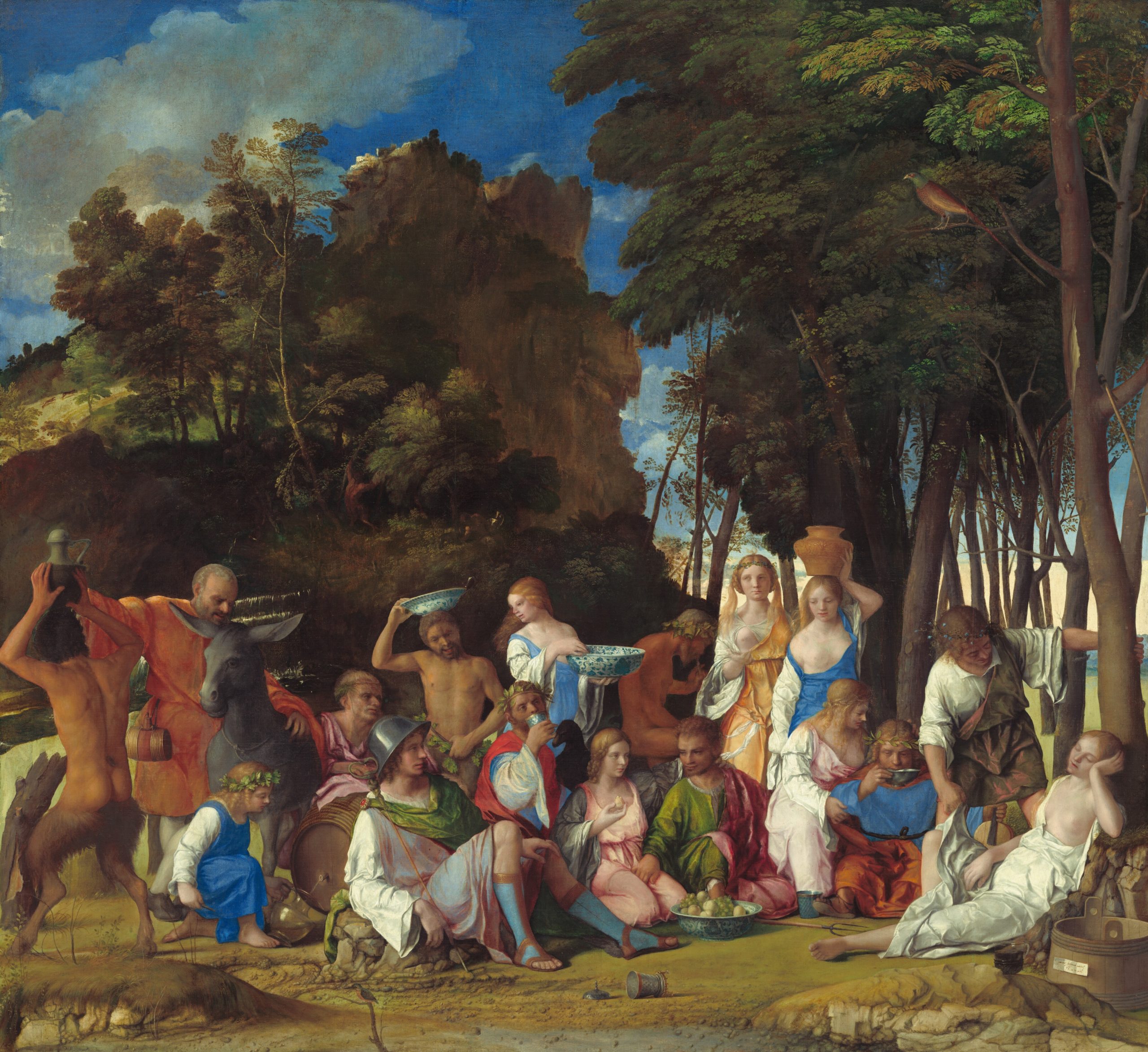
Silenus, Bacchus’ companion and tutor, who can be recognized thanks to his proximity to his iconographic symbol, the donkey.
Bacchus. His childlike appearance is an allusion to the first book of the Fasti representing January and the Macrobian belief that Bacchus takes the form of a child during the winter solstice
Mercury, the messenger god

Based on the figure of Silenus from the Mantuan drawing and the Blenheim Sarcophagus.
Lotis
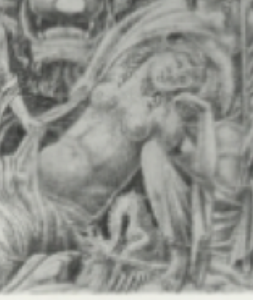
Based on the reclining nymph from the Mantuan drawing and the Blenheim Sarcophagus.
Priapus, the Roman fertility god

Based on the small satyr from the Mantuan drawing and the Blenheim Sarcophagus.
A Satyr
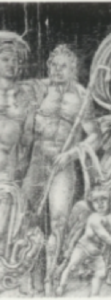
Based on the figure to the right of Bacchus in the Mantuan drawing and the Blenheim Sarcophagus.
A Nymph
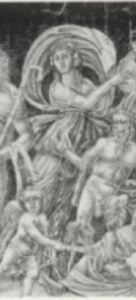
This figure is shown staring at Bacchus, mirroring the related figure from the Mantuan drawing who is also depicted gazing at the wine god.
Pluto and Persephone. Their appearances are likely based on Alfonso d’Este and his wife.
Most likely Pan—due to his flute—but has also been read as Faunus or Sylvanus, both of whom are forest gods similar to Pan.
Janus, god of beginnings. Normally depicted with two heads, Janus is recognizable thanks to his hand overlapping with the snake of Mercury’s caduceus.
Apollo, god of music, poetry, and the sun.
Ceres, the mother of Persephone
Maia, the mother of Mercury and the avatar for the month of May.
Jupiter, king of the gods. Recognizable thanks to his avian attribute, the eagle, perched beside him.
The final allusion to the Blenheim Sarcophagus in Feast of the Gods is the depiction of Priapus and Lotis, the central characters from the first book of Ovid’s Fasti. In the painting, Lotis is asleep, reclining on one hand, with her breast exposed, while Priapus is shown standing over her, pulling at her robe. Both figures are located on the far right of the painting, and their location, interaction, and body positioning all mimic the satyr and nymph on the lower right of the Blenheim Sarcophagus. While one parallel could be a coincidence, these four distinct visual allusions are by no means accidental, and they suggest that Equicola was looking directly at either the sarcophagus itself or the Mantuan drawing when formulating the scheme for the painting. In fact, according to Luba Freedman, both Alfonso and Equicola were familiar with the composition of the Blenheim Sarcophagus, though she does not indicate whether they had seen the sarcophagus itself or just a late fifteenth century drawing.[69] Furthermore, the reclining Lotis figure in Feast of the Gods recalls the Sleeping Nymph, an ancient marble statue that Equicola would have likely familiarized himself with while in Rome.[70] In referencing both Ovid and Macrobius, as well alluding to the Blenheim Sarcophagus and the Sleeping Nymph, Equicola engaged in his own “creation of beauty by selection” by selecting specific elements from a variety of sources and synthesizing them into a single product. This product, however, was just the beginning of Equicola’s effort to design paintings that emphasize his patron city’s humanistic prestige.