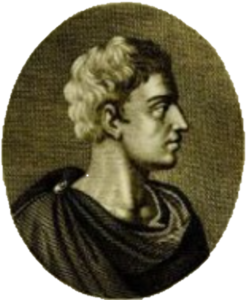
In order to achieve his aim of designing a painting that would embody the humanist process of selective creation, Equicola drew inspiration from multiple texts, with Ovid’s Fasti serving as the foundational source. Edgar Wind first proposed that the Fasti were the key to understanding Feast of the Gods in 1948, and has since become a foundation for all subsequent analysis.[54] The Fasti is a series of six books written by Ovid detailing the Roman holidays from the perspective of the gods, in which each book covering one month from January to June.[55] In the first book, Ovid details a Bacchic feast attended by the wine god’s retinue, along with several gods and nymphs. Since Bellini’s Feast of the Gods depicts the interaction between Priapus and Lotis on its far right and includes all the central figures of the Fasti, Wind’s argument remained virtually uncontested for years. It was not until Phillip Fehl’s 1974 article that scholars once again began debating the literary origin of Feast of the Gods, though Fehl’s argument would be later debunked by Anthony Colantuono.
Colantuono argues that Equicola meant to adapt Ovid’s scene, not copy it, which he states is shown through key differences between the painting and the myth.[56] The most visible of these differences is Bacchus’s depiction as a small child, which Colantuono argues represents the belief held by the ancient writer Macrobius that the god’s appearance changed based on the seasonal changes of the sun, and that the appearance of a young Bacchus indicated a winter solstice, when the sun was at its weakest.[57] Colantuono suggests that Equicola included this element as an allusion to the Fasti, which was a calendar in verse, with the myth of Feast of the Gods taking place specifically on the winter solstice (also signaled by the presence of the kingfisher), which Equicola alludes to throughout his schema. Equicola’s invention was therefore a revision of Ovid’s myth in light of the work of Macrobius, with physical and natural-philosophical rebirth, as well as procreation during the Halcyon Days and marriage as a major allegorical theme.[58] Colantuono’s theory that Equicola’s design included references to both Ovid and Macrobius is in line with the humanist principle of creation of beauty through selection.[59] By alluding to two different texts within in a single composition, Equicola was engaging in the selective method of literary-artistic creation, a process that he would take even further by including references to ancient sculpture in his design scheme.