
Madelaine Harris; Rochester Institute of Technology
Cite as: Harris, Madelaine. 2026. “Diversion or Disposal? How Zero Waste Systems Rethink Waste Management at RIT”. Food-Fueled. doi:10.57912/32180499.
Please click here to download the piece as a PDF. The text is also listed below.
Food waste has environmental, economic, and social impacts due to systemic food waste challenges existing in production, policy, retail, and consumption practices. Every year, an estimated one-third of all food produced for human consumption is wasted globally. (Gustavsson et al. 2011). As a result, 170 million metric tons of carbon dioxide are generated annually in the United States (U.S. E.P.A 2021). Additionally, food waste results in revenue loss within the food supply chain between the farming, manufacturing, retail, and restaurant industries. At each level, these wasted resources, including labor, natural resources, and energy, highlight an inefficient food system that raises inquiry on new approaches for diverting waste (U.S. E.P.A 2025).
To combat food waste, zero waste policies, initiatives dedicated to diverting waste from landfill by conserving and recovering all possible materials, can be utilized to rethink how to approach food systems (U.S. EPA 2025). These policies go beyond recycling and composting as a means for waste management, focusing on the idea of an overarching closed-loop system of production and consumption that minimizes environmental impacts, conserves natural resources, and creates a sustainable economy (U.S. EPA 2025).
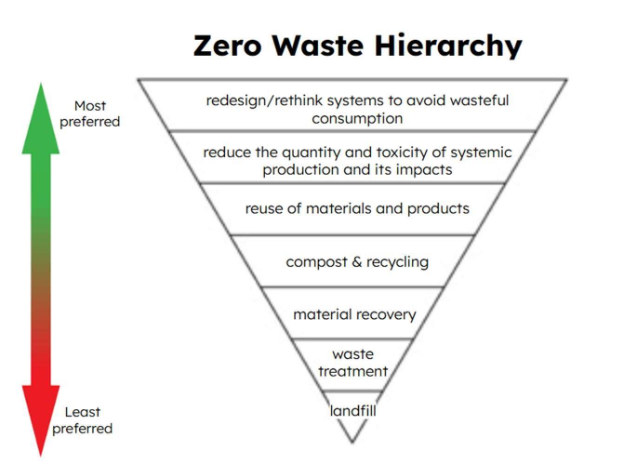
Figure 1: The zero waste hierarchy based on the Zero Waste International Alliance guidelines where the order of most preferred to least preferred systemic actions are: redesigning/rethinking systems to avoid wasteful consumption, reducing the quantity and toxicity of systemic production and its impacts, reusing materials and products, composting and recycling, material recovery, waste treatment, and landfill waste, respectively.
(Figure Credit: Madelaine Harris, 2025 based on Zero Waste International Alliance guidelines, 2026)
The Zero Waste Arena (ZWA) Initiative at the Rochester Institute of Technology (RIT) is a program aimed at reducing landfill waste at RIT home hockey games. Although originally piloted in 2015, the ZWA Initiative officially launched in 2023 following issues regarding limited commercial composting options, staffing, and education gaps in zero waste sorting.
Initially, the RIT ZWA Initiative team needed a third-party composting vendor to process the food waste generated at the Gene Polisseni Center; however, barriers on expense, accessibility, and accepted waste proved to be an obstacle. Depending on the composting facility, accepted waste criteria can vary and lead to confusion about zero waste sorting on a case-by-case basis. Although zero waste initiatives aim to divert landfill waste, in some cases, food tainted items (e.g. grease stained paper) and certain materials used in items (e.g. Styrofoam, items made of mixed materials such as plastic-lined paper cups) must be placed in landfill. In doing so, it prevents the contamination of other items, as well as addressing the difficult and expensive process of separating mixed polymer components for some facilities. These factors can complicate the zero-waste sorting process for those unfamiliar with local policy and were a consideration during the creation of the RIT ZWA Initiative.
Former Zero Waste Director, Jackson Guthrie, described the redesign process of the ZWA Initiative program as “coordinat[ing a] newer [and] more operations focused version”. With previous experience working at a composting company as his guide, Guthrie hired and trained Zero Waste Ambassadors to streamline the sorting process. This process allowed the Zero Waste Ambassadors to be “highly trained, efficient, and effective” in diverting waste while raising awareness for zero waste programs to patrons who visit the sorting station. Patrons can partake in the Zero Waste Arena Initiative by placing their trash in bins at designated stations where Zero Waste Ambassadors sort into bins designated for landfill, recycling, and compost; however, items with 15% or more food contamination (e.g. excessive grease or condiment residue) must be sorted into landfill.
Yet, despite the program running for three successful years at the Gene Polisseni Center, Zero Waste Arena Team Lead, Jade Lewis, described challenges regarding the “confusion and aversion to the [zero waste] stations”. In addition to sorting waste at hockey games, Zero Waste Ambassadors spread awareness and education on zero waste initiatives; however, this has been met with limited success. Lewis recounted that although “Ambassadors are encouraged to explain the program to patrons and respond to any aversion in a polite and patient manner… some patrons still choose to dispose of their waste in the bathroom trash cans (which [the Zero Waste Ambassadors] do not sort nor have control over) or dispose of their waste behind the Ambassadors”.
Current Zero Waste Director, Rachel Dodge, expressed that the greatest challenge regarding spreading the zero-waste messaging was “the amount of time that patrons are interacting with [the zero waste stations].” Education barriers on zero waste sorting can lead to people not participating or over-participating by incorrectly sorting waste due to misconceptions on recycling/composting, waste policy varying by locality, and lack of interest/awareness for zero waste sorting.

Figure 2: Zero Waste Ambassadors run zero waste sorting stations (as shown above) where Ambassadors sort patron’s waste into designated bins for landfill, composting, and recycling. (Photograph by Madelaine Harris, 2025)
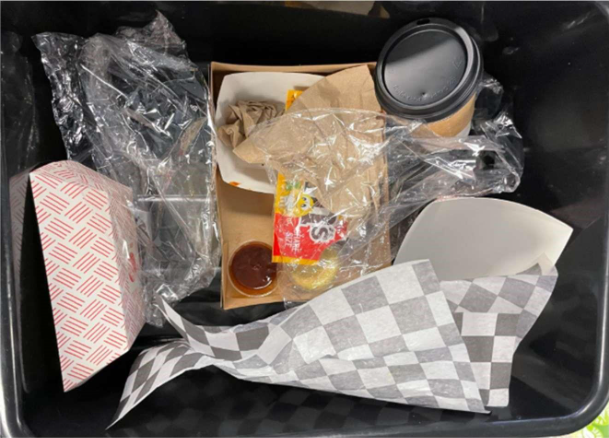
Figure 3: Patrons can place their trash in collection bins at the zero waste arena stations (as shown above) which can then be sorted into designated bins for landfill, composting, and recycling by Zero Waste Ambassadors during RIT hockey games. (Photograph by Madelaine Harris, 2025)
Despite these challenges, the ZWA Initiative has seen promising results with wasted food collection. Following its relaunch for the 2023-2024 hockey season, the ZWA Initiative was exclusive to the men’s home hockey games but eventually expanded to the women’s home hockey games the following year. This program’s growth has seen an increase in waste diverted from landfills, primarily compost materials, as Zero Waste Ambassadors attend more events. At the end of each hockey game, all sorted materials are bagged and sent to a third-party composting vendor. These compost and recycling materials are weighed and processed at the facility, with the results being reported back to the RIT Office of Sustainability.
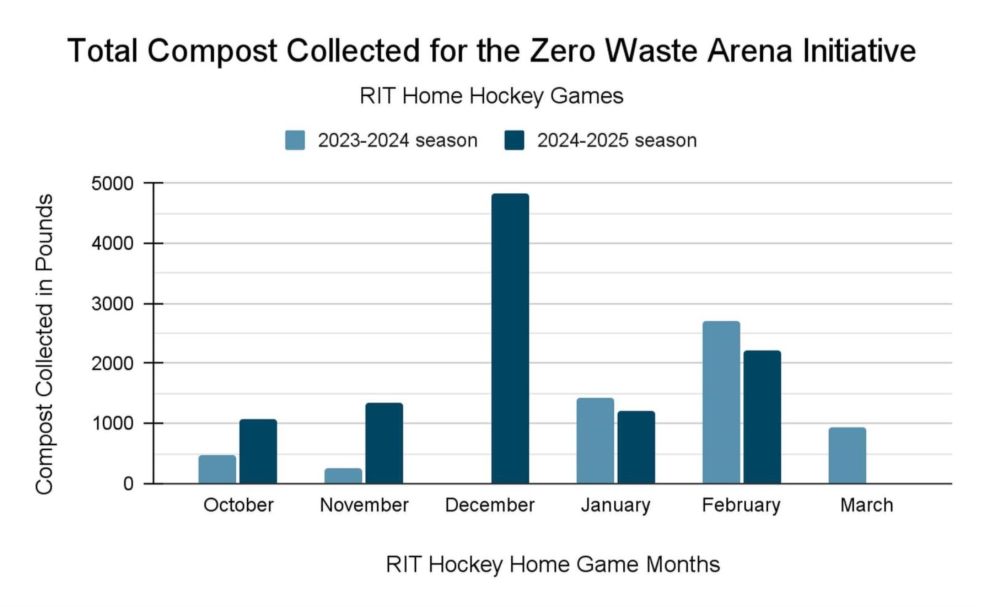
Figure 4: Total compost collected (in pounds) for the Zero Waste Arena Initiative at RIT on a month-to-month basis comparing hockey seasons where an increase in compost collected is shown following the expansion of the program into women’s hockey games in the 2024-2025 season. Discrepancies are shown for December 2023-2024 due to no
compost being logged from the third-party vendor and March 2024-2025 due to
neither RIT hockey teams making playoffs at the end of the season.
(Data Credit: RIT Office of Sustainability, 2025) An all-text version of this figure is available as Supplemental Table 1.
A Breakdown Analysis of Compost Collected at RIT Home Hockey Games
| Total amount of compost collected, in pounds | Total number of home games where the RIT ZWA team collected compost | Average amount of compost collected per home game, in pounds | |
| 2023-2024 Hockey Season | 5,833 | 16 | 364.6 |
| 2024-2025 Hockey Season | 10,680 | 34 | 314.1 |
Table 1: A breakdown analysis of compost collected at RIT home hockey games showing the increase of total compost collected during hockey seasons following the expansion of the Zero Waste Arena Initiative into women’s hockey games in the 2024-2025 season. (Data Credit: RIT Office of Sustainability, 2025)
Since joining the RIT Sustainability Team, Dodge, Lewis, and Guthrie have found that being a part of the RIT Zero Waste Arena Initiative has been rewarding. For Dodge, the best part has been “hands-on experience” in sustainability and food waste while Lewis has enjoyed “seeing the tangible results of the program”. Guthrie has appreciated the program “challeng[ing] the average attendee’s views of common waste systems” and noted that the Zero Waste Arena Initiative has challenged the “stigma around waste as an “out of sight, out of mind” activity”.
Currently, the Zero Waste Arena Initiative remains exclusive to the Gene Polisseni Center with the exception of having limited sorting stations during the “Tigers vs Trash” event during Earth Week at Brick City Cafe. Both Dodge and Lewis have hopes to expand the ZWA Initiative into dining halls. For the upcoming 2026-2027 hockey season, Dodge and Lewis plan on releasing a promotional video to educate patrons on how to use the zero waste stations. Lewis acknowledged that the idea of someone sorting your trash might be “strange” but hopes to “build a friendly environment that makes it less intimidating” through education and awareness.
Beyond the Zero Waste Ambassadors and stations, the Zero Waste Arena team hopes to leave a lasting impact on the community and rethinking waste systems with Dodge aiming for the Zero Waste Arena Initiative messaging to “spread [the] kind of education, eventually people would be able to sort their own waste correctly, both in the arena and everywhere else.” Guthrie echoed this statement and affirmed that he “look[s] forward to when the program has been around long enough that no active student has ever known the arena without it”.
While food waste remains a systemic issue, zero waste efforts and approaches can help mitigate landfill usage and reframe consumption practices. The Zero Waste Arena Initiative at the Rochester Institute of Technology addresses this notion by opening the dialogue to rethinking waste management and spreading awareness through stewardship.
Acknowledgements
This work was supported by NSF Grant # 2115405 SRS RN: Multiscale RECIPES (Resilient, Equitable, and Circular Innovations with Partnership and Education Synergies) for Sustainable Food Systems. Findings and conclusions reported here are those of the authors and do not necessarily reflect the views of the National Science Foundation.
Many thanks to Rachel Dodge, Jackson Guthrie, and Jade Lewis for their thoughtful and insightful interviews.
References
Gustavsson, Jenny; Sonesson, Ulf; Cederberg, Christel; van Otterdijk, Robert; Meybeck, Alexandre, “Global food losses and food waste – Extent, causes and prevention”, (2021), Food and Agriculture Organization of the United Nations https://www.fao.org/4/mb060e/mb060e.pdf.
Jaglo, Kirsten; Kenny, Shannon; Stephenson, Jenny, “From Farm to Kitchen: The Environmental Impacts of U.S. Food Waste”, (2021), U.S. Environmental Protection Agency. https://www.epa.gov/system/files/documents/2021-11/from-farm-to-kitchen-theenvironmental-impacts-of-u.s.-food-waste_508-tagged.pdf.
“Sustainable Management of Food Basics”, U.S. Environmental Protection Agency, last modified August 22, 2025 https://www.epa.gov/sustainable-managementfood/sustainable-management-food-basics.
“How Communities Have Defined Zero Waste”, U.S. Environmental Protection Agency, last modified December 17, 2025 https://www.epa.gov/transforming-waste-tool/howcommunities-define.
“Zero Waste Hierarchy of Highest and Best Use 8.1.”, Zero Waste International Alliance, accessed November 2025, https://zwia.org/zwh/.
| Total Compost Collected for the Zero Waste Arena Initiative, in pounds | ||
| 2023-2024 Season | 2024-2025 Season | |
| October | 486 | 1080 |
| November | 266 | 1340 |
| December | 0 | 4820 |
| January | 1440 | 1220 |
| February | 2706 | 2220 |
| Marsh | 935 | 0 |
Supplemental Table 1: Total compost collected (in pounds) for the Zero Waste Arena Initiative at RIT on a monthto-month basis comparing hockey seasons where an increase in compost collected is shown following the expansion of the program into women’s hockey games in the 2024-2025 season. Discrepancies are shown for December 20232024 due to no compost being logged from the third-party vendor and March 2024-2025 due to neither RIT hockey teams making playoffs at the end of the season.