
Tanishka Khanna; American University
Cite as: Khanna, Tanishka. 2026. “The Effect of Boiling Duration in Salt Water on the Texture and Flavor Absorption of Tofu”. Food-Fueled. doi:10.57912/32180511.
Please click here to download the piece as a PDF. The text is also listed below.
Section I: Introduction
The motivation for this study stems from my interest in developing vegetarian dishes that retain some of the texture and flavor characteristics typically found in meat-based recipes. The recipe used in this paper was developed by me. While tofu serves as a common protein substitute, its high moisture content and relatively bland taste can limit flavor absorption during marination. The main goal for this experiment was to explore how pre-boiling tofu in salt water might modify its internal structure, thereby enhancing its capacity to absorb marinade flavors.
This experiment focuses on identifying the relationship between boiling time and changes in tofu’s texture and flavor absorption. A single variable—the duration of boiling in salt water— is going to be manipulated with the goal is to understand the molecular interactions responsible for these physical and sensory changes. The findings have both practical and scientific value, demonstrating how temperature, salt concentration, and protein denaturation influence food texture and flavor binding.
Section I.a: Base
Ingredients:
- One block of tofu
- 6 tablespoons soy sauce
- ½ tablespoon chili oil
- ¼ tablespoon sesame oil
- ½ tablespoon rice vinegar
- ½ tsp brown sugar
- ⅛ tsp salt
- ⅛ tsp pepper
- 3-5 cloves of garlic (depending on their size)
- ½ tsp neutral oil
- Optional: any type of spicy pepper (to taste)
Steps:
- Grate or finely chop the garlic and add it to a bowl with chili oil. If using a spicy pepper, chop it into small pieces and add it to the bowl in this step.
- Heat your neutral oil until it is slightly sizzling and pour it into the bowl, over the garlic and chili oil.
- Add the rest of the ingredients (in any order)
- Mix all the ingredients
- Put the tofu in a container with the marinade and let it soak for a minimum of an hour in the fridge.
- Done!
Section II: Experimental Framework
The experimental variable was the boiling duration in salt water. Four trials will be conducted:
- Trial 1: No boiling (control)
- Trial 2: Five minutes of boiling
- Trial 3: Ten minutes of boiling
- Trial 4: Twenty minutes of boiling
Section II.a.: Constants
Each block of tofu was boiled in the same pot that had 2.5 cups of water and approximately ⅛ teaspoon of salt. The tofu pieces were then marinated for equal period of time. The experiment controlled for tofu type (Wildwood firm tofu) as well as water volume, salt concentration, and marinade exposure time across trials. These constants will help isolate the experimental variable. The experiment effectively isolates one variable, boiling duration, while holding all others constant. This design allows for a clear causal interpretation between boiling time and marinade absorption. The control trial (no boiling) provides a baseline for comparison, demonstrating that differences in flavor intensity and texture were due to boiling time rather than other factors. The constant salt concentration will ensure that osmotic effects are due to duration, not variation in salinity.
Section II.b.:Confounding Variables
- Cooling time before marination: Slight differences in tofu temperature post-boiling may alter absorption.
- Tofu batch variability: Even within the same brand, slight differences in firmness or protein concentration can alter texture.
- Subjective sensory evaluation: Texture was not quantified in a standardized way, introducing human bias.
Future experiments could employ texture analyzers and thermometers to minimize subjectivity.
Section II.c.: Hypothesis
For LSA3, two trials were conducted: one with boiling the tofu for five minutes and one with boiling the tofu for twenty minutes. The following table summarizes the observations for these trials.
Figure 1, Observations from Experimental Trials
| Trial 1: five minutes of boiling | Trial 2: twenty minutes of boiling | |
| Appearance | After boiling: No change After Marinade: Marinade penetrated through only a little | After boiling: No change After Marinade: Marinated penetrated through roughly twice the length of the other |
| Texture | After boiling: Soft Bouncy A little jiggly Smooth | After boiling: Softer Jigglier Bouncier Smoother (surface) |
| After Marinade: • No change except slightly firmer because cooler | After Marinade: • No change except slightly firmer because cooler | |
| Taste | After boiling: Soft (slightly softer than out of the box) lightly salty After Marinade: Strong marinade taste | After boiling: A lot softer – more like firm or med firm tofu Lightly salty, slightly saltier than five minutes of boiling Slight briny taste After Marinade: Strong marinade taste, less than in other trials |
Based on these observations, I hypothesize that the longer the tofu is boiled in salt water, the more marinade it will absorb, and the more gel-like and soft the texture will be.
Section III: Molecular Components of Tofu
Tofu’s structure primarily consists of soy proteins, particularly glycinin and βconglycinin (Mulalapele and Xi 2021, 192). These are globular storage proteins found in soybeans that form a gel matrix upon coagulation during tofu production (Guan et al. 2021a, 2-6). The interactions between these proteins, water molecules, and ions such as sodium chloride (salt) change the tofu’s firmness, elasticity, and porosity.
When tofu is heated, the denaturation of soy proteins alters its internal structures, exposing hydrophobic regions and reactive groups that influence texture (Guan et al. 2021b, 2-6). In the saltwater environment, sodium and chloride ions can disrupt hydrogen bonding and electrostatic interactions within the protein network, facilitating both water loss and the diffusion of salt compounds into the tofu (plantifullybased 2025).
Key molecules involved include:
- Water (H₂O): Facilitates diffusion and influences the tofu’s moisture content and softness. Tofu is also made up of primarily water (Rohyami and Pribadi 2017, 1-2).
- Salt/Sodium chloride (NaCl): Contributes to osmosis, protein unfolding, and ionic balance.
- Soy proteins (glycinin and β-conglycinin): Undergo protein (thermal) denaturation, changing the texture and porosity of tofu.
Section III.a.: Molecular Interactions and Chemical Processes in this Study
Protein Denaturation:
- Heating tofu in boiling water causes its soy proteins to unfold and aggregate. This process exposes hydrophobic residues that can interact more strongly with nonpolar flavor molecules in the marinade. Denaturation also modifies water-holding capacity. Shorter boiling durations (five minutes) may cause partial denaturation, retain elasticity, while longer boiling (twenty minutes) can lead to excessive softening due to protein unfolding and network breakdown. This is what changes the texture of the tofu. The protein denaturation threshold is 70–80°C, typical for soy proteins (Liu et al. 2004, 815; Lakemond et al. 2000).
Osmosis and Diffusion:
- Saltwater boiling establishes an osmotic gradient that drives water molecules out of the tofu matrix while sodium and chloride ions diffuse inward. This process reduces internal moisture and increases porosity, enabling deeper flavor penetration during marination (“How Does Osmosis Help Us Cook? – Smore Science,” n.d.). The diffusion rate follows Fick’s laws, meaning higher temperature and longer boiling increase ion migration and moisture exchange (Zhou et al. 2015).
Section IV: Expected Experimental Observations
These predicted observed outcomes of the trials are based on the predicted molecular behaviors, as well as observations from LSA3.
- Trial 1 (No boiling): Tofu will remain firm with limited to no marinade absorption (i.e., the marinade will not penetrate deep into the tofu). Texture will be slightly rubbery and water-rich, indicating minimal to no protein denaturation and poor porosity. I have not
officially conducted this trial for my experiment, but I have done this many times before, so my predictions are also based on my experience.
- Trial 2 (five minutes): Slightly softer texture, modestly improved flavor penetration, and mild saltiness. This suggests partial dehydration and minor protein unfolding.
- Trial 3 (ten minutes): Optimal texture, firm but porous, with noticeably improved marinade absorption. Protein denaturation appeared balanced, creating microchannels for flavor diffusion.
- Trial 4 (twenty minutes): Excessive softening and breakdown of structural integrity. Flavor absorption will be the highest due to the most water loss from the osmosis process.
These observations would support the hypothesis that increased boiling time in salt water improves tofu’s ability to absorb a marinade and soften the texture of the tofu.
Section IV.a.: Relevant Scientific and Practitioner Context
The concept of modifying tofu texture through thermal and saline treatment is supported by both culinary practice and scientific literature. Practitioner sources such as Plantifully Based and Emi’s Good Eating discuss boiling tofu as an alternative to pressing, suggesting that this process enhances firmness and flavor retention (plantifullybased 2025).
From a scientific perspective, research on soy protein gels confirms that heating induces conformational changes in glycinin and β-conglycinin, altering water-holding capacity and mechanical properties (Mulalapele and Xi 2021, 196). These studies validate the hypothesis that protein denaturation under controlled conditions can optimize textural outcomes.
Section V: Experimental Process and Observations
For this experiment, 3 cups of water were brought to a boil along with ¼ tsp of salt. All pieces of tofu were then added at the same time. Two pieces of tofu were taken out at five minutes to perform measurements; the same was done at ten minutes and twenty minutes. Each piece of tofu was then put in the same container of marinade and left in the container for ten minutes before conducting measurements. For the wetness test, each piece of tofu was left on a piece of paper for five minutes before the area of the wet spot was measured.
The following table summarizes how measurements were conducted:
| Measurement | Assessment | Special Care/Technique | |
| 1 | Mm marinade penetrated the tofu | Measuring tape | • Take the tofu out of the marinade and cut it in half to see how far the marinade penetrated |

| • | Since tofu is only half covered by marinade (as seen below in pictures), I will only measure the penetration from the side that was submerged in the marinade | |||
| 2 | Wetness | Spread Test | • | Do after boiling before marinating |
| • | Shake off the tofu before placing it on paper | |||
| • | Measure the area of the wet spot left on the paper | |||
| 3 | Color | Hex Code | • | After taking a clear picture of the tofu, I will upload the picture to this hex code finder |
| • | I will take the color from the middle of the (inside) of the area of the tofu that was submerged in the marinade |
Section V.a.: Calculating the Area for the Wetness Test
| Trial | Rectangle 1 | Triangle 1 | Triangle 2 | Area |
| 1 | Length: 2.9 Width: 2.1 | N/A | N/A | Area= 2.9*2.1= 6.09 |
| 2- Measured as two triangles and a rectangle | Length: 4.6 Width: 6.2 | Base:4.1 Height: 2.8 | Base: 4.8 Height: 2.4 | Area= (4.1*2.8*0.5) + (4.6 * 6.2) + (4.8*2.4*0.5)= 40.02 |
| 3 | Base: 3 Height 5. | Base: 4.8 Height 3.7 | N/A | Area= (3*5) + (4.8*3.7*0.5)= 23.88 |
| 4 | Base: 2.5 Height: 3.6 | N/A | N/A | Area= 2.5*3.6 = 9 |
Section VI: Results
| Trial 1 (Control) | Trial 2 (5 min) | Trial 3 (10 min) | Trial 4 (20 min) | |
| Wetness Test (area) (cm^2) | 6.09 | 40.02 | 23.88 | 9 |
| Penetration (mm) | Negligible Amount (roughly 1/8 mm) | 0.2 | 7 mm | 4mm |
| Color | #fdf4d5 | #e7ce87 | #c6aa73 | #e4d5a3 |
Figure 1: Chart showing final measurements for all trials.
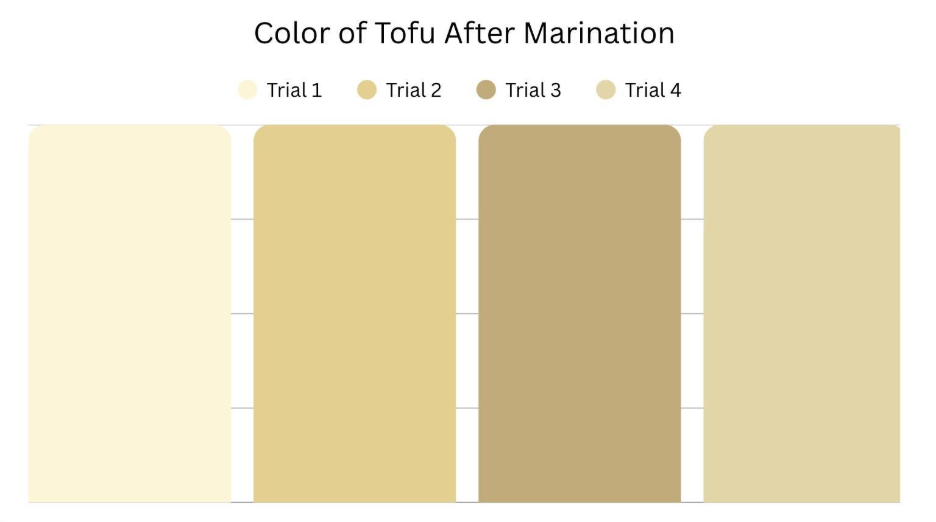
Figure 2; Legend: This graph shows the area of the wet spot left on a piece of paper after a piece of tofu was placed on it after 0 (Trial 1), 5 (Trial 2), 10 (Trial 3), and 20 (Trial 4) minutes of being boiled in salt water. The piece of tofu from Trial had the highest area (40.02 cm²), followed by Trial 3 (23.88 cm²), Trial 4 (9.00 cm²), and Trial 1 6.09 cm²).
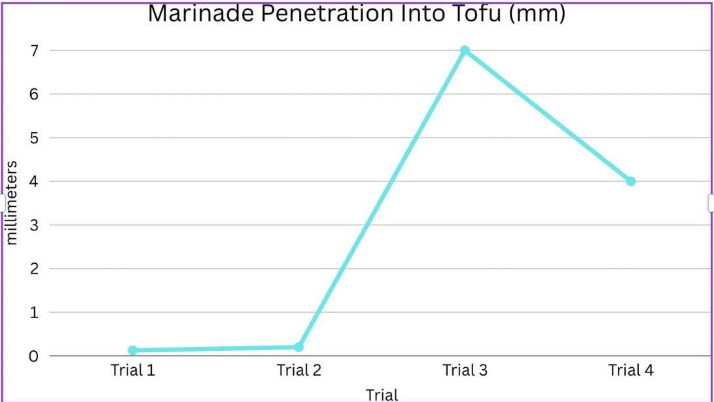
Figure 3: Legend: This graph shows the millimeters the marinade penetrated into the tofu after being boiled in salt water for 0 (Trial 1), 5 (Trial 2), 10 (Trial 3), and 20 (Trial 4) minutes. Trial 3 had the highest amount of penetration (7 mm), followed by Trial 4 (4 mm), Trial 2 (0.2mm), and Trial 1 (~0.125mm).
Figure 4: This Graphic shows the hex codes and the color of the inside of the tofu after marination.
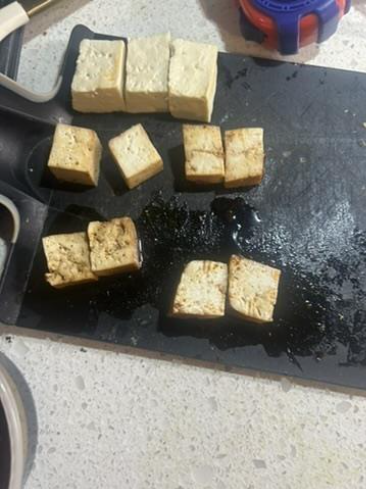
Figure 5: This picture shows the final results of the tofu after being marinated and cut in half. The tofu on the top was not boiled or placed in the marinade. From left to right, the tofu pieces are Trial 1, Trial 3, Trial 2, and Trial 4.
.
Section VII: Analysis of Results
The results demonstrate that boiling time has a clear, measurable effect on the physical properties of tofu, particularly in terms of water release, marinade absorption, and color change. These differences can be directly explained by the molecular behavior of soy proteins and the diffusion of salt and marinade compounds through the tofu’s protein gel network.
Section VII.a.: Wetness Test
The wetness test showed a non-linear relationship between boiling time and the amount of water released. The tofu boiled for five minutes produced the largest wet spot (40.02 cm²), indicating substantial water expulsion, while both the control (6.09 cm²) and the 20-minute sample (9 cm²) released far less water. Trial 3 released roughly half the amount of water (23.88 cm²) as trial 1. This trend reflects changes in the protein network caused by heat. During the early stages of boiling, the soy proteins (primarily glycinin and β-conglycinin) begin to denature and loosen, allowing previously trapped water to escape easily (Liu et al. 2004, 818-20). By ten to twenty minutes, however, the protein network becomes more fully denatured and reorganizes into a denser, water-holding structure (Liu et al. 2004, 818-20). As a result, the longer-boiled samples retain more water internally and release less upon contact with the paper. Thus, the wetness results track heat-induced protein unfolding and subsequent restructuring that alters the tofu’s water-binding capacity.
Section VII.b.: Marinade Penetration (Diffusion Depth)
Marinade penetration increased substantially from the control (negligible) to the 10minute sample (7 mm), before decreasing again in the twenty-minute sample (4 mm). This pattern indicates that boiling alters the porosity and internal diffusion pathways of the tofu, which is consistent with the literature (Liu et al. 2004; Mulalapele and Xi 2021,196). Moderate boiling (approximately 10 minutes) appears to create an optimally open protein network with widened pores, allowing marinade molecules to diffuse deeper into the interior. In contrast, prolonged boiling leads to a collapse or tightening of the protein gel structure as denatured proteins aggregate and water saturates internal pore spaces (Liu et al. 2004;Guan et al. 2021b, 202-206). With fewer free pathways available, marinade diffusion is reduced. The decrease in penetration at 20 minutes, therefore, reflects a shift from an expanded protein matrix to a more compact, water-logged structure in which the marinade molecules cannot easily migrate.
Section VII.c.: Hex Code Differences (Pigment Diffusion)
Hex color values provide additional evidence for the same diffusion patterns. The tofu reached its darkest interior color at ten minutes, corresponding to the highest marinade penetration and therefore the greatest concentration of colored marinade pigments within the tofu. The twenty-minute sample showed a lighter color than the ten-minute sample despite being boiled longer, consistent with the reduced diffusion depth observed in the penetration measurement. Thus, color differences further support the conclusion that intermediate boiling promotes maximal marinade absorption, whereas excessive boiling restricts diffusion.
Section VII.d.: Overall Molecular Interpretation
Across all measurements, the data align with the known thermal behavior of soy proteins and diffusion phenomena. Short boiling times promote water release by partially opening the protein network, while intermediate boiling expands pores sufficiently for enhanced diffusion of marinade compounds (Guan et al. 2021b, 202-206). Extended boiling, however, leads to protein coagulation, water saturation, and pore collapse, all of which diminish the tofu’s capacity to absorb additional flavor (Cai and Chang 1999). The combined wetness, penetration, and color results therefore provide a coherent molecular explanation: the degree of protein denaturation caused by boiling time directly governs tofu’s water retention and marinade absorption properties.
Section VIII: Discussion
The purpose of this experiment was to determine how the length of time tofu is boiled in saltwater influences its texture, water release, and ability to absorb marinade. Overall, the data demonstrates that boiling time has a non-linear effect on tofu structure: moderate boiling (ten minutes) maximizes marinade penetration, while very short or very long boiling times have less marinade absorption; however, both have more marinade absorption than the control of no boiling time. These findings align with the expected molecular behavior of soy proteins, which denature, unfold, and reorganize as they are exposed to heat.
The wetness test showed that tofu boiled for only five minutes released the most water, suggesting that partial protein unfolding disrupted the gel network enough to allow trapped water to escape readily. The ten-minute and twenty-minute samples retained more water, consistent with the formation of a more cohesive, heat-restructured protein matrix that binds water more effectively. Similarly, the marinade penetration and color data showed that the ten-minute sample had the deepest diffusion of marinade pigments, indicating maximal pore openness and optimal diffusion pathways at that stage of denaturation. In contrast, the twenty-minute sample absorbed less marinade than the ten-minute sample despite being boiled longer. This decrease is consistent with the protein network becoming more compact and water-saturated at extended boiling times, which reduces the free space available for flavor-carrying molecules to enter. However, it is important to consider sources of error. One is that even though I shook off the tofu after taking it out of the boiling water and before placing it on the paper, I may have shaken some pieces more or less than others. Another is that I wasn’t able to perfectly calculate the area of the wet spot left by the tofu.
These chemical observations aligned well with how I liked each of the trials. When ranking the tofu pieces from most to least preferred, the results followed: Trial 3 (10 minutes) > Trial 2 (5 minutes)/Trial 1 (Control) > Trial 4 (20 minutes). Trial 3 had what felt like the perfect amount of flavor; the marinade was strong when biting into the tofu but diffused enough that it was not too strong. In contrast, Trial 1 had almost no marinade flavor, consistent with the negligible penetration measured in the results. Trial 2 absorbed more flavor but was too intense for my liking. This is likely because the protein network was still loose enough that the marinade remained more concentrated near the surface rather than diffusing evenly throughout (Liu et al. 2004). Trial 4 was the least preferred because the flavor of the marinade was overwhelmingly strong; given the lower penetration depth measured for that sample, the marinade likely stayed near the surface, leading to a concentrated and harsh flavor intensity instead of a balanced one.
Taken together, the data and my preference both support the conclusion that moderate boiling is optimal for creating a tofu structure that both retains moisture and absorbs marinade effectively. The experiment highlights the interplay between heat-induced protein denaturation, diffusion, and taste perception. Small variations in boiling time significantly alter molecular structure and therefore affect the amount of marinade that can be absorbed.
Section IX: Conclusion
This experiment shows that boiling time has a significant impact on tofu’s ability to release water and absorb flavor, and these effects can be explained by heat-induced changes in the tofu’s protein network. Tofu boiled for approximately ten minutes demonstrated the greatest marinade penetration and darkest interior color, indicating that this boiling duration creates the most open and favorable structure for diffusion of flavor molecules. Shorter boiling times allowed excessive water release, while prolonged boiling caused the protein network to collapse and re-tighten, reducing the movement of marinade molecules into the tofu. Overall, the results support the conclusion that moderate boiling optimizes the molecular conditions for flavor absorption, while both under- and over-boiling reduce tofu’s ability to take in marinade.
References
Cai, Tiande, and Kow-Ching Chang. “Processing Effect on Soybean Storage Proteins and Their Relationship with Tofu Quality.” Journal of Agricultural and Food Chemistry 47, no. 2 (1999): 720–27. https://doi.org/10.1021/jf980571z.
Emilia Leese. “Crispy Tofu.” Emi’s Good Eating, November 28, 2014. https://emisgoodeating.com/2014/11/28/crispy-tofu/.
Guan, Xiangfei, Xuequn Zhong, Yuhao Lu, et al. “Changes of Soybean Protein during Tofu Processing.” 10, no. 7 (2021): 1594. https://doi.org/10.3390/foods10071594.
Guan, Xiangfei, Xuequn Zhong, Yuhao Lu, et al. “Changes of Soybean Protein during Tofu Processing.” 10, no. 7 (2021): 1594. https://doi.org/10.3390/foods10071594.
“How Does Osmosis Help Us Cook? – Smore Science.” Accessed October 23, 2025. https://www.smorescience.com/how-does-osmosis-help-us-cook/?print=print.
Lakemond, Catriona M. M., Harmen H. J. de Jongh, Martin Hessing, Harry Gruppen, and Alphons G. J. Voragen. “Heat Denaturation of Soy Glycinin: Influence of pH and Ionic Strength on Molecular Structure.” Journal of Agricultural and Food Chemistry 48, no. 6 (2000): 1991–95. https://doi.org/10.1021/jf9908704.
Liu, Zhi-Sheng, Sam K. C Chang, Li-Te Li, and Eizo Tatsumi. “Effect of Selective Thermal Denaturation of Soybean Proteins on Soymilk Viscosity and Tofu’s Physical Properties.” Food Research International 37, no. 8 (2004): 815–22. https://doi.org/10.1016/j.foodres.2004.04.004.
Mulalapele, Lina Tokuna, and Jun Xi. “Detection and Inactivation of Allergens in Soybeans: A Brief Review of Recent Research Advances.” Grain & Oil Science and Technology 4, no. 4 (2021): 191–200. https://doi.org/10.1016/j.gaost.2021.11.001.
plantifullybased. “Tofu Prep 101: Give Your Tofu the Best Texture!” Plantifully Based, September 27, 2025. https://plantifullybasedblog.com/2025/09/27/tofu-prep-101-giveyour-tofu-the-best-texture/.
Rohyami, Yuli, and Rizki Maulana Pribadi. “Validation of Methods on Formalin Testing in Tofu and Determination of 3,5-Diacetyl-Dihydrolutidine Stability by UV-Vis Spectrophotometry.” 2017, 020018. https://doi.org/10.1063/1.5016011.
Zhou, Larissa, Kendra Nyberg, and Amy C. Rowat. “Understanding Diffusion Theory and Fick’s Law through Food and Cooking.” Advances in Physiology Education 39, no. 3 (2015): 192–97. https://doi.org/10.1152/advan.00133.2014.