
Rebecca Leonard; Rochester Institute of Technology
Cite as: Leonard, Rebecca. 2026. “The State of Food Waste Legislation: An Analysis of State-level Policies to Address Food Waste”. Food-Fueled. doi:10.57912/32180568.
Please click here to download the piece as a PDF. The text is also listed below.
Introduction
The scale at which food waste interventions should occur in the United States has been a long-debated topic. Opinions on the scale at which they are most effective range from individual action to international agreements, with many people believing that local or state governments have the most power to reduce food waste, while others think they are ineffective and inadequate to address issues (Kakadellis, Sarah, et al. 2025). These perspectives and opinions are especially relevant given the sheer scale of food waste in the United States. An examination of current state legislation reveals clear differences in the effectiveness of laws addressing food waste, depending on their strategies.
Although the total amount of food wasted annually in the U.S. is debated, it is estimated at around 63 million tons according to Rethink Food Waste Through Economics and Data (ReFED). The federal government has created a goal to reduce food waste by 50% from 2016 levels by the year 2030, with which they have created a national strategy outlining four objectives: preventing food loss, preventing food waste, encouraging organics recycling, and supporting food loss and waste prevention (“National Strategy for Reducing Food Loss and Waste and Recycling Organics” 2025). Despite this, there has been little to no federal action in recent years to combat the growing issue of food waste.
State governments have had to take action to reduce food waste, as the federal efforts regarding the issue have been minimal. Between 2020 and 2025, 104 state bills have been proposed regarding food waste prevention tactics. Of those, only about 21% have been enacted or adopted. Determining the success of these bills that have become law is difficult, as many policies have multiple goals that may not all be achieved (FitzGerald et al. 2019). For example, many proposed bills attempt to incorporate a wide range of strategies at once rather than focus on one.
Methods
Legislation was identified in the National Conference of State Legislatures’ Environment and Natural Resources State Bill Tracking Database by examining laws under the categories of Waste and Recycling – Food and Waste and Recycling – Composting from 2020 to 2025. For each bill, the year it was proposed, its status (pending, enacted, adopted, or failed), and the relevant keywords (Table 1) were recorded.
| Keyword | Number of Relevant Bills | Keyword | Number of Relevant Bills | |
| Tax Credit | 5 | Composting | 48 | |
| Oyster Shells | 3 | Liability | 10 | |
| Fund | 11 | Resale | 1 | |
| Grant | 13 | Date Labels | 15 | |
| Education | 19 | Recycling | 10 | |
| Fines | 4 | Municipal | 12 | |
| Donation | 35 | Biosolids | 1 | |
| Waste Facilities | 1 | Farming | 5 | |
| Infrastructure | 11 | Diversion | 39 | |
| Universities | 3 | Digestion | 11 | |
| Share table | 5 | Rescue | 5 | |
| School | 16 | Study | 9 | |
| Goals | 6 | Initiatives | 5 | |
| Public Awareness | 2 | Waste Audit | 1 | |
| Task Force | 7 |
Table 1. Number of state proposed bills (n = 104) from 2020-2025 regarding certain key words and phrases. Most bills contained multiple keywords, so the total exceeds the number of bills analyzed.
State Analysis
Of the states that proposed legislation between 2020 and 2025 (n = 22), 13 successfully enacted or adopted at least one (Figure 1). Many states proposed a large number of bills, yet these states often had a 0% rate of enactment. For example, Connecticut had seventeen failed bills, and New Jersey has twelve bills labeled as “pending,” which likely means they died but were never labeled as failed. Most states passed only one or two laws (Figure 2). This is likely because when a state drafts a large food waste law, there is no need to draft subsequent legislation. After all, the law is designed to go through phases already planned and written into the law. However, many states that proposed only one bill also had that bill fail, thus meaning they had no successful laws put in place to reduce food waste (Figure 3). Maine uniquely proposed one bill, which successfully passed, giving it the highest success rate for food-waste-related bills (Figure 3).
As states across the country attempt to implement food waste reduction tactics, an analysis that accounts for each state’s food waste generated by its residents quickly becomes relevant. There seems to be no trend between the states that proposed or even successfully implemented food waste policies and the amount of food waste they generate per capita (Kakadellis, Sarah, et al. 2025). Additionally, the two states with the highest and lowest food generation per capita; Arizona and Arkansas, were not involved in any food waste legislation during the years of study. This means it is not the case that states with high levels of food waste are driven to reduce it with policies, nor are states with low levels of food waste maintaining those levels by implementing policies.
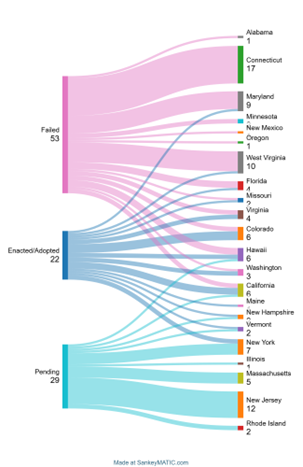
Figure 1. Sankey diagram illustrating a state-by-state breakdown of law status.
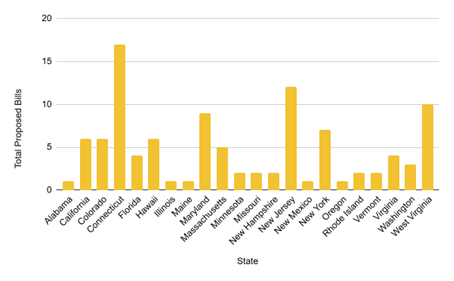
Figure 2. Total proposed bills regarding food waste, broken down by state.

Figure 3. Proportion of food waste bills enacted or adopted, broken down by state.
Keyword Analysis
As there are many aspects from which to view the issue of food waste, there is also a long list of related keywords and phrases in state legislation. Some tactics, such as mandating waste audits, were proposed only once since 2020, while others, such as encouraging compost in some form, appeared nearly fifty times (Table 1). Of all the keywords that were considered in this analysis, composting, diversion, and donation appeared the most frequently (Table 1). Diversion was defined as any bill requiring an explicit reduction in food waste sent to landfills without a specific reduction strategy. Of the keywords that appeared in ten or more bills, liability, a subset of donation, had the highest success rate (Figure 4). Education, which was classified as bills encouraging citizens to learn about food waste, had the lowest proportion of bills enacted (Figure 4). Most keywords fell around the average for all bills, but those much higher and much lower could be considered to determine whether there is a more widely supported policy method for reducing food waste.

Figure 4. Proportion of laws enacted or adopted, sorted by keyword classification.
Discussion
The process of creating policy can encourage innovation to solve a problem, whether or not the policy is enacted (Marsh and McConnell 2010). The fact that states are considering ways to reduce their food waste, despite the lack of federal motivation to do so, is promising for addressing the scale of food waste in the United States.
Each state has a unique strategy for how to combat food waste, and therefore, each state has potential areas it could be missing that could be effective as well. For example, many sources believe that setting quantifiable targets for food waste reduction is an important step (Garske et al. 2020), yet many U.S. states, including those involved in food waste legislation, lack such targets. Additionally, a mix of tactics is likely the most effective approach, which could explain why California and Washington are seeing higher reduction rates than Vermont, a state often commended for its composting efforts (Kakadellis et al. 2025).
Potential for bipartisan support should be considered in state legislation to maximize the proportion of proposed bills that become law. One food waste reduction strategy that appears to have a wider range of support is encouraging the use of share tables in schools (Prescott et al. 2020). Share tables allow students to redistribute unopened and uneaten food to other students in need at the same school, and they seem to be an effective strategy for reducing food waste in schools. Current policy regarding share tables is concentrated in many states that have not been recently involved in food waste legislation (Prescott et al. 2020), indicating that this is one such area for potential bipartisan support.
References
FitzGerald, Cathal, Eoin O’Malley, and Deiric Broin. “Policy Success/Policy Failure: A Framework for Understanding Policy Choices.” Administration 67, no. 2 (May 1, 2019): 1–24. https://doi.org/10.2478/admin-2019-0011.
“Food Waste Data-Causes & Impacts.” ReFED, 2022. https://refed.org/food-waste/the-problem/.
Garske, Beatrice, Katharine Heyl, Felix Ekardt, Lea Weber, and Wiktoria Gradzka. “Challenges of Food Waste Governance: An Assessment of European Legislation on Food Waste and Recommendations for Improvement by Economic Instruments.” Land 9, no. 7 (July 16, 2020): 231. https://doi.org/10.3390/land9070231.
Kakadellis, Sarah, Selena Mao, Asch Harwood, and Edward S. Spang. “State-Level Policies Alone Are Insufficient to Meet the Federal Food Waste Reduction Goal in the United States.” Nature Food 6, no. 2 (January 9, 2025): 196–204. https://doi.org/10.1038/s43016-024-01092-w.
Marsh, David, and Allan McConnell. “Towards a Framework for Establishing Policy Success.” Public Administration 88, no. 2 (April 5, 2010): 564–83. https://doi.org/10.1111/j.1467- 9299.2009.01803.x.
“National Strategy for Reducing Food Loss and Waste and Recycling Organics.” USDA, February 8, 2025. https://www.usda.gov/about-food/food-safety/food-loss-and-waste/national-strategy-reducing-food-loss-and-waste-and-recycling-organics.
Prescott, Melissa Pflugh, Alicia Grove, Marisa Bunning, and Leslie Cunningham-Sabo. “Characterizing and Assessing the Quality of State K–12 Share Table Policies as a Potential Mechanism to Reduce Food Waste and Promote Food Security.” Journal of Nutrition Education and Behavior 52, no. 1 (January 2020): 21–30.
https://doi.org/10.1016/j.jneb.2019.10.014.